Eight months into running an automation agency, u/Agnostic_naily landed a client that reframed what this work is actually worth.
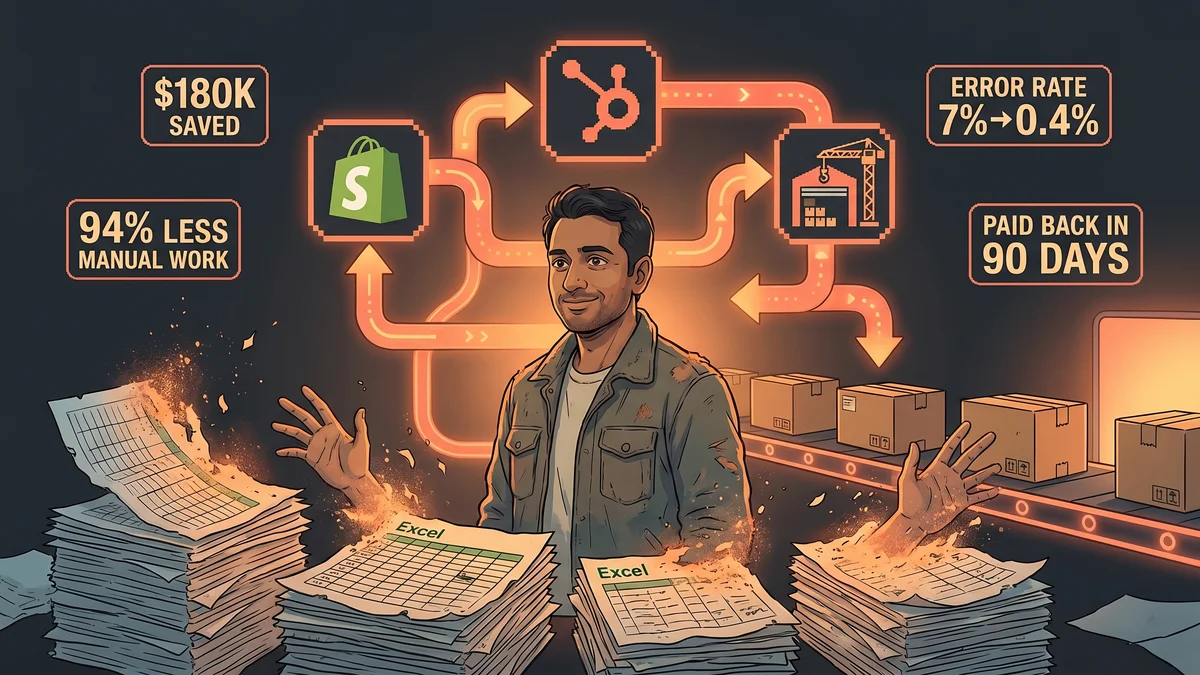
A 47-person e-commerce brand. Shopify, HubSpot, and a warehouse system from 2019 that nobody had touched since the pandemic. Three people on the fulfillment team, 60 hours a week, moving data between four tools. Excel as the integration layer. A 7% order error rate.
He quoted six weeks to fix it. They laughed.
The Fulfillment Win
The core automation was straightforward: connect Shopify, HubSpot, and the warehouse API through n8n so data moved automatically instead of manually. The part that made it actually work was harder.
Standard automation breaks on exceptions. Unusual address, inventory mismatch, partial shipment — these aren’t edge cases in e-commerce, they’re 15% of all orders. The old approach either hard-coded every scenario (brittle) or passed it to a human (expensive). He used GPT-4 API calls to handle those messy orders in plain logic, letting the model reason through the exception rather than forcing it into a decision tree.
Eighty lines of Python. Forty-eight hours to build the core workflow. Four weeks of testing before go-live.
Results at 90 days: 94% reduction in manual fulfillment time. Error rate dropped from 7% to 0.4%. Annual saving: $180K in salary and error costs combined. Full payback in under 90 days.
The Onboarding Win
Then the client asked him to fix B2B onboarding.
Their process took 14 days. Document intake, wholesale portal provisioning, welcome sequences — all manual, all slow. He rebuilt it in Make (better native document handling for this use case), added AI-generated welcome sequences based on customer type, and auto-provisioned accounts in their wholesale portal on intake.
New timeline: 48 hours.
The result he didn’t expect: customers onboarded in 48 hours had 34% higher 90-day retention than those who went through the old process. Speed of onboarding correlates with lifetime value. That’s worth keeping in mind when someone asks why this work is worth the cost.
The Reporting Win
The third automation was simpler but representative of a pattern that shows up constantly.
A senior analyst was spending 16 hours a week pulling from six dashboards and formatting slides for 12 clients. Manual aggregation, manual formatting, manual delivery. The workflow now does all of it automatically — pulls, formats, sends. The analyst does analysis now instead of being a data transfer layer.
This one’s worth flagging separately because it’s the most common version of the problem. A skilled, expensive person spending their most structured hours on work that has no variance. The work is predictable enough that it can be described precisely. If it can be described precisely, it can be automated.
What Makes It Work
Three things he’d tell anyone going after this kind of work:
Start with the most system handoffs. That’s where the hours bleed. The more tools involved in a manual process, the bigger the automation win — because every handoff is a place where someone currently sits between two systems.
AI exception handling is the differentiator. Standard automation handles the clean 85%. The messy 15% is what separates a tool that actually works from one that still needs a human watching it. If you can handle the edge cases, you can quote with confidence.
Fix the logic before automating it. Two of his six weeks on this project were spent understanding why certain exceptions existed — before touching a line of code. Automating a broken process just makes the breakage faster.
The businesses most worth targeting, in his view, are companies in the 30–100 employee range. Big enough to have real, costly problems. Small enough to move fast and see results in weeks. Most of them are paying $50–60K a year for someone whose entire job is copying data between systems — and haven’t paused to ask if the entire thing could run automatically.
Usually, it can.