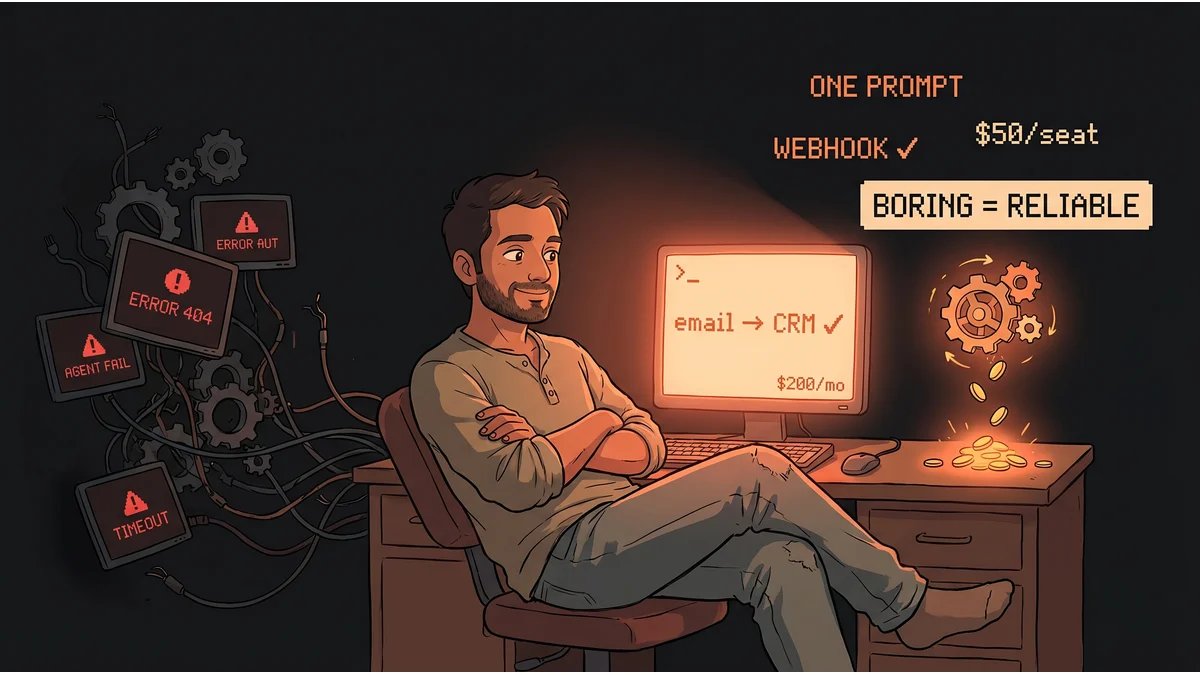
TL;DR
- After building 25+ AI agents, one builder posted the uncomfortable truth: the ones making money are the boring ones
- Email-to-CRM tool: $200/month MRR. Resume parser: $50/month per seat. No glamour. Consistent revenue.
- The rule: “every agent you add is a new failure point”
- The profitable stack: OpenAI API + n8n + one tight prompt + webhook — four components total
- Best for: anyone building or buying AI automation for their business
The most honest post in the AI agent space this year didn’t have a founder reveal, a product demo, or a viral hook. It had 25 agents worth of data behind it.
The builder had been shipping agents long enough to see the pattern clearly. The agents generating consistent revenue weren’t the ones that looked impressive in a demo. They were the boring ones. Single task. Clean input. Reliable output. Running every day with nobody watching them.
That’s the uncomfortable truth nobody in the “AI agent revolution” space wants to post about.
What the Numbers Actually Show
The post came with specific revenue examples — not projections, not “potential MRR,” actual results from agents already running.
An email-to-CRM automation: $200 a month in recurring revenue. The workflow is exactly what it sounds like. An email arrives. The agent reads it, extracts the contact details, drops them into the CRM. One input. One output. No user interface, no intelligent routing, no multi-agent handoff. The whole thing runs on OpenAI’s API, n8n, one prompt, and a webhook.
A resume parser: $50 per seat per month. Upload a resume. Get back structured data. One job. Does it reliably.
Neither of these will make the headline at an AI conference. Neither requires an AI PhD to understand or maintain. Both generate revenue every single month — which is more than most of the sophisticated multi-agent pipelines competing for attention in the same space.
The Rule Nobody Wants to Hear
“Every agent you add is a new failure point.”
That’s the uncomfortable truth the post led with. And it’s not theoretical — it’s what happens to complex pipelines in production.
An eight-step workflow has eight places it can break. When one API call returns an unexpected format, when one prompt misreads an edge case, when one conditional branch hits an input nobody anticipated — the whole thing goes down. And debugging across multiple models, multiple prompts, and multiple API integrations isn’t a quick fix. It’s an afternoon you weren’t planning to spend.
The agents that fail in production aren’t usually poorly built. They’re the ones that accumulated steps — one more filter, then a retry loop, then a conditional branch for the exceptions — until the thing that worked in testing became too fragile to trust in a client’s actual environment.
The Boring Stack
The profitable agents the builder described share the same architecture: OpenAI API, n8n, one tight prompt, a webhook. Four components. Nothing between them.
Not because the builder didn’t know how to build something more sophisticated. But because they’d already learned what adding more components does to reliability — and to the hours spent maintaining it.
The stack is boring. The revenue is real.
What This Actually Means for Anyone Using AI
The uncomfortable truth isn’t that AI agents don’t work. It’s that the ones that work best don’t make good demos.
A resume parser doesn’t generate conference slides. An email-to-CRM tool isn’t worth a product launch post. But at $200/month MRR, it also doesn’t need to be — it just needs to keep running.
The pattern the builder observed after 25+ agents is the same one showing up across every business that’s deployed automation successfully: the wins aren’t the impressive ones. They’re the ones doing one boring job, reliably, without requiring attention.
That shift — from demo-worthy to dependable — is what separates the agents that generate revenue from the ones that generate excitement.
And it turns out those are very different things.