TL;DR
- Repair shop owner (16 years) automated 90% of customer service with n8n, ElevenLabs, and Airtable
- 80+ hours/month freed up, running cost under €200/month, proven across 12+ months in production
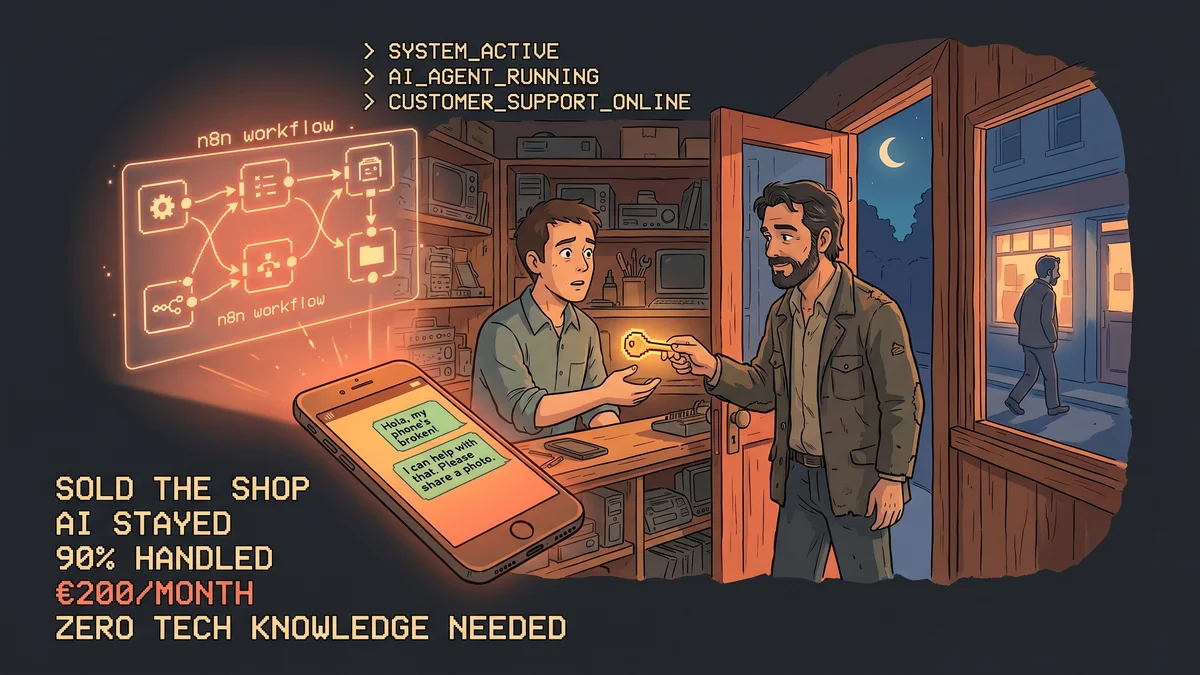
- Sold the business in 2025 — new owner with zero technical knowledge kept everything running without help
- The real test of automation: would it still work if you weren’t there?
- Full workflow open-sourced on GitHub
The real test of any automation isn’t how it works for the person who built it.
A device repair shop owner spent 16 years running his business. For most of that time, the biggest drain wasn’t broken phones or sourcing parts — it was answering the same WhatsApp messages, day after day: “how much to fix my screen?” “when can I pick it up?” “do you have this part?”
More than 80 hours a month, just on messages. More if you counted calls.
So he built a system to answer for him. What happened after he sold the business proves something more interesting than efficiency.
The System He Built
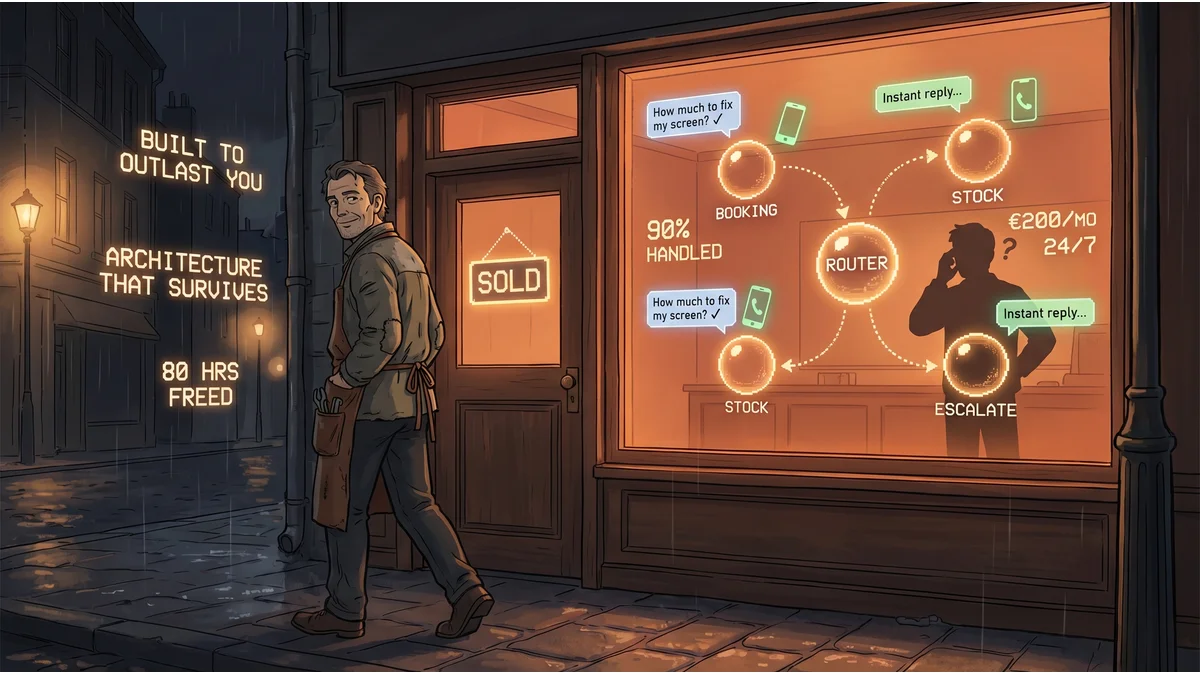
Every customer contact — WhatsApp message or phone call — flows into an n8n routing workflow that classifies what the customer needs and hands it to one of four specialized sub-agents:
- Booking agent — checks real calendar availability, confirms the appointment slot
- Quote agent — looks up the specific device model and repair type in the database, returns accurate pricing
- Stock agent — checks current inventory in real time, places internal reorders when parts are missing
- Escalation agent — when the others can’t handle it, passes the conversation to a human with full context attached
Voice calls run through ElevenLabs. The same four sub-agents handle both channels — different entry point, identical logic underneath.
The Three Things That Actually Mattered
He ran it in production for over a year. The lessons weren’t about the AI models.
Model tiering. The booking agent doesn’t need a powerful model. It’s parsing “next Tuesday at 3pm” and checking a calendar — any fast, cheap model handles that fine. The quote agent needs accuracy (device specs, compatibility, up-to-date pricing), so it gets the better model. Running everything on the top tier would have cost 3-4x more for the same outcome.
Pseudo-streaming on WhatsApp. Instead of one long message arriving after a pause, responses get split into sentences and sent sequentially. Customers see typing indicators. They feel like they’re talking to someone. This changed how customers experienced the speed more than any optimization to the underlying AI.
Airtable as the single source of truth. Prices, stock levels, and booking availability all live in Airtable. Agents query it in real time. No sync issues, no stale data, no agent quoting a price that changed three weeks ago. The database discipline made the AI reliable; the AI didn’t make the database irrelevant.
One more non-obvious finding: adding a reasoning step to the router — making it think before picking a tool chain — cut routing errors by roughly half.
A Year of Real Numbers
Running continuously from late 2024:
- 90% of interactions handled without a human
- 80+ hours/month freed up
- Under €200/month total operating cost
- Under 30 seconds average response time
- 24/7 availability instead of shop hours only
These aren’t projections or demo metrics. They’re twelve months of a live business.
What Happened When He Sold
In 2025, he sold the repair shop.
The buyer had zero technical background — no automation experience, no coding, no familiarity with n8n, ElevenLabs, or any of the tools involved. The WhatsApp agent, the voice agent, the routing workflows, the Airtable setup — all of it transferred with the business.
The new owner kept everything running. No handholding from the original builder.
“All the AI systems — the WhatsApp agent, the voice agent, the automations — kept running without me. That’s when I knew the architecture was right.”
That line is the whole story. A well-built system doesn’t require its builder to keep working. The buyer didn’t understand how it was built. They didn’t need to. It just ran.
The Pattern Worth Copying
The technical stack here — n8n for routing, specialized sub-agents per task type, a real database as the source of truth, voice as a second channel on the same logic — is replicable for almost any service business where the same questions arrive on repeat.
He open-sourced the full workflow on GitHub. Anyone can look at the actual implementation, not just a description of it.
What’s notable: this wasn’t built by an AI specialist. It was built by a repair shop owner who wanted to stop answering the same question two hundred times a month. The system worked well enough to survive a change of ownership intact.
That’s the bar worth setting — not “does it save me time?” but “would it still work if I wasn’t there?”