A French founder started an n8n automation agency in early 2024, signed a national bank in the first few months, and sold his shares 18 months later. Not because the business failed — both original clients still pay. He sold because he burned out before he could fix the structural problems he’d ignored at the start.
He posted the whole thing, titled “I will not promote,” in r/startups. It has 100 points, 72 comments, and the kind of specificity that usually stays private.
The Start Was Real
When u/oyodeo launched, there was almost no local competition in France for n8n-first automation. He was early to a specific niche and it worked immediately. A national bank signed. A training industry firm signed. Both are still clients.
“Amazing timing at the start” is how he describes it. That part is true and worth saying plainly: the early window for automation agencies was real. It rewarded people who moved first.
The First Wall
Hiring broke the momentum.
The problem wasn’t finding someone who could build n8n workflows. The problem was finding someone who understood the client’s business well enough to know what to automate, cared whether it actually worked for the client, and could communicate clearly when they were stuck. He hired one person who didn’t meet that bar and had to let them go a few weeks in.
This is a recurring theme in knowledge work businesses: the technical skill is table stakes. The judgment — knowing what matters to the client, when to push back, when to escalate — is what makes someone actually useful.
The “We’re a Dev Agency” Moment
About a year in, a realization landed: “We’re basically a development agency.”
Clients don’t care if you use n8n, Zapier, Make, Node.js, or Python. They care about results, reliability, time-to-delivery, and price. They compare you to freelancers, other dev shops, internal IT teams, and large system integrators — not other n8n specialists.
So he stopped leading with n8n. He started leading with AI and outcomes. The tool became an implementation detail, not the selling point. This was the right call, but it came a year into the business.
The Mistake That Compounded
The biggest structural mistake: no recurring revenue.
Every project got quoted and delivered. No maintenance contract. No ongoing fee. When the work was done, it was done — until the client came back with a problem.
This sounds like discipline until you realize what actually happens to automations over time: APIs change authentication methods. Third-party services update their schemas. Business processes evolve. Monitoring lapses. What worked at delivery starts degrading in months without someone watching it.
His recommendation now: price a recurring annual fee at roughly 20% of the project cost, automatically included in every contract, covering monitoring, API updates, and small changes. Price it as insurance, not overhead. Bill it automatically. Without it, you’re building a project business — high effort, lumpy revenue, no compounding.
The Exit Reason
By 18 months, he was done.
“I was never made to satisfy clients. I’m too selfish for that,” he wrote in the comments.
The work had shifted. Less building, more client meetings. Project management. Hiring and firing. The agency had started to work — both original clients are still active — but the model had turned into a human resources job. He’d entered it to solve technical problems. He stayed too long solving people problems.
He sold his 50% to his business partner.
The Tool Shift
One more note from the post, worth flagging for anyone building automation businesses right now:
“I haven’t created a node myself since I sold my shares. Claude does it all.”
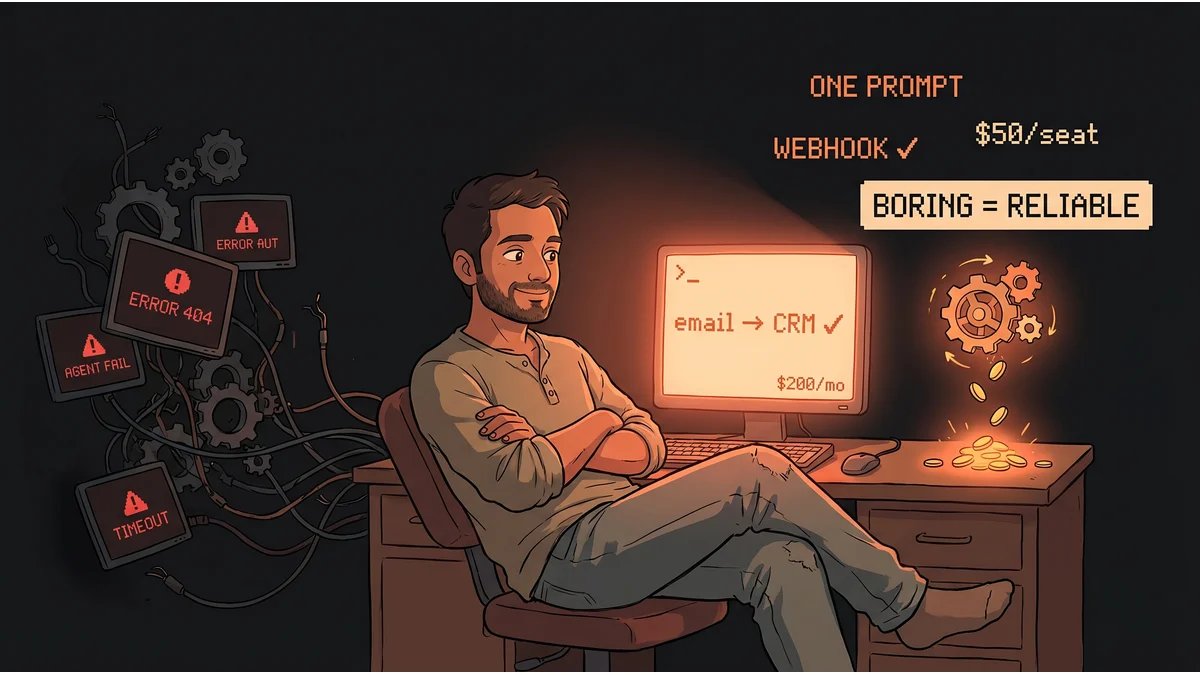
His current take: n8n is genuinely good for small, linear automations — predictable if-this-then-that pipelines. For anything requiring judgment, adaptation, or reasoning, he now uses LLMs directly. The workflow builder is the plumbing; the intelligence lives in the model.
This shift is already underway across the automation space. The agencies that thrive over the next few years will probably be the ones that treat n8n as infrastructure and LLMs as the actual product — not the other way around.
The Lessons, Direct
From his post and the comment thread:
Sell outcomes, not tooling. The client doesn’t care what you used. They care that it works.
Hire for curiosity and communication first. Someone who asks good questions and flags problems early is more valuable than a faster builder.
Price recurring from day one. Not as an upsell. As the default. Automations require maintenance. Someone has to pay for that time.
Protect builder time or change the model. If you’re the person who builds things, an agency will slowly move you away from building. That’s the job. Know it going in.
Use n8n where it’s strong. Don’t be religious about tools. When the workflow needs to think, reach for a model.
The business isn’t a failure story. Both original clients still pay. The exit was chosen, not forced. But the lessons are expensive ones — the kind you pay for in founder hours before you understand why they matter.