Most companies think of automation as a cost-cutting exercise. Fire people, save money. That’s not what happened here.
An automation consultant, eight months into running their agency, shared a detailed post-mortem of their first enterprise-scale engagement. The client was a 47-employee e-commerce brand. The waste wasn’t in headcount — it was in three people spending 60 hours a week serving as human cables between software that didn’t talk to each other.
Three separate automation projects. Three measurable before-and-after results. The $180K figure was only the beginning.
Bite 1: The Fulfillment Team Was Excel
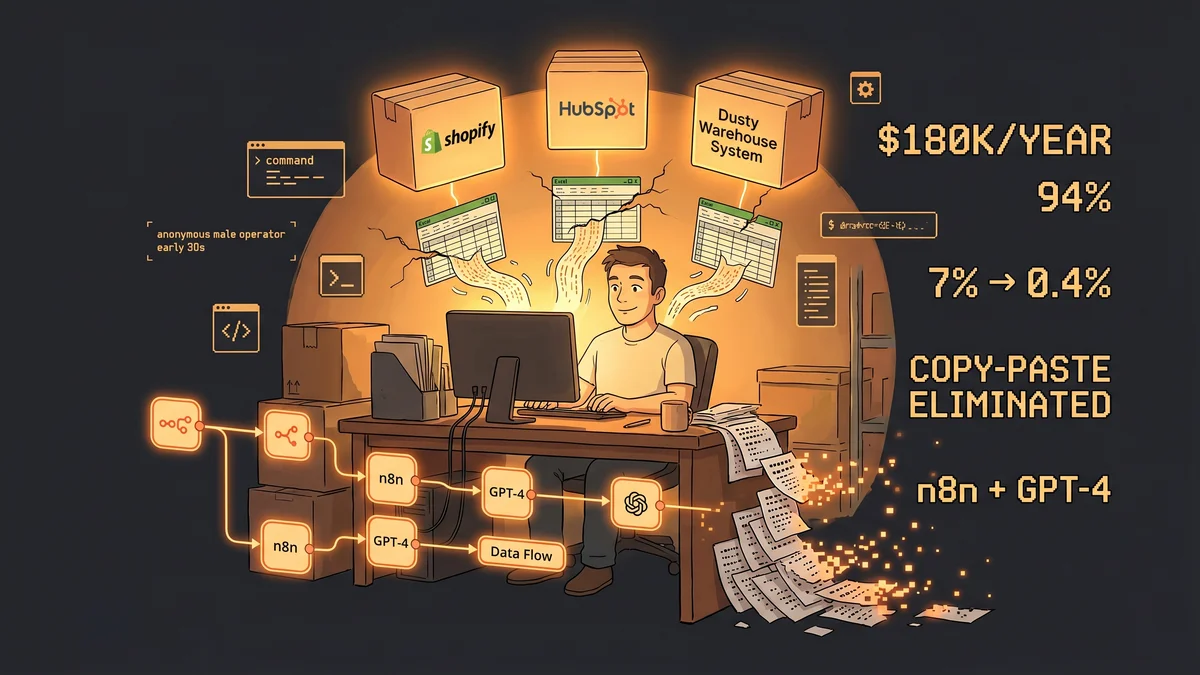
The fulfillment setup at the client: Shopify for orders, HubSpot for customer data, a warehouse system from 2019 that had never been integrated with anything. Three people bridging the gap manually. Sixty hours a week. Excel as the connective tissue.
Seven percent of orders had errors — wrong address, inventory mismatch, partial shipment. Each error cost time and money on both ends.
The consultant built an n8n workflow connecting all three systems. Standard automation handles the clean cases. The differentiator was what happened on the messy 15%: unusual orders that would have caused a rule-based automation to fail. GPT-4 API calls handled those edge cases with plain-language logic rather than brittle conditional branches.
The build took 48 hours to construct and four weeks to test before go-live. Results at 90 days: 94% reduction in manual fulfillment time, error rate from 7% to 0.4%, $180K in annual savings from salary and error cost reduction combined. Full payback on the project cost: under 90 days.
The insight the consultant flagged: start with processes that cross the most system boundaries. That’s where the hours bleed. The more tools involved in a manual step, the larger the automation win.
Bite 2: The Onboarding Gap That Was Costing Retention
After the fulfillment win, the client asked for a second project: B2B onboarding. Their wholesale customer onboarding took 14 days. Document collection, validation, provisioning, welcome sequences — mostly manual, mostly waiting.
The consultant rebuilt it in Make (better native document handling than n8n for this use case). AI-generated welcome sequences based on customer type replaced the generic templates. Smart document intake with validation replaced the email back-and-forth. Auto-provisioning in the wholesale portal replaced the manual account setup.
New onboarding time: 48 hours.
The unexpected result: customers onboarded in 48 hours had 34% higher 90-day retention than those onboarded under the old 14-day process.
This is worth sitting with. Speed of onboarding correlates directly with lifetime value — not because faster is better in some abstract sense, but because early engagement drives habit formation, and 14 days of waiting is 14 days of the customer not forming the habit of using the product.
Bite 3: The Analyst Who Was Just a Data Transfer Layer
The third project was a reporting workflow. A senior analyst spent 16 hours a week pulling data from six different dashboards and formatting it into slides for 12 clients.
Sixteen hours. Every week. From someone hired to analyze, not to copy.
The consultant built a workflow that pulled, formatted, and sent the reports automatically. The analyst now does actual analysis. The work they were hired for.
No headcount reduction. The same person, doing a job that matches their title.
The Pattern Across All Three
The consultant’s summary of where this kind of work is most valuable: look for the 30-to-100 employee range. Big enough to have costly operational problems. Small enough to move fast and see results in weeks.
In that size range, companies are frequently paying $50,000–$60,000 a year for someone whose actual job is transferring data between systems that don’t integrate. They don’t frame it that way — the job title says operations manager or fulfillment coordinator — but the task log tells a different story.
The automation work that pays the highest ROI isn’t replacing skilled judgment. It’s replacing the friction between tools that should have been connected years ago but weren’t.
Three projects. One client. $180K in annual savings at go-live, plus a retention improvement no one predicted, plus a senior analyst doing the work they were hired to do.
The value was there the whole time. It was just hiding in Excel.