TL;DR
- Non-technical founder built email marketing automation for $3K/yr in savings — by describing the workflow to Claude
- E-commerce owner deployed 5 AI agents managing 4 inboxes, 0 missed escalations — no coding background
- One builder turned a 3-day manual process into 30 minutes with a self-improving Claude Code skill
- Best for: business owners who have repeating workflows but no technical staff to automate them
- Key lesson: the barrier to automation is no longer coding — it’s being able to describe what you already do
None of these people could code. All of them have automation that runs without them.
The common denominator isn’t technical skill. It’s knowing their own workflows well enough to explain them — and a willingness to hand the execution off to Claude.
The Email Marketer Who Described Her Workflow Into Existence
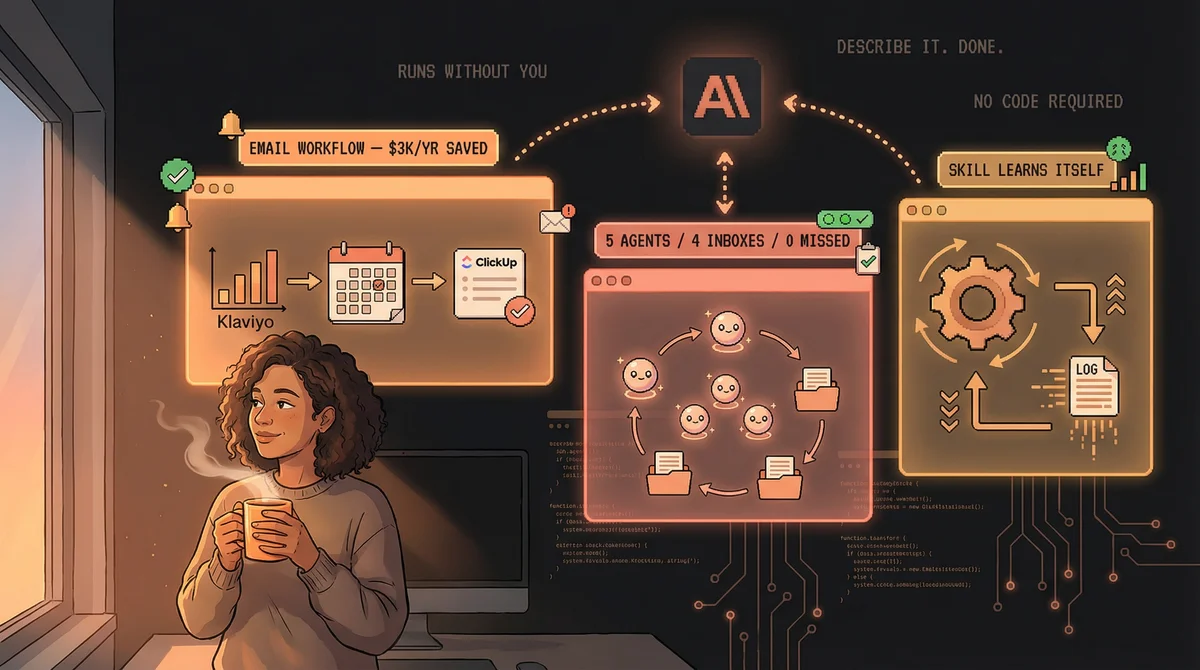
@fenbeys runs email marketing for their business. Every week, the same cycle repeated: pull performance data from Klaviyo, figure out what to send next, research content angles, create task briefs in ClickUp for the team. Repeating work that consumed hours and required mental overhead even between the actual work.
They described this workflow to Claude — step by step, tool by tool. Claude connected to Klaviyo, read what worked and what didn’t, planned the next content calendar accordingly, researched topics, and dropped ready-to-execute briefs directly into ClickUp.
No code was written. The workflow now runs on its own. The outcome: $3,000 saved per year in automation tools that no longer need to exist, and a marketing system that runs without anyone orchestrating it manually.
The takeaway: the workflow existed in someone’s head. Speaking it out loud was the only setup required.
The E-Commerce Owner Who Hired Five AI Agents
Steve Gaudio runs an e-commerce business with zero coding background. He also had four business inboxes — customer inquiries, orders, escalations — all requiring attention across the day.
He built a five-agent system using Openclaw. Each agent handles a defined scope. Together, they manage all four inboxes: routing messages, drafting responses, flagging anything that needs a human decision. When an escalation requires judgment, it surfaces. Everything else gets handled.
After a month of operation: zero missed escalations. When Steve added “build the website” to a task list one afternoon, he woke up the next morning to a completed website.
This isn’t a chatbot he queries when he has a question. It’s a team that shows up, does the work, and knows when to ask for help. For a non-technical founder, that’s the difference between running a business and being consumed by it.
The Skill That Teaches Itself
@xSoloTrades had a workflow that took 2-3 days every time they ran it. They built it into a Claude Code skill. The same workflow now runs in 20-30 minutes.
The interesting part isn’t the speed. It’s what happens after each run: the skill logs its own performance. What worked, what got stuck, what needed retrying. Those logs feed back into the next run. The system improves itself without human intervention.
The result is automation that compounds. Not just faster — continuously getting better at its own task. One initial setup. No ongoing maintenance. The claimed improvement: 100x productivity.
The Pattern
Three different workflows. Three different tools. One pattern: none of these people wrote code. What they did was describe — with enough precision to be actionable — exactly what their business needed to happen. Then they got out of the way.
The barrier to automation used to be technical skill. These cases suggest it’s now something simpler: the ability to articulate what you already do.