Some mornings, a retired financial markets trader opens his dashboard and finds content waiting that he didn’t know was being written.
The company has a pulse that isn’t his.
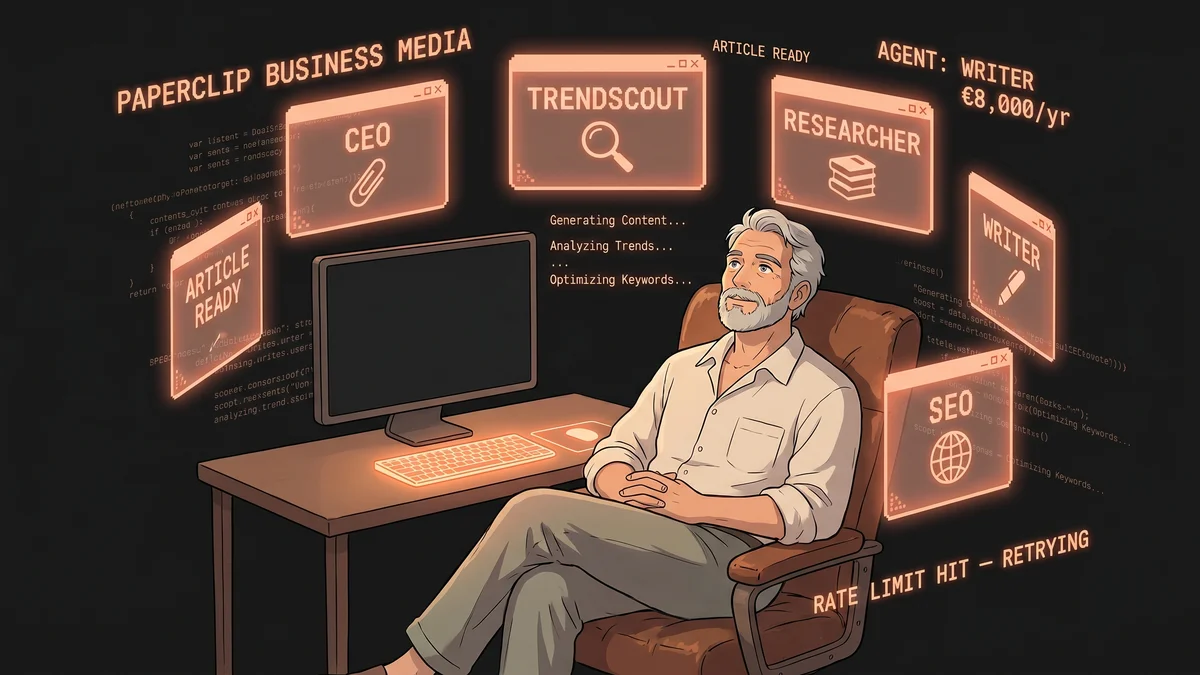
Paperclip Business Media publishes articles about AI-agent companies for non-technical business readers. Five AI agents run the operation: a CEO agent, a TrendScout, a Researcher, a Writer, and an SEO Agent. The human founder—thirty years reading financial markets, now reading agent output—supervises. He doesn’t write.
This is not a success story, he says in his own words. It’s a field report from the part of AI adoption nobody puts in the landing-page screenshots.
Who He Is
The founder goes by u/Icy_Comfort_6220 online. When he retired from financial markets, he didn’t want to play golf. He wanted to build something that had never existed before.
He is not a developer. He built everything with AI assistance, Claude primarily. That matters, because his thesis is that non-technical domain experts who understand risk, systems, and the difference between a signal and noise are the people who will define the next phase of AI adoption—not developers.
He spent six months building before posting his first field report.
The Architecture
Five agents with distinct roles, running on the Paperclip AI platform:
- CEO Agent — receives strategic goals, delegates to the team, reviews outputs before the founder sees them.
- TrendScout — monitors AI-agent industry news, identifies story angles, gathers competitive intelligence.
- Researcher — deep-dives on assigned topics, cross-references sources, builds the factual foundation.
- Writer — transforms research into readable articles. Instructed to use warmth and humor. “It works better than you’d expect.”
- SEO Agent — optimizes for search, checks factual accuracy, handles the unglamorous work nobody wants to do.
He thinks of them in Jungian terms and acknowledges this probably says more about him than the technology.
The Economics
The math is the kind that stops you mid-scroll:
| Traditional | Paperclip Business | |
|---|---|---|
| Content production (2 articles/week) | €52,000/year | €120/year (marginal) |
| My time per article | N/A | 1 hour |
| Setup cost | €0 | ~€20,000 (one-time) |
| Year 1 total | €52,000 | ~€28,000 |
| Year 2+ total | €52,000 | ~€8,000 |
The €120/year is the Paperclip AI subscription cost for article production — the marginal cost of each piece once infrastructure is in place. Full operational cost runs around €650/month: infrastructure, AI subscriptions, hosting, maintenance, tooling. Against €4,300/month for equivalent traditional production. Year 2 onward, the math speaks a clear language.
What Works
Consistency. Agents don’t have bad days. They don’t miss deadlines. A topic identified Monday can be a published article by Wednesday when everything is configured correctly.
Research depth. The Researcher consistently finds angles the founder says he would have missed. His thirty years in markets trained him to spot patterns — but the agent casts a wider net.
Tone. The Writer has developed a voice. He didn’t expect this. A prompted instruction to use warmth and humor produced something that doesn’t read like a machine.
Self-correction. The system detects errors and attempts to fix them autonomously. Not always successfully. But it tries.
What Doesn’t Work — The Honest Part
This is where most AI success posts end. This one doesn’t.
The “Master of the Universe” trap. When the agents finally ran, the feeling was invincible. So he left the default configuration untouched. Why change what’s working? Forty-eight hours later, Claude hit its rate limit. All five agents: frozen. An AI rocket launch followed by running out of fuel. The lesson he drew: throttle your heartbeat intervals immediately — set them to 86,400 seconds (once daily) before you feel like a god, then tune back up to 3,600 (hourly) when stable.
The empty instructions problem. This one still makes him cringe. He spent weeks wondering why the agents felt “off” — not quite on brand, not quite hitting the right angles. Then he discovered it: all five agents had been running with completely empty instruction fields. The agents were improvising. For weeks. When he finally wrote proper instructions for each — Role, Task, Output format, Context — the quality improvement was immediate and dramatic.
One article took three weeks. PAP-15. A 1,168-word article. Three weeks. Running on a local machine with Claude Pro, the agents kept hitting the rate limit wall, getting knocked down, starting again. Impressive and completely impractical for a publishing operation.
Running at half capacity. Currently, the company produces approximately one article per week at stable operation, not two. Full capacity hits rate limits. “The honest truth: what I launched is a proof of concept at 50% of its intended output. The concept is proven. The scaling is still in progress.”
True originality remains human. The agents recombine well. They don’t invent. The big creative leaps still come from the founder.
The Philosophical Question Nobody Talks About
When your company operates without you, what is your role?
His answer: Vision and Ethics. The agents execute. He decides what kind of company they are, what they stand for, what they refuse to publish. That turns out to be enough — and more important than he expected.
Some mornings the dashboard has content waiting that he didn’t know was being written. “It’s productive. It’s also genuinely uncanny.”
Where It Stands
Paperclip Business Media is pre-revenue, building audience. Publishing 1-2 articles per week, stabilizing. Infrastructure moving to Railway for 24/7 autonomous operation. Next milestone: full deployment on Claude Max, then first paid client.
The company exists. The agents run. The founder supervises.
The polished version of this story would say it works perfectly. His version: the architecture is sound, the economics are compelling, and getting here required discovering that the agents had no instructions, that one article took three weeks, and that feeling like a god is the most dangerous moment in the whole process.
For non-technical domain experts watching this space: the tools are far enough along that someone who spent thirty years reading financial markets can build a journalism company without writing a line of code. The gap between promising and working is still real. So is the gap between working and working well. But the architecture is proven. The economics are compelling. The next phase of AI adoption will be built by people who understand a domain deeply — not people who understand the code.
Source: u/Icy_Comfort_6220 posted this field report on r/AI_Agents in May 2026. Paperclip Business Media: paperclip-business.com