TL;DR
- Kandarp Desai, Engineering Leader at Xactly, built an AI agent that reads all Google Workspace systems each morning
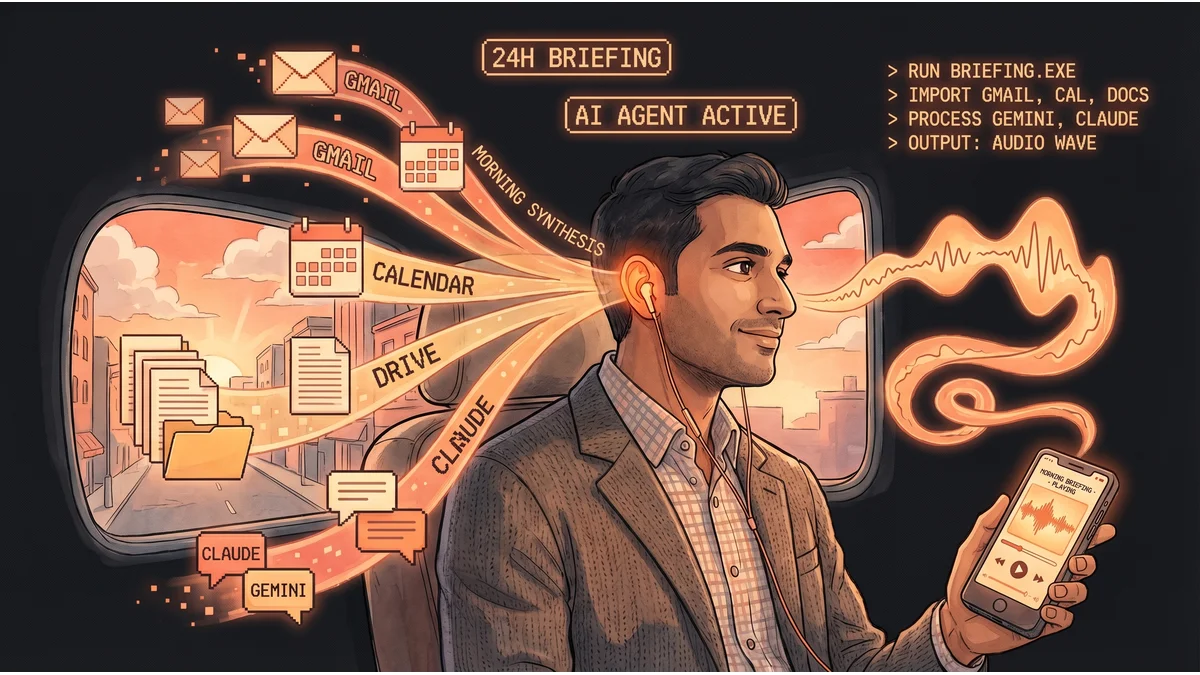
- Claude AI synthesizes 24 hours of org activity into a narrative; Google Gemini delivers it as audio
- Designed for the commute — no screen required
- Replaced the fragmented morning scroll across email, calendar, and shared docs
- The shift: from querying five tools one by one to receiving one synthesized briefing
Every professional who manages people or projects runs the same broken morning routine. Check email. Scan Slack. Open the calendar. Look at the project tracker. Parse the overnight notifications. Piece it all together in your head.
The information exists across five or six tools. The synthesis happens manually. It takes 20-40 minutes. And it still misses things.
Kandarp Desai, Engineering Leader at Xactly, solved this differently.
The Setup
Instead of opening tools one by one, Desai built an AI agent that opens them all — and brings the summary to him.
The agent connects to Google Workspace, where the organization’s operational data lives: email, calendar, shared documents, Drive activity. It reads the last 24 hours of activity across those systems. Claude AI synthesizes the data into a coherent narrative. Google Gemini handles the voice layer.
The result isn’t a dashboard or a report. It’s an audio briefing — played during the morning commute.
“I have replaced my daily morning scrolling with listening to the last 24 hours of activities,” Desai said.
Why the Format Matters
The delivery method is the design decision that makes this work.
Text-based briefings — a daily digest email, a document summary — require you to find desk time to read them. They compete with everything else on your screen. They’re easy to skim and miss. And most people already have too many unread summaries in their inbox.
Audio is passive. It works during the commute, the walk, the first coffee. It doesn’t require allocating attention to a screen. It doesn’t need to win the competition for tab-switching priority.
Desai’s setup reclaims time that was already spent — the commute — and converts it from random social media consumption into a structured catch-up on exactly what moved in the organization the day before.
The Systems-of-Record Angle
The phrase Desai used — “all systems of record” — is what separates this from a simple email summary.
Most morning catch-ups are fragmented because organizational memory is fragmented. A decision made in email doesn’t automatically appear in the project tracker. A calendar change doesn’t notify Slack. A document updated in Drive doesn’t surface unless someone specifically looks.
An agent that spans all those systems doesn’t just summarize each one independently — it has the raw material to connect them. The meeting scheduled yesterday, the prep document created for it, the email thread that preceded the invite: those three form a unit of context that no single tool holds. The synthesis is what’s valuable, not the data retrieval.
Google Workspace as the source makes the integration relatively clean — Gmail, Calendar, Docs, and Drive share an ecosystem. The agent doesn’t have to stitch together five different authentication flows. One workspace, one data source, one pull.
The Ambient Intelligence Shift
Most AI tools still operate on request. You open the tool. You ask the question. You get the answer. The bottleneck is remembering to ask — and having the presence of mind to ask the right question before your first meeting.
What Desai built is proactive. The agent runs on a schedule, reads what changed, synthesizes the relevant context, and delivers a narrative — whether or not you remembered to go looking. It’s a different model of how AI integrates with work: not a smarter search, but a standing monitoring system that reports to you.
Desai noted that task management integration is already in progress — the logical next layer. Today it delivers “here’s what happened.” The next version will add “here’s what you need to do about it.”
The Implication for Any Leader
The word “briefing” has a specific history. Generals get briefed before operations. Intelligence officers get briefed at the start of every shift. Executives get briefed before board meetings. The briefing model exists because arriving informed is worth the infrastructure cost — in high-stakes roles, someone’s job is to synthesize what’s available and deliver it in a form that lets the decision-maker focus on decisions.
What Desai built applies that logic to an engineering leader at a B2B SaaS company. It costs setup time once, runs automatically every night, and delivers organizational awareness in a form that doesn’t require sitting at a desk.
The question this use case puts on the table is simple: how many minutes do you spend every morning assembling a picture of what happened in your organization yesterday? And what would you do with that time if the picture arrived before you opened your laptop?