TL;DR
- Sales coach Mor Assouline automated 30+ minutes of weekly post-session admin to zero
- Also built AI call auditing for a $120M+ funded company — thousands of calls scored on methodology, automatically
- Real-time Slack alerts fire when reps demonstrate high-leverage techniques
- Took 1.5 months to build; integrates Slack and Salesforce for trends
- Key lesson: high-frequency + low-complexity + manual + time-consuming = highest AI ROI target
Mor Assouline coaches sales reps at LinkedIn, HubSpot, and Klaviyo. He also helped a $120M+ funded company review every sales call they’ve ever recorded. The difference between those two jobs? AI handles the admin layer for both.
Every Friday at 1 PM, something happens in Mor’s business that he no longer thinks about. Fathom opens. A transcript extracts. Topics get identified, summaries formatted, a new lesson published to his Kajabi course, the course reordered so the latest session lands at the top, and a recap posted to Slack. His group of enterprise AEs gets the takeaways from the week. Mor gets back 30 minutes.
That used to be manual.
“If you’re a seller or sales leader doing repetitive pre or post-session work every week,” he wrote, “you’re sitting on hours of reclaimed time.”
The Recurring Task Problem
Most people try to automate the dramatic stuff — the multi-step pipelines, the complex decisions, the things that feel important. Mor targets the opposite: find the task that happens every week, that you execute the same way every time, that produces predictable output. That’s your automation candidate.
His post-coaching workflow was textbook: pull the Fathom recording, read the transcript, identify coaching topics, generate “How to…” summaries, publish to Kajabi, reorder the course, post to Slack. Identical steps. Every Friday. Every week for as long as he coached.
He wired it together with Claude Cowork. The difficult parts weren’t the logic — they were the edge cases. Fathom uses encrypted video streaming that blocks standard automated downloads. Kajabi handles course ordering through a drag-and-drop UI that standard browser automation can’t navigate. He built custom workarounds for both. Now the whole sequence runs while he’s still delivering the session.
He shows up. He coaches. The rest is handled.
The Enterprise Version
The personal automation was practice. The enterprise application was the real test of the principle.
A $120M+ funded company came to him with a familiar problem: thousands of sales calls and no systematic way to review them. Managers could listen to five calls a week, maybe. Coaching was reactive and spotty. Reps who nailed a technique had no fast path to reinforcement. The ones struggling had no fast path to correction.
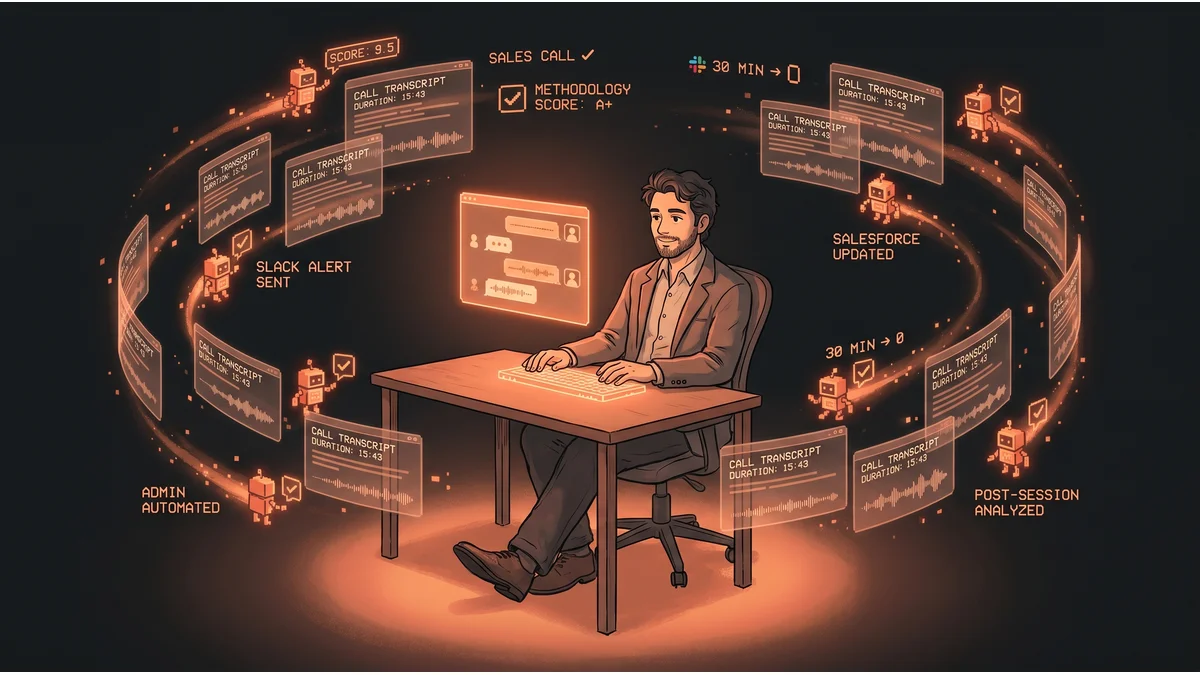
Mor built an AI agent system that audits all of them.
The agents score every recorded call against the company’s proprietary sales methodology — the same rubric a senior manager would apply, but applied consistently across every call in the pipeline. When a rep demonstrates a high-leverage technique, a Slack notification fires immediately. Not in a weekly 1-on-1. Not in a quarterly review. Immediately, while the rep can still connect the feedback to the conversation they just had. Salesforce gets the aggregated trend data so managers can see what’s happening across the whole team.
It took 1.5 months to build a working v1. The system is still being refined.
The Formula
Mor’s framework is direct: “high-frequency + low-complexity + manual + time-consuming = AI agent opportunity.” Sales coaching is full of exactly these tasks. Post-session summaries. Call scoring. Methodology tracking. Rep performance trends. None of them require human judgment. They just require someone to do them — and that someone used to be a person.
“We’re entering a whole new era,” he wrote, “where the competitive advantage isn’t knowing how to use AI — it’s knowing how to wire AI into your actual workflows.”
Two use cases, same pattern. Whether it’s 30 minutes of personal admin or thousands of enterprise calls, the move is identical: find the recurring task, wire it up, and spend your actual time on the conversation itself.
The AI doesn’t coach anyone. Mor does. The AI just makes sure nothing slips through.