TL;DR
- 47-employee e-commerce brand, 3 people spending 60 hours/week copy-pasting between 4 tools
- The automation agency owner quoted six weeks to fix it — the client laughed
- Built in 48 hours. Four weeks of testing. Then live.
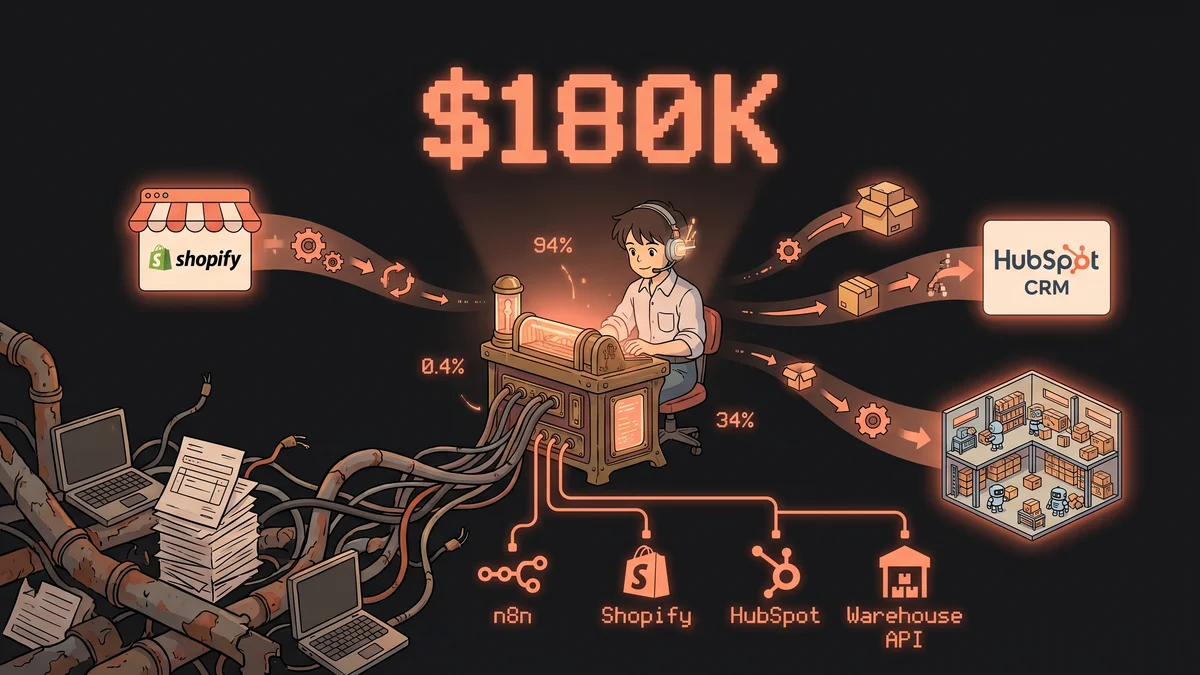
- 90 days later: 94% reduction in manual time, $180K/year saved, error rate from 7% to 0.4%
- Payback: under 90 days
- That was just the first project. Two more followed.
Eight months into running his automation agency, he landed a client that changed how he thought about what this work was worth.
The company: 47 employees, e-commerce, a Shopify store feeding into HubSpot feeding into a warehouse management system that hadn’t been touched since the pandemic. Three people on the fulfillment team. Sixty hours a week between them. Copying and pasting between four different tools. Excel as the integration layer between systems that should have talked to each other automatically.
Order error rate: 7%.
He quoted six weeks to fix it.
The client laughed.
What He Built
The core automation connects three systems that previously required a human in the middle: Shopify → HubSpot → Warehouse API. Built in n8n. Core workflow: 48 hours. Testing: four weeks before go-live.
The technical part wasn’t the hard part. Standard workflow automation is straightforward when orders behave predictably. The problem is that 15% of this company’s orders don’t behave predictably — unusual addresses, inventory mismatches, partial shipments, fulfillment edge cases that don’t map cleanly to any rule you can write in advance.
This is where most automations break. When an exception hits a rule-based workflow, it either crashes or routes to a human anyway. You’ve moved the problem, not solved it.
He used GPT-4 API calls to handle exceptions in plain logic instead of trying to hard-code every scenario. The LLM reads the weird order, understands what’s unusual about it, and resolves it in context. No brittle if/else chains. No exception that falls through to someone’s inbox.
Eighty lines of Python for the custom logic. That’s the entire custom layer on top of n8n.
90 Days Later
- 94% reduction in manual fulfillment time
- $180,000 annual saving (salary costs plus order error reduction)
- Error rate: 7% → 0.4%
- Full payback: under 90 days
The fulfillment team that spent 60 hours a week as a human data transfer layer — they still exist. They now work on the exceptions the AI can’t resolve and on the decisions that require judgment. The volume work that shouldn’t have needed humans in the first place is gone.
The Projects That Followed
The fulfillment automation opened the door to two more.
B2B onboarding. A 14-day customer onboarding process — welcome sequences, document intake, validation, provisioning in the wholesale portal — rebuilt in Make (chosen over n8n for better native document handling). The result: 48 hours, end to end.
The number that surprised him: customers onboarded in 48 hours had 34% higher 90-day retention than customers onboarded under the old process. He wasn’t expecting to find a retention signal in an operations project. But speed of onboarding turned out to be a direct predictor of whether customers stayed. “Worth keeping in mind when you’re pitching the business case for this kind of work,” he wrote.
Reporting. A senior analyst spending 16 hours a week manually pulling data from six dashboards and formatting slides for 12 clients. He built a workflow that does the entire thing automatically — pulls, formats, sends. The analyst now does analysis instead of being a data transfer layer.
Three automations. One client. The scope grew because the first one worked.
The Three Rules He’d Tell Anyone
After this project, he distilled what actually made the difference:
1. Start with processes that have the most system handoffs. The hours are bleeding at every point where a human has to move data from one tool to another. The more tools in a manual process, the bigger the automation win. Look for Excel spreadsheets acting as bridges between systems.
2. AI exception handling is the differentiator. Anyone can connect Shopify to HubSpot with a no-code tool. The moment something unusual hits a rigid rule, it breaks. If you can handle the messy 15%, you can quote with confidence and charge accordingly.
3. Don’t automate a broken process. Two weeks of this project was spent understanding why certain exceptions existed before writing a line of code. Automating broken logic just makes it break faster. Fix the process first. Then automate it.
The Gap Nobody’s Closing
He focuses on companies in the 30–100 employee range. His reasoning:
“Big enough to have real, costly problems. Small enough to move fast and see results within weeks.”
In this segment, companies are frequently paying $50–60K a year for someone to copy-paste between systems — not because they want to, but because no one has told them the entire process could run automatically. The knowledge gap is wider than the technical gap.
The $180K saving at this company wasn’t from cutting-edge AI. It was from connecting three systems that already existed, handling the edge cases that standard automation ignores, and doing it before someone else figured out it was possible.
The opportunity is mostly in the obvious places: wherever a human is acting as a data transfer layer between tools that don’t talk to each other.
Source: Reddit r/AI_Agents