TL;DR
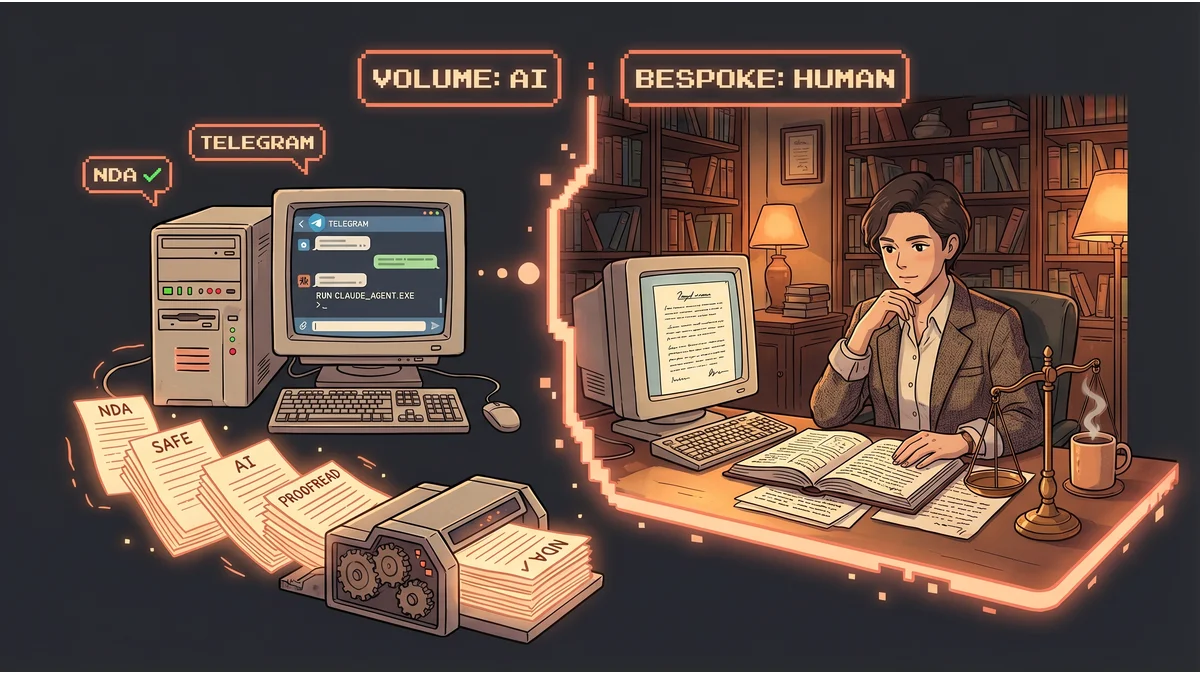
- A practicing lawyer runs a Claude agent on a dedicated computer, controlled via Telegram, connected to Google Drive
- It handles: NDA fills, SAFE agreement templates, document proofreading, and content summaries
- It doesn’t touch: bespoke drafting and legal strategy — both require professional judgment, not pattern matching
- The honest line isn’t “AI can’t do law” — it’s “AI handles the volume work so the lawyer handles the judgment calls”
- Best for: Legal professionals, compliance teams, or anyone managing high-volume document workflows
- Key lesson: Knowing what AI won’t do is as important as knowing what it will
Most AI legal tools are sold by people who’ve never been to court. Here’s what one practicing lawyer actually deployed — and the specific line they won’t let it cross.
The legal AI space is full of promises. Tools that will “revolutionize” due diligence, “transform” contract review, “replace” hours of associate time. The demos are polished. The claims are large.
Which is why it’s worth paying attention when a practicing lawyer shares not just what their AI does — but what it explicitly won’t.
The Setup
The lawyer known as @wassielawyer built their AI legal agent around a simple architecture: a dedicated computer running Claude, connected to Google Drive for document access, controlled remotely via Telegram.
The separation is intentional. The agent runs on its own machine — not as a tab in a browser or an app on the main work computer. Documents live in Google Drive. Instructions and results flow through Telegram.
This isn’t the sleekest setup on the market. It’s not a branded product or a subscription tool. It’s a working system built by someone who needed it to function reliably in a real practice.
The Telegram interface means the lawyer can send a document from anywhere — “proof this NDA,” “summarize this agreement” — and get a result without sitting at a specific machine. The agent runs. The result comes back.
What It Handles
The agent’s task list is specific.
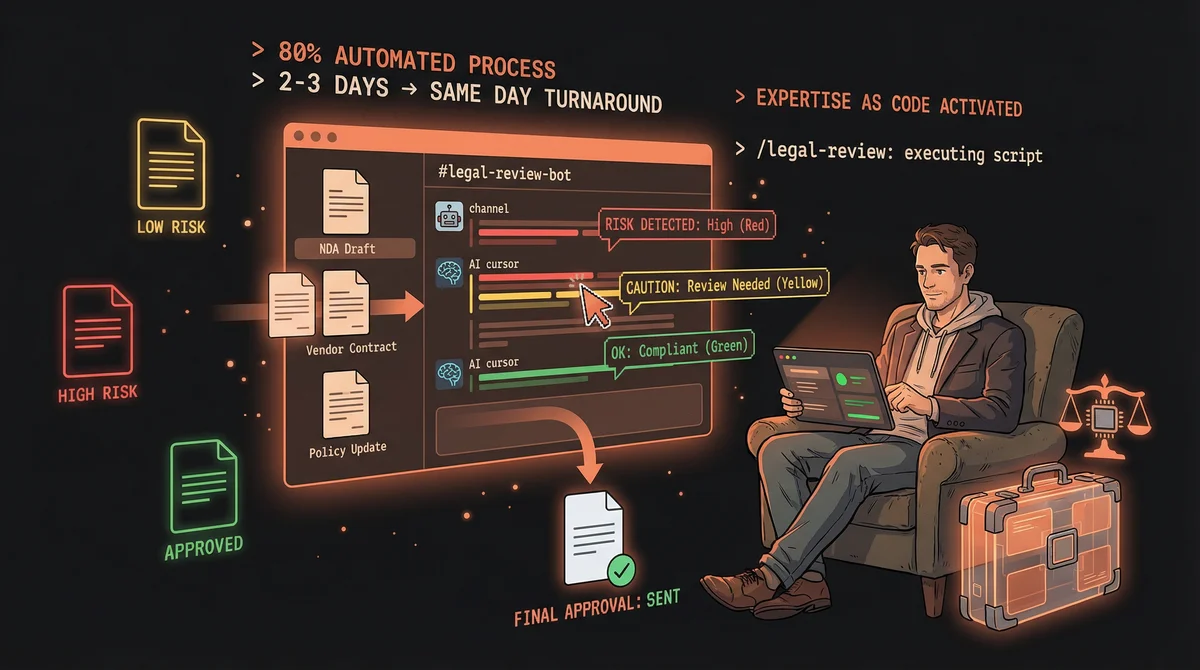
Standard template fills. NDAs and SAFE agreements follow predictable structures. Parties, dates, definitions, terms. When the skeleton is consistent, AI can fill it accurately. The lawyer sends the relevant details; the agent produces a complete draft of the standard form.
Document proofreading. Catching errors in legal documents — inconsistent defined terms, mismatched references, missing signatures, incorrect cross-references — is tedious and error-prone when done manually at volume. The agent runs the check systematically, flagging issues for human review.
Summaries. Long agreements, due diligence packages, or regulatory filings distilled to the key points. Not analysis — summary. What are the parties? What are the key terms? What are the operative dates?
These three categories share a structure: they’re high-volume, rules-based, and the outputs are verifiable. If the NDA fill is wrong, a lawyer can catch it on review. If the proofreading missed something, a second pass finds it. The tasks have known shapes.
What It Won’t Touch
Two categories are explicitly off-limits.
Bespoke drafting. Standard templates have known structures. Bespoke drafting — creating legal language for a unique situation — requires judgment about what the clause should say, not just how to fill it in. What risk is being allocated? To whom? Under what circumstances? What language would hold up if disputed?
This is the work that takes a decade to get good at. The AI can apply a template. It cannot reliably invent novel legal language for situations it hasn’t encountered, and the cost of getting it wrong isn’t visible until something goes wrong.
Legal strategy. Which claim to bring. Which clause to negotiate hardest. Whether to settle or litigate. What counterparty behavior signals about their position. Strategy requires context — about the client, the relationship, the jurisdiction, the precedent, the risk tolerance. It requires professional accountability. It requires being wrong to cost something.
No AI system carries that accountability. The lawyer does.
The Honest Framing
What @wassielawyer shared isn’t a cautionary tale about AI limitations. It’s a deployment pattern that works.
The split is logical once you see it: AI handles volume, humans handle judgment. Every practicing lawyer spends time on both. The ratio shifts.
Document review at high volume is where mistakes hide in plain sight simply because human attention fatigues. An agent that systematically checks every defined-term usage, every cross-reference, every date consistency doesn’t tire on the fourth document the way a human does.
Standard template fills are often delegated to the most junior person on a team precisely because they’re mechanical — the judgment has already been made about what the template should contain. An agent can do the same mechanical work without consuming anyone’s time.
That frees the lawyer for the work that actually requires them: strategy, judgment, the calls that will get pushed back on.
Why This Matters
Legal AI coverage falls into two camps. The first is breathless: AI will replace lawyers, compress billing cycles, disrupt the entire profession. The second is defensive: AI can’t practice law, the liability is unsolvable, the tools are hype.
What @wassielawyer built lives in neither camp.
It’s a working system used by a real practitioner, with honest limits that reflect how law actually works. The lawyer didn’t hand the practice over to a tool. They identified the portion of their workload that was rules-based and high-volume, automated that portion, and kept the rest.
That’s the pattern that will show up in every professional field that AI starts to reach: not replacement, not refusal, but a redrawing of what requires a human.
The question every legal professional should be sitting with: which parts of your day are volume work in disguise?
The answer to that question is what @wassielawyer automated.