Two people ran the same experiment six weeks apart. One was a creator who did a full credit card audit. One was a professional who asked Claude to generate a Word document almost as a joke. Both ended up cancelling subscriptions.
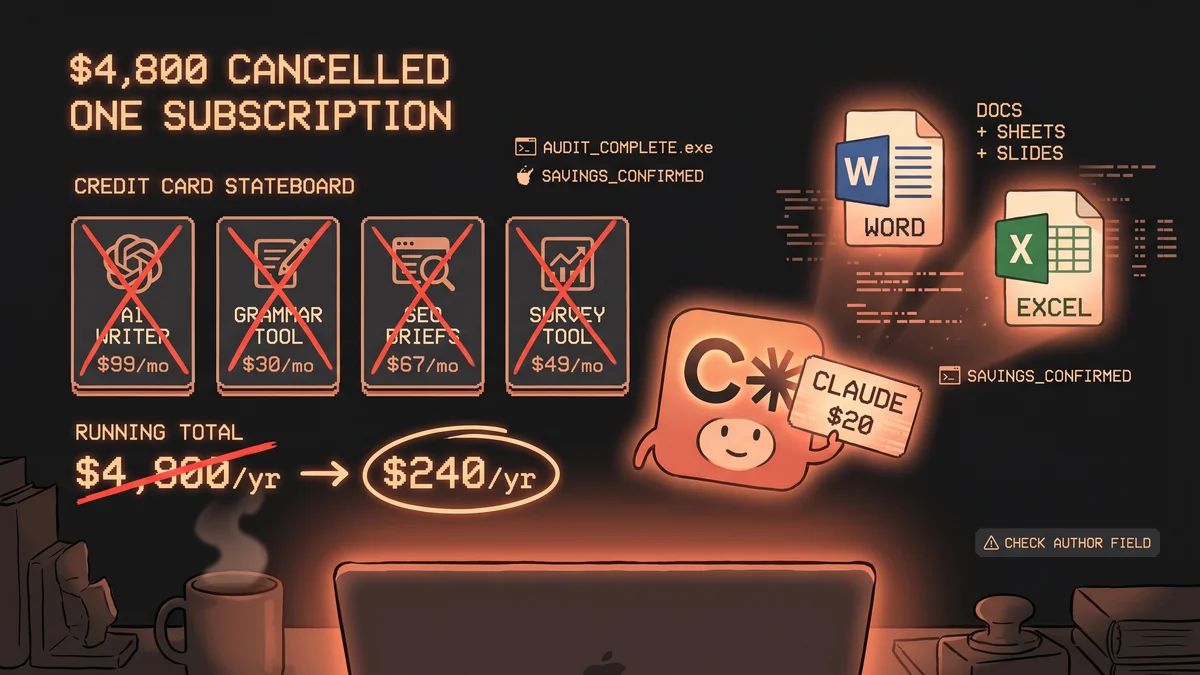
Together they cut $4,800 a year in SaaS costs while paying $20/month for Claude Pro. The math is straightforward. What’s interesting is how they got there.
The Credit Card Audit
u/Historical-Driver-64 pulled up his SaaS subscriptions and went line by line.
Jasper: $99/month for AI writing assistance. Claude does the same job. Gone. $1,188/year saved.
Social media scheduler: $79/month. One of three team members actually used it. The other two were using native scheduling features. Gone.
Grammar and tone checker: $30/month. Checked a list of its features against Claude. Claude covered roughly 85% of them. Gone.
Survey tool: $49/month. Used twice in a year. Had been auto-renewing for eight months after the campaign that needed it ended. Gone.
SEO content brief generator: $67/month. Auto-renewed through an entire quarter with zero usage.
The four secondary tools plus Jasper totaled around $4,800/year. All replaced — or simply cancelled — once he actually looked at what each one did versus what Claude already handled.
His framework for deciding what stays: “Am I paying for creation or storage and distribution?” If the tool creates things — content, documents, briefs, analyses — Claude is probably already doing that job. If the tool stores, routes, or distributes things, it probably stays.
The exceptions he kept: accounting software, CRM, and project management. Those aren’t creation tools. They’re infrastructure. Claude doesn’t replace infrastructure.
The Document Revelation
The second case is different — less about a bill audit and more about discovering a capability that was always there.
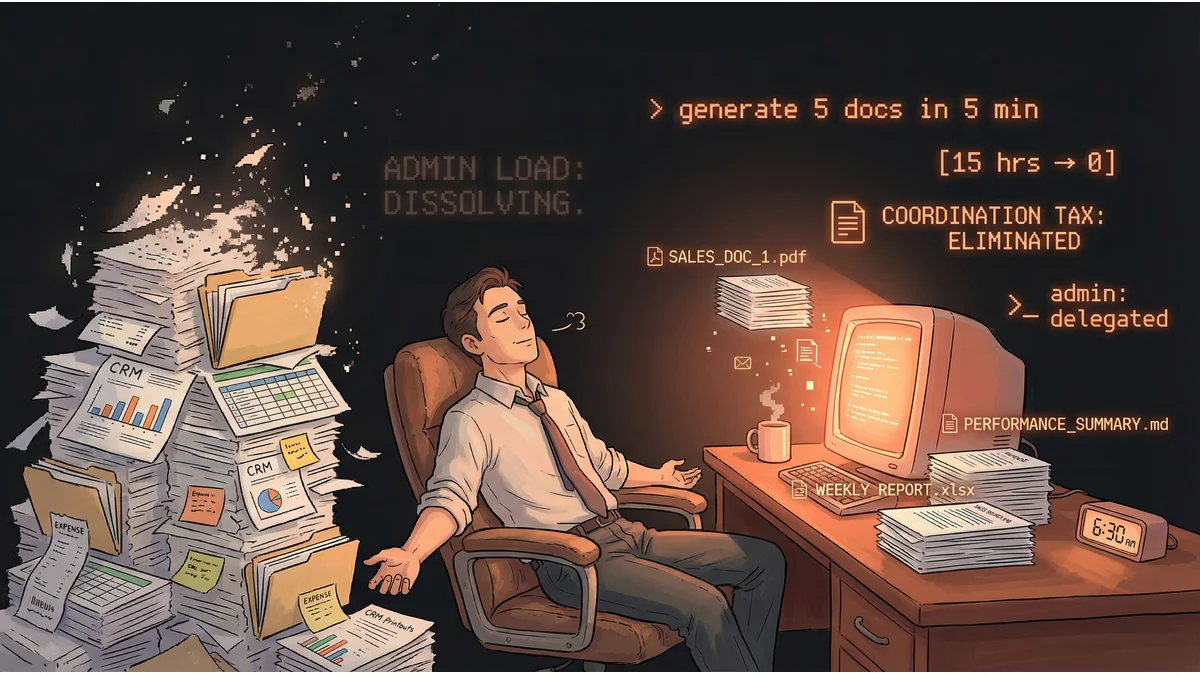
A professional on r/PromptEngineering had been using Claude for over a year. Every session ended the same way: Claude would produce text, and they’d copy it into Word and spend time reformatting everything manually.
Then, almost as a test, they asked Claude to output a client proposal as an actual .docx file.
It worked. Proper headings, bullet points, spacing, section structure. “Two minutes. Real Word document. Looks like something I’d have spent two hours on,” they wrote.
From there: .xlsx files with working formulas, conditional formatting, and multiple tabs. Slide decks with speaker notes. PDFs. Three subscriptions cut — specific tools they’d been paying for to create documents that Claude had been able to generate all along.
The top comment on the post, with 87 upvotes, added a practical warning: Word documents have an author field in the file metadata. Claude-generated .docx files default to listing the author as “python.” Before sending anything to a client, go into the file’s info panel and update that field. The document itself is fine. The metadata will give it away if you don’t check.
The Pattern
Both cases share the same shape. A tool exists to do one specific creative task. Claude Pro does that task adequately — sometimes better. The tool costs $30-100/month. Nobody checked whether the overlap existed.
The software market built an enormous category of specialized creation tools in the years before general-purpose AI was capable. Most of those tools solved real problems. Now they solve problems that a $20 subscription already handles.
Not all of them. Storage is still storage. CRM is still CRM. A social media scheduler that auto-posts at the right times for each platform is still useful even if Claude can write the captions. The tools worth keeping are the ones doing work Claude genuinely can’t do, not the ones Claude does quietly in the background while you pay someone else for the same output.
The credit card audit is worth running. Pick a month, pull the recurring charges, and ask one question per line: does Claude already do this?