There’s a version of AI adoption that looks like a productivity trick: use an AI chatbot to draft the thing faster, cut an hour off the task, repeat. That version is useful. It’s also not where the interesting stuff is happening.
A different version is emerging. AI as the layer the work actually runs on — not an assistant you consult, but infrastructure you built once and now depends on. Two people shared what that looks like from the inside.
Finance: 16x in One Year, Without Changing Jobs
Charlie (@FreemoneySol) is a 24-year-old finance analyst. He shared his year in a single thread, and the numbers are specific enough to be useful.
Early 2025: his company got access to Claude. Cash flow modeling went from 8 hours to 3. Not bad — a 2.7x gain just from having a capable AI in the loop.
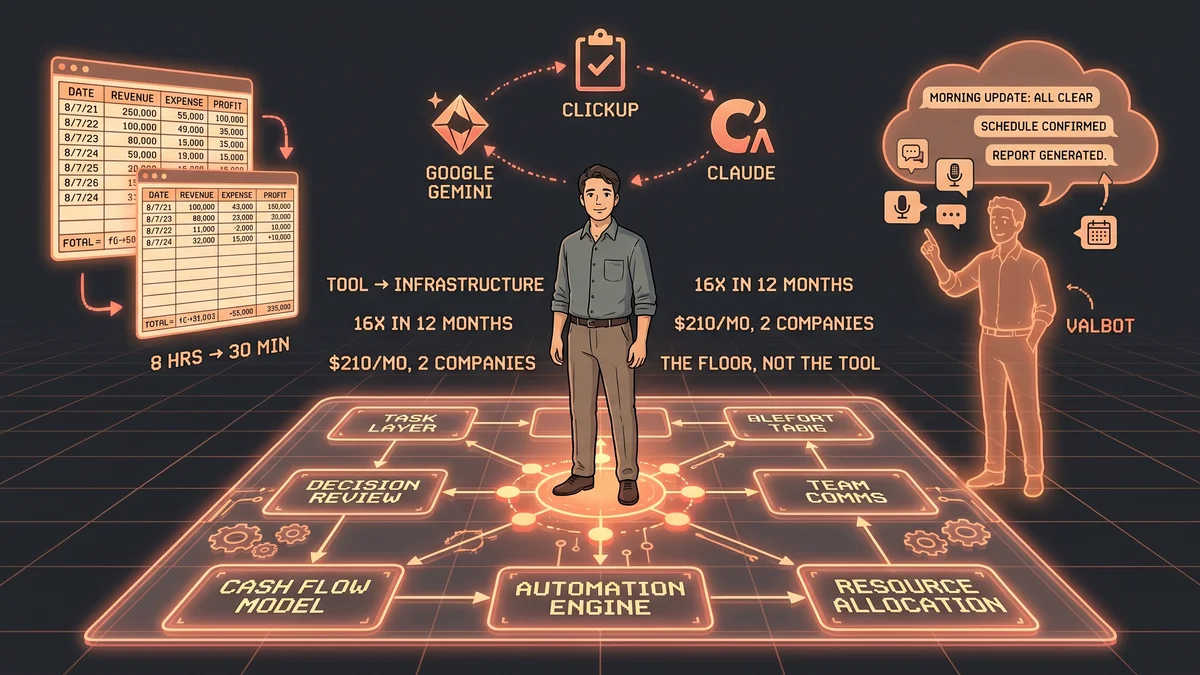
Late 2025 to early 2026: the team added Claude for Excel — a native add-on that works directly inside spreadsheets. The same 8-hour model now takes 30 minutes. Not because Charlie got faster, but because the work changed shape.
The new workflow: type a question into Claude for Excel specifying which tabs hold the data, ask for the model. Receive a near-complete cash flow statement. Spend 30 minutes checking it instead of 8 hours building it.
That’s a 16x improvement in 12 months, from the same analyst, doing the same work.
Charlie didn’t soften what that means. He laid out the business logic plainly: his company can now either keep the same headcount and quintuple output, or cut staff and produce 2x what they did before. He noted that option B is usually more economically efficient. Then he kept going to work.
The takeaway: Phase 1 AI adoption (chatbot assistance) and Phase 2 (native tool integration) are not the same thing. The jump from assistant to infrastructure produces gains in a different order of magnitude.
Operations: Two Companies, One Stack, $210/Month
Valentyn Yaromenko (@Yaromen_ko) opened his thread with a clear position: “I hate ‘I replaced McKinsey with a $20 Claude’ posts. Most of them are just people playing with tools and farming likes.”
Then he described what actual production AI ops looks like.
He runs two companies on a three-layer stack. Google Workspace AI — Gems configured as virtual C-level advisors, NotebookLM, AI Studio — handles decision pressure-testing. Every major decision gets reviewed by the AI layer before it goes anywhere. No exceptions.
ClickUp Superagents handle task and project management. His team has used ClickUp for 8 years, which meant when Superagents launched, the agents already had full historical context. That context advantage wasn’t an accident — it was the result of 8 years of centralized tooling paying off in a way nobody anticipated.
The most unusual part: Valbot. His digital twin. An AI agent that now runs his task layer and communicates directly with his team — not answering questions, but participating in operations as a proxy for him. The third layer, Claude + MCP, is rolling out to technical and go-to-market teams with full stack integration.
The takeaway: The advantage goes to whoever spent years building context in a single system. AI didn’t create his edge — it amplified what was already there.
The Pattern
Charlie’s work moved from construction to review. Valentyn’s operations moved from him to a system that runs without him in the loop for every decision.
Both describe the same underlying shift: AI stopped being the thing they use and became the thing the work runs on. The tasks didn’t disappear — the layer that executes them changed.
That’s what infrastructure means. You stop thinking about the tool because the tool is now part of the floor.