Some tools existed only for people who could afford specialists. A data analyst to pull market research. A developer to build a monitoring system. The work was real, the need was real — but the access wasn’t.
AI changed that equation. Not for everyone, not for every task — but for specific, structured work, the barrier is gone.
Two people found this out in very different domains.
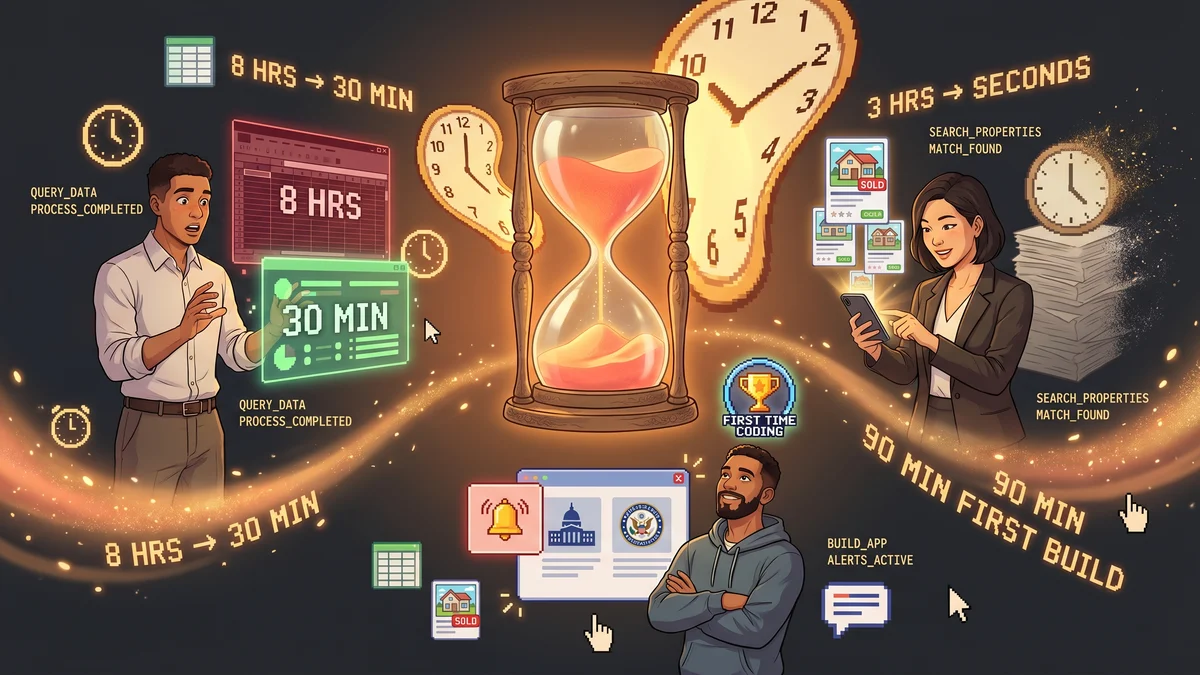
Real Estate: 3 Hours → Seconds
Real estate deals go to whoever gets there first. Literally — faster research means first to qualified deals.
The problem Dipto Barua was solving: his clients were spending 3 hours researching a single property deal. Their competitors had already compressed that to 8 minutes. They were losing deals every week because they couldn’t move fast enough.
He built an AI agent. It searches live market data, remembers every conversation, and answers property questions in seconds. You ask about a neighborhood — it knows the comps, the trends, the context from every conversation you’ve had before.
The agent didn’t just make his clients faster. It leapfrogged the competition entirely. From out-competed to out-competing — not by working harder, but by removing the research bottleneck that was the actual constraint.
What it took: A custom AI agent with live market data integration. No technical background required to use.
The lesson: The bottleneck wasn’t knowledge — it was access speed. When research moves from hours to seconds, the constraint disappears.
Civic Tech: Never Coded → Working App in 90 Minutes
Alexander McCoy needed a monitoring tool. He wanted to scan Twitter and Bluesky for posts from members of Congress and state governors on specific topics, then fire alerts to a Slack channel and his email when something matched.
The kind of tool that normally requires a developer, a few days of back-and-forth, and a budget for their time.
Alexander McCoy had never written a single line of code in his life.
He opened Claude Code and started describing what he wanted. The conversation went back and forth — he’d describe a feature, Claude would build it, he’d test it, they’d adjust. 30 minutes to build. 60 minutes to install and debug. 90 minutes total.
The app now runs on a configurable schedule, filters out false positives, tags posts with elected official context, and routes alerts to a dedicated Slack channel. McCoy is using it — not as a demo, as an actual organizing tool.
When someone asked what prompts he used, he corrected the framing: it wasn’t a single prompt. It was a conversation. He said what he wanted; Claude built it. He found problems; they fixed them. The kind of iterative process that used to require a developer is now available to anyone who knows what they want and can explain it.
What it took: Claude Code and a conversation. No technical background. No prior coding.
The lesson: The barrier to building wasn’t the work itself — it was the specialized language. When AI handles the translation from intent to code, the work becomes available to anyone with a clear problem.
The Pattern
A real estate tool builder removed a 3-hour research process. A political organizer removed the “you’d need a developer for this” gate.
Different industries, different use cases, different outcomes — but the same underlying shift. Tasks that required specialists don’t always require specialists anymore. Some work moved back into the hands of the person who actually needed it done.
Neither case involved a technical background. Neither involved a team. Both involved someone who knew what the problem was, found that AI could solve it, and showed up.
That’s the actual unlock: not the tools, but the willingness to describe the problem.