TL;DR
- Sales rep generates 5 complete sales documents from a folder of notes — in about 5 minutes
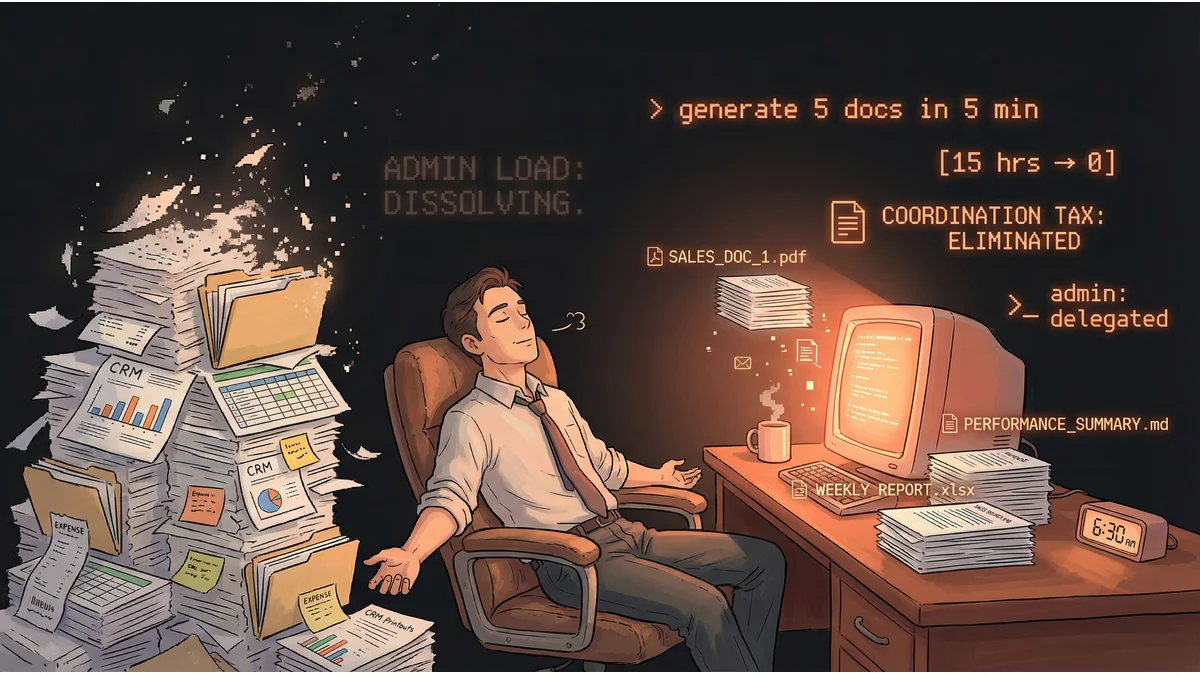
- Another sales professional eliminated 15 hours per week of CRM scraping, expense filing, and reporting
- HR manager pulls performance data from 5 separate systems and generates monthly reports in 2 minutes
- Best for: sales teams and managers spending more time gathering information than using it
- Key lesson: the bottleneck wasn’t the decisions — it was the prep work before the decisions
The pattern isn’t that AI replaced these people. It’s that AI replaced the part of their job they were doing instead of their actual job.
Every knowledge worker carries a second job hidden inside their first one. The sales rep who spends three hours prepping documents before a client meeting. The manager who spends Friday afternoon pulling reports from four different systems. The HR lead who manually compiles employee data before writing a performance summary.
This is the coordination tax — time spent gathering, organizing, and formatting information that someone else will eventually use to make a decision. Three people handed it to AI. Here’s what happened.
The Sales Rep Who Stopped Writing Docs
@KyleLogiks works in sales. After every client call, the post-call work begins: executive summary, business case, pricing deck, mutual action plan, pricing spreadsheet. Five documents. Each one takes time. Together, they take hours.
He built a simple workflow: drop everything from the call — notes, attachments, transcripts — into a folder. Claude asks a few clarifying questions. Then it generates all five documents.
“All I do is drop all my notes, attachments, call transcripts etc into a folder and answer a couple questions.”
Time to five complete sales documents: roughly 5 minutes.
The work didn’t disappear — it got batched and delegated. The sales rep still provides the raw material and answers questions. Claude handles the formatting, structure, and language that would otherwise take hours. The human time investment: minutes.
The Sales Rep Who Got 15 Hours Back
@Stephen19718352 counted what admin actually cost him: about 15 hours per week, all spent gathering and organizing information.
Specifically: pulling customer data, emails, and notes from a CRM to generate opportunity reports. Filing and submitting expenses (with human sign-off still in place). Running weekly analytics to flag significant changes in sales numbers. Processing meeting transcripts into shared notes for ongoing reporting.
Each task was low-judgment, high-time. Each was exactly the kind of work AI handles without complaint.
“15 hours is quite a bit of time — that’s all time spent gathering and organising information.”
With Claude handling the stack, that time went back. The human work that remains: reviewing what Claude surfaced, signing off on expenses, acting on the analytics. The actual judgment calls. The job.
The HR Manager Who Gets Reports in 2 Minutes
@reallyoptimized manages people. Monthly performance reports used to mean pulling data from everywhere — invoices, chat logs, email metrics, phone records, timeclock punches — and making sense of it.
Five data sources. One employee. Multiply by however many people are on the team.
The new workflow: load all of it into Gemini. Ask who the top performers are. Get a consolidated report in minutes.
“I can load in invoices, chats, email numbers, phone data, timeclock punches… Gemini can then determine the best performers easily.”
Two minutes per month, down from hours of manual cross-referencing. The manager still makes the calls — who gets recognized, who needs support, how to act on what the data shows. The AI does the grunt work of aggregating and summarizing.
The Pattern
All three handle different jobs. All three share the same underlying problem: meaningful work buried under information logistics.
The coordination tax isn’t unique to sales or HR. It shows up anywhere a professional spends more time preparing data than using it. Pulling, formatting, consolidating, translating — work that exists only to support the real decision, but consumes the same hours.
AI is good at the logistics. It’s less good at the judgment. These three cases show what it looks like when that boundary gets drawn correctly: AI takes the 15-hour prep job, the human takes the 5-minute decision.