TL;DR
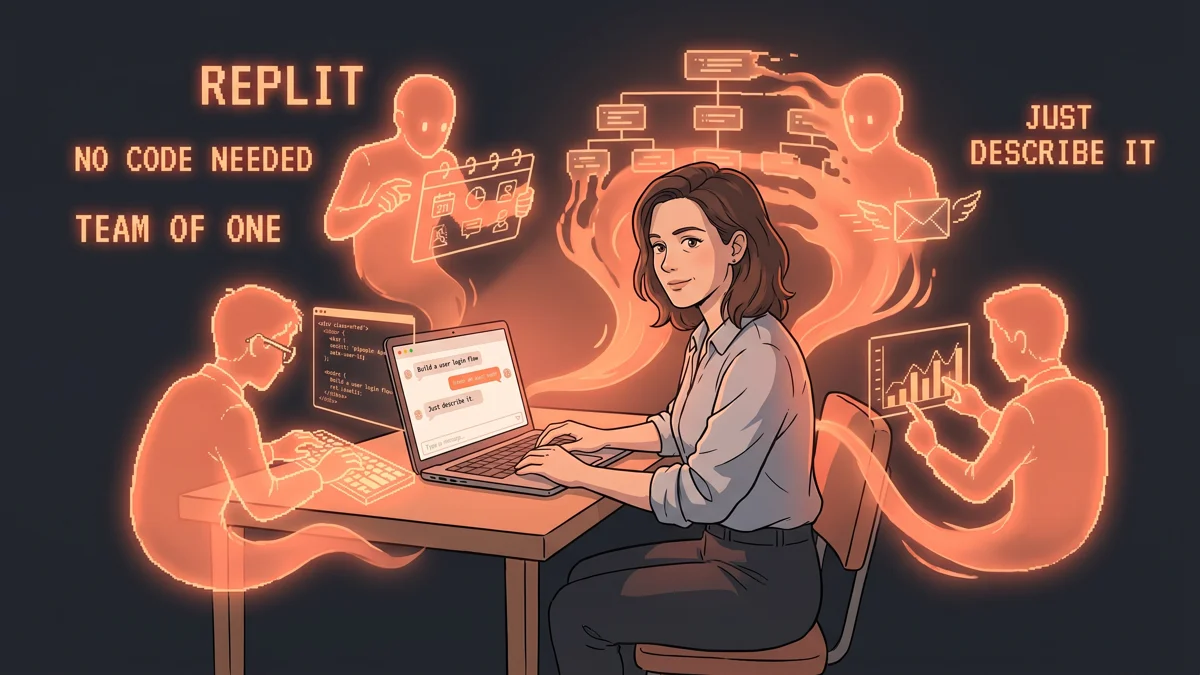
- A nonprofit consultant with zero coding experience built a software platform alone using Replit AI
- A solo developer built a vibe-coding platform in 4 months, hit $1.5M revenue in its first month, sold to Wix for $80M
- Both cases come from Fortune’s May 2026 report on AI-enabled solopreneurship
- Key pattern: AI didn’t just reduce overhead — it made the team unnecessary from day one
- Best for: service business owners who assume they need a team to build software
Two years ago, both of these businesses would have required a team to exist. A product manager. Developers. A QA person. Maybe a designer. Today, neither has any of them.
This is the part of the AI story that gets undersold: it’s not that AI helps small teams work faster. It’s that some businesses no longer need a team to get started.
Dana Snyder: The Nonprofit Consultant Who Built Software Alone
Dana Snyder runs Positive Equation, a nonprofit consultancy. Her clients are small nonprofits — the kind too small to afford a human consultant, which describes 93% of U.S. nonprofits.
Her idea: build an AI-powered software platform that could guide a nonprofit through monthly giving program development on demand. No consultant on the other end. Just a system that generates fundraising strategies, donor communication plans, and program names — then handles podcast production and keynote creation on top of that.
The problem: Snyder has no technical background. She couldn’t hire a development team. And the organizations she was trying to serve couldn’t afford the kind of platform she had in mind.
So she built it herself. Using Replit’s AI coding tools, she spent six months building the platform without writing a line of code herself. She described her goal simply: “If we can use AI for the manual, repeatable tasks, we then have more brainpower to spend on ideating.”
When the platform launched, Snyder remained the only full-time employee. That’s not a temporary state while she scales. That’s the model.
Takeaway: The ceiling on what a solo non-technical founder can build has moved. Replit didn’t give Snyder the ability to code — it made the question of whether she could code irrelevant.
Maor Shlomo: The Aspirational Ceiling
If Snyder represents what’s now accessible to a non-coder, Maor Shlomo represents what’s possible at the extreme end.
Shlomo is a developer — but he’s the kind who previously spent seven years building a VC-backed company to over 100 employees. He knew how to scale. He also knew how much it cost.
For Base44, he took a different approach. He built the product solo in about four months — a vibe-coding platform that lets non-technical users create full applications through text prompts, including databases, authentication, integrations, and email. He bootstrapped it. No co-founders. No funding.
One month after launching in February 2025, Base44 had ~$1.5 million in subscription revenue and 10,000 users. By May, it had 250,000 users and $189,000 in monthly profit. In June 2025, Wix acquired it for $80 million in cash.
The 8-person team that existed by then received $25 million in retention bonuses. The product that generated the exit value was built by one person.
Takeaway: Shlomo’s previous company needed 100+ people and seven years to reach scale. Base44 reached an $80M outcome in months. The constraint wasn’t the AI. It was his time.
The Pattern
Dana Snyder built for a market that previously couldn’t afford what she was offering. Maor Shlomo built a product that previously required a team to exist. Both did it alone.
The common thread isn’t the tools or the industry. It’s the starting assumption: what if I don’t need a team to build this?
That question used to have an obvious answer. Increasingly, it doesn’t.