TL;DR
- Anthropic lawyer (zero code) built legal review system, cut turnaround 80%
- Car buyer used Claude Desktop to negotiate $2K below MSRP (20 dealer emails)
- Free AI fitness coach replaces $500/month personal training
- Best for: Non-technical people wanting production AI workflows
- Key lesson: You don’t need to code. You need to know what work needs doing.
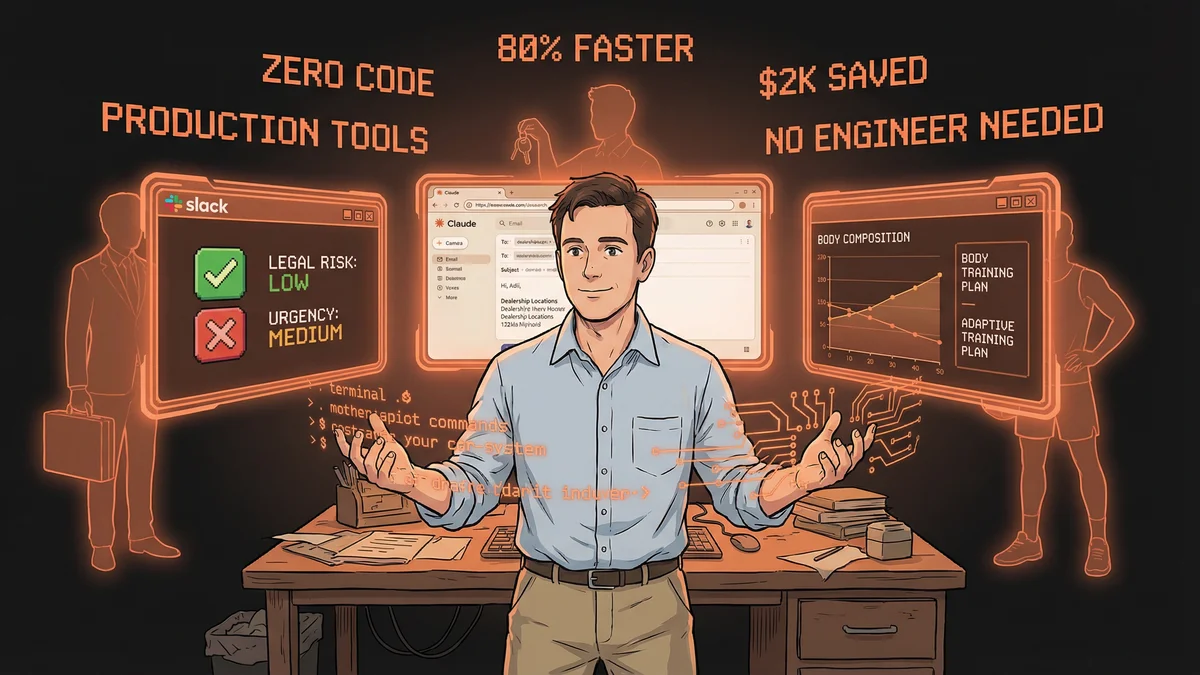
Three people with zero coding experience built AI systems that do real work. One saved $2,000 on a car. One cut legal review time by 80% at a $380 billion company. One replaced a $500/month fitness coach. Here’s how.
The Lawyer Who Coded Legal Judgment
Mark Pike is Associate General Counsel at Anthropic. He had zero coding experience. He also had a problem: every product launch was held up by 2-3 days of legal review back-and-forth.
Marketing would submit landing pages, blog posts, emails, push notifications the night before launch. Legal would flag issues. Marketing would revise. Legal would review again. Repeat.
The old process took 2-3 days per launch.
Pike didn’t ask engineering to build a solution. He built it himself using Claude Skills.
What he built:
- Self-serve legal review tool pinned in Slack
- Marketing pastes content in
- AI checks against Anthropic’s actual legal guidelines (stored as Skills)
- AI flags issues with risk levels (low/medium/high)
- AI tells you exactly how to fix each issue
- Pike reviews final version (only high-judgment calls)
Result: 80% of grunt work automated. Legal team became “judgment layer” instead of checklist executors.
The innovation wasn’t automation. It was expertise as code. Pike codified his review criteria — what counts as an overstated claim, what needs a trademark symbol, what creates liability — into a Claude Skill. Not just instructions. Executable judgment.
One community member said it best: “Pike stored his review criteria as a skill — basically codified judgment, not just instructions. That’s the difference between ‘AI that does tasks’ and ‘AI that thinks like your best reviewer.’”
What got replaced: 2-3 days of back-and-forth, manual checklist execution What Pike still does: Legal judgment calls that actually require a lawyer Tools used: Claude Skills, Slack Coding required: Zero
The Car Buyer Who Didn’t Call a Single Dealer
@nahtnam wanted a 2026 VW Golf R at $3,000 below MSRP. In California, where dealers sell Golf Rs above MSRP.
He tried calling dealerships. It sounded miserable. He gave up.
Then he tried Claude Desktop.
The prompt:
“Find VW dealers in California. I want a 2026 Golf R, $3,000 off MSRP, ready to buy immediately.”
What Claude did (autonomously):
- Found VW dealers in California
- Tracked down general managers and sales managers (not generic info@ emails)
- Drafted ~20 personalized emails to decision-makers
- Email template included urgency: “First dealer to hit my number gets the business. Email only — once we agree on a number with a written purchase order I’ll come in to close.”
@nahtnam hit send on all 20 emails without really reviewing. Then waited.
Most dealers said no. Some ghosted. One said they’d never sold a Golf R under MSRP.
One dealer said yes.
Final price: $2,000+ below MSRP.
When @nahtnam called local dealers with the offer to see if anyone could match, they thought he was lying. “Which dealer? If you don’t buy it right now, I will.” One dealer said “Forget $2,000 under, we could do $2,000 OVER.”
Why it worked: Claude removed the friction that prevents outreach at volume. 20 personalized emails to the right people at 20 dealerships. @nahtnam was never going to do that himself. But Claude doesn’t get tired and doesn’t mind boring work.
What got replaced: Cold-calling 30+ dealerships (which he never would have done) What @nahtnam did: Hit send 20 times, then closed one deal Tools used: Claude Desktop, Chrome, Gmail Coding required: Zero
The Fitness Coach You Already Own
Most people pay $500+ per month for personalized fitness coaching. @FinFreedom414 pays $0.
The setup:
- Buy a body composition scale that syncs to your phone
- Prompt Grok to act as your personal trainer
- Provide context: goals, injuries, training frequency, current body comp data
The weekly loop:
- Upload new body composition data
- AI adjusts the plan based on results:
- Body fat down? → Calories adjusted
- Strength stalling? → Training volume changed
- Weight dropping too fast? → Nutrition tweaked
This isn’t a static meal plan or generic workout template. It’s adaptive programming based on real data.
The cost: Free vs. $500/month human coach
The difference from one-shot prompts: Most people ask AI for a workout plan once and never update it. This is a feedback loop. AI doesn’t just generate a plan — it adapts based on your weekly data.
What got replaced: $500/month personalized coaching What the human does: Upload data weekly, follow the adjusted plan Tools used: Grok, body composition scale Coding required: Zero
The Pattern: Domain Expertise + AI = Production Tools
All three people knew what work needed doing. They didn’t know how to code. They used AI to build the solution anyway.
- Pike knew which legal checks slow down launches → codified those checks as a Skill
- @nahtnam knew outreach at volume beats one phone call → let Claude do 20 emails instead of 1
- @FinFreedom414 knew coaching works when it adapts to data → built a weekly feedback loop
The companies that win the next five years won’t be the ones with the most engineers. They’ll be the ones where domain experts can turn their expertise into executable systems.
No translation layer. No requirements doc. No convincing an engineering team it’s worth scheduling.
You know the problem. AI builds the fix.
That’s the unlock.