The conventional wisdom around AI and business looked like this: automate the work, reduce the headcount, cut costs, improve margins. It was the obvious play. It turns out it mostly didn’t work.
A new Gartner study put numbers on what a lot of companies are quietly discovering. Three stories show what separating the winners from the rest actually looks like.
The Data: 80% Cut Workers. Most Got Nothing.
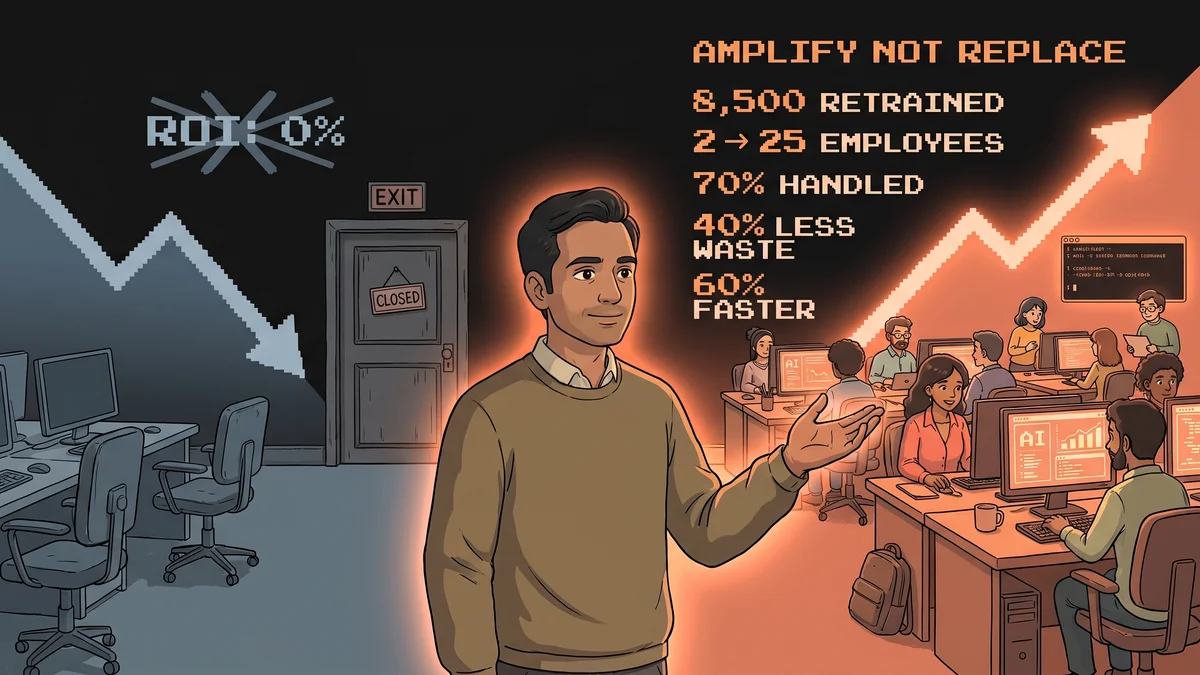
Gartner surveyed more than 350 executives and found that about 80% of companies that piloted AI had already reduced their workforce. Forty-nine thousand AI-related layoffs were recorded in 2026 alone — nearly matching all of 2025’s total.
The striking part: none of it correlated with better returns.
Workforce reduction rates were nearly identical between high-ROI companies and low-ROI companies. Gartner’s VP analyst, Helen Poitevin, was direct: “Looking only at layoffs is shortsighted in terms of getting value from AI.”
The companies that came out ahead used AI to enhance what their workers could do — not to subtract workers from the equation. The layoffs, she said, appear to be mostly exploratory: companies testing the idea rather than executing a coherent strategy.
Takeaway: Cutting headcount is not an AI strategy. It’s a budget decision dressed up as one.
IKEA: 8,500 at Risk, Fastest-Growing Revenue Stream
In 2023, IKEA automated roughly half of its phone call operations. Around 8,500 employees were at risk of redundancy.
IKEA didn’t let them go. Instead, the company retrained them as interior designers — using AI tools that recommend product placements within homes. A job that previously required significant training and showroom time became something these workers could do with AI assistance, at scale.
That retrained role became the fastest-growing revenue stream in the company. The same people who were about to lose their jobs ended up driving new revenue.
Robert Half research found that 29% of companies that laid off workers for AI had already quietly rehired them — the “boomerang” trend, because companies eventually realized they still needed the human judgment they’d offloaded.
Takeaway: IKEA didn’t ask “who can AI replace?” They asked “what could our people do if AI removed the ceiling?” That’s a different question with a different answer.
Amarra: From 2 Employees to 25 — With AI on the Team
Amarra is a New Jersey manufacturer and wholesaler of special-occasion gowns. They started using AI in 2020, when the company had two employees. Today they have 25, serving over 800 independent retailers worldwide.
The AI handles the operational load that would otherwise block growth. ChatGPT drafts product descriptions at 60% of the previous time cost. An AI inventory system reduced overstocking by 40% by predicting demand from historical and seasonal data. AI chatbots now handle 70% of customer inquiries.
Cofounder Kunal Madan described the motivation plainly: “enhance efficiency and elevate the customer experience.” Not shrink the team — scale what the team can deliver.
That’s the difference. Amarra didn’t use AI to run the same business with fewer people. They used it to run a bigger business with more people than they could have otherwise supported.
Takeaway: AI absorbed the work that would have constrained growth. The humans scaled the parts AI can’t do: relationships, judgment, new markets.
The Pattern
Three different companies, three different sectors, one consistent finding. The AI-driven layoffs didn’t pay off. The AI-driven amplifications did.
The companies that win aren’t asking “what can AI cut?” They’re asking “what does AI make possible that wasn’t possible before?” IKEA turned at-risk employees into a new revenue stream. Amarra grew from 2 people to 25. The 80% who just cut headcount are still looking for the ROI.
The question isn’t whether to use AI. It’s what you’re trying to build with it.