TL;DR
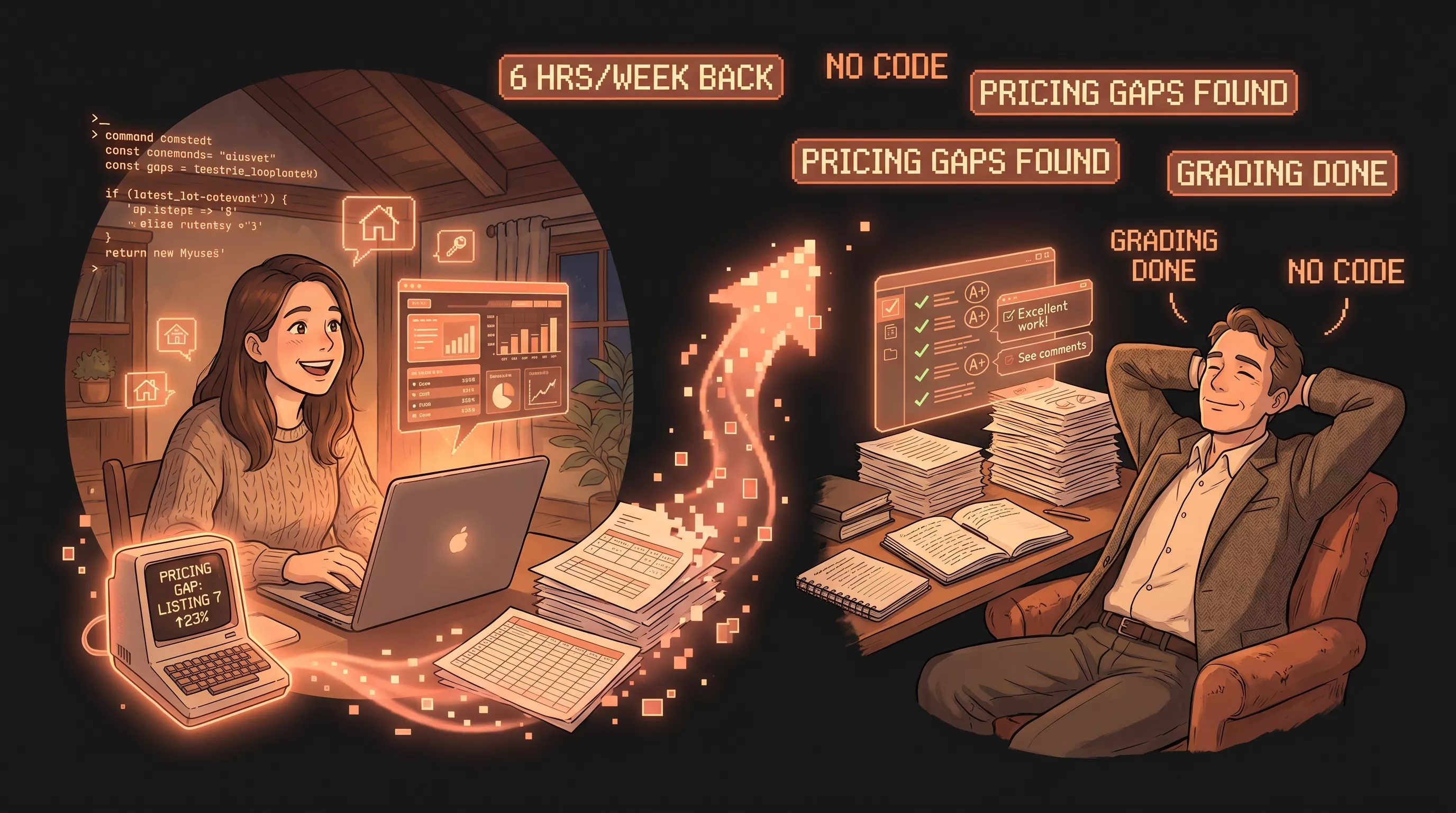
- A short-term rental platform let property managers ask AI questions about their bookings in plain English — no dashboards required
- Teachers using AI grading tools reclaim 5.9 to 7 hours every week
- Neither group learned to code. They described the problem. The AI solved it.
- Best for: Business owners and professionals losing hours to admin and reports
- Key lesson: The jobs that drain you most are often the first ones AI can take off your plate
The work that never made it into the job description is exactly what AI is eating first.
Nobody became a short-term rental host to run pricing analysis reports. Nobody became a teacher to spend Sunday nights grading essays. That administrative layer — the routine analysis, the pattern-matching, the paperwork — is where AI is landing hardest in 2026.
Two industries, two very different use cases. Same outcome.
Property Managers: Asking the Question Instead of Running the Report
Hospitable is a property management platform used by short-term rental hosts. In April 2026, it became the first company in its industry to launch a Model Context Protocol (MCP) server — a technical layer that connects AI assistants directly to live property data.
What that means in practice: a property manager with 12 listings on Airbnb can now open Claude or another AI assistant and type “which of my listings has the biggest pricing gap this weekend?” and get a specific answer. No pulling data. No building a spreadsheet. No logging into three different dashboards.
Pierre-Camille Hamana, Hospitable’s CEO, has been public about the investment: the company signed a $250,000 agreement with OpenAI and increased AI spending by 50% since late 2025 — the equivalent of adding three full-time employees, but focused entirely on automating the analysis work that hosts used to do manually.
The platform now handles weekly booking summaries, pricing inconsistency detection, and occupancy gap identification. Tasks that required a spreadsheet and 45 minutes now take a conversation.
The typical Hospitable user isn’t a developer. They’re a host managing a few properties, already stretched thin. The bet is that if AI can absorb the analytical overhead, they spend more time on the actual business — guest experience, property maintenance, growing their portfolio.
Teachers: Six Hours a Week Back
A different industry, a clearer number. A 2026 survey from Gallup and the Walton Family Foundation found that 60% of educators are now using AI tools regularly. Among those using AI-assisted grading platforms specifically, the weekly time savings run between 5.9 and 7 hours.
Over a 36-week school year, that’s roughly six full weeks of time returned to actual teaching.
Tools like MagicSchool and Gradescope handle essay feedback, rubric application, and formative assessment at scale. A teacher running 120 student essays through an AI grader gets structured feedback in minutes instead of hours. They can review, adjust, and return grades in a fraction of the time.
The limitation is real and worth naming: AI grading works well for structured assessments. For nuanced creative writing or complex argumentation, human judgment still matters. But for the volume of routine feedback that accumulates in any classroom — weekly quizzes, reading responses, structured paragraph writing — the pattern-matching is solid enough to trust.
Teachers who’ve adopted the tools consistently describe the same shift: less Sunday grading, more preparation. Less reactive marking, more proactive teaching.
The Pattern
Property managers and teachers don’t share an industry, a customer, or a business model. What they share is a category of work: analytical tasks that follow a pattern, repeat weekly, and consume time that could go toward the actual job.
AI didn’t need to understand property management or pedagogy to start replacing those tasks. It needed to handle pattern recognition, data aggregation, and structured output — which it does well.
Both groups found the same thing: the work they were drowning in wasn’t the job they signed up for. And it turns out that’s exactly where AI gets to work first.