Most businesses compete for the same leads from the same sources: LinkedIn, trade databases, Google Maps. Two builders decided to look somewhere else — in data that was always technically public, just practically impossible to process by hand.
Both built pipelines. Both found leads their competitors aren’t seeing.
The Obituary Scraper
Who: A marketing operator who runs AI pipelines for three real estate companies. He won’t reveal all his methods, but shared one example publicly.
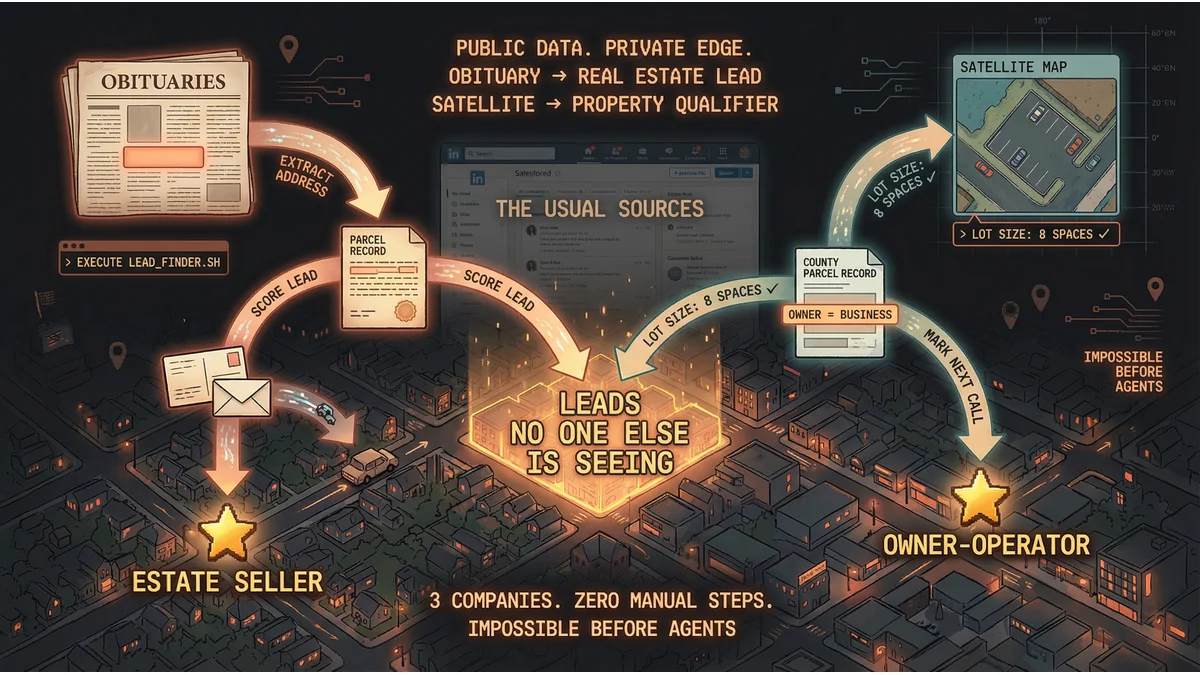
The pipeline: When someone dies and leaves behind a property, that property often goes to market. The problem is timing — identifying potential sellers before they’ve already listed means reaching them before the competition. His Hermes + Openclaw pipeline monitors obituary notices, extracts address clues from the text, runs a lead scorer against client buy criteria, and automatically triggers postcard and email outreach. When field agents are already driving nearby, the system routes them for a drive-by.
Each step was theoretically doable before. Scraping obituaries: yes. Parsing addresses from text: yes. Scoring leads: yes. Routing field agents: yes. Doing all five reliably, in sequence, at scale, automatically: that required an agent pipeline. He runs it for three companies. He says the leads this surfaces were “long-tail marketing that was impossible before these tools.”
The takeaway: The data source isn’t secret — obituaries are public. The edge is processing them fast enough to be first.
The Satellite Qualifier
Who: A local service business owner building his first client pipeline using AI. His target: small businesses where the owner also owns the property.
The pipeline: He built a system that pulls small business listings in a geographic area, links each business to county parcel records, downloads the satellite image of the property, and runs aerial classification to estimate lot size. The final filter: business owner = property owner, lot size 1–30 spaces. Contacts that pass the filter get marked “call next.”
Why does the satellite image matter? Because his business involves the physical property — and satellite imagery lets him pre-qualify prospects on lot characteristics before ever making contact. He documented the whole process and shared it publicly. He also flagged the limitation honestly: aerial classification sometimes misreads partial lots, so humans still do a final review on edge cases.
The takeaway: Three public sources — business listings, parcel records, satellite imagery — combined into one qualifier no competitor is running manually.
The pattern
Both pipelines share the same structure: public data, multi-step matching, automated outreach only to contacts that pass all filters. Neither required proprietary data. Neither required code expertise. Both required knowing what to look for and building an agent to find it.
The companies seeing the same leads in the same databases are competing on margin. These two are competing on access.