TL;DR
- Small business bought 18 months ago ran into bank covenant trouble 2.5 months in
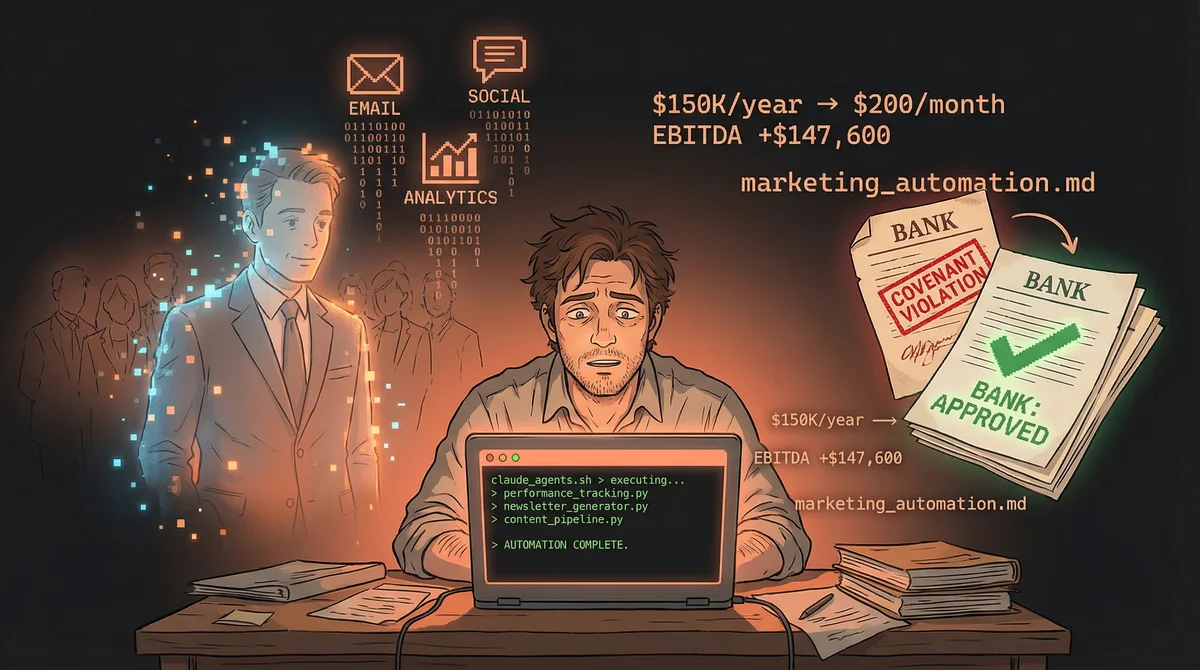
- Owner automated marketing with Claude agents: performance tracking, newsletters, daily content
- AI handled majority of marketing head’s work after two weeks of testing
- Terminated $150K/year position, kept junior marketer as backup
- $150K salary savings added to EBITDA calculation, restored bank compliance
- Cost: $200/month for Claude vs $150K/year for the position
- Key lesson: When the budget says “fire someone,” sometimes you can fire the position instead
A friend bought a small business 18 months ago. Two months ago, the bank said they might take it back. He saved it by deleting a $150,000 job that AI now does for $200 a month.
Omar caught up with this friend over the weekend. The conversation wasn’t about growth strategies or expansion plans. It was about survival.
The Crisis
Eighteen months into owning the business, the lender came calling. The covenant wasn’t being met — the company wasn’t generating enough EBITDA coverage relative to the debt. In plain English: earnings weren’t high enough to satisfy the bank’s minimum requirements.
The message was clear: fix the numbers, or we’re coming for the keys.
The Search for Coverage
The owner needed to add earnings to the pro-forma covenant calculation. Fast. He started looking at every repetitive task across the business, asking a question most owners avoid: what here could disappear?
The marketing department caught his attention. Not because the work was bad — because it was repetitive. Performance tracking across media channels. Weekly newsletter production. Daily content creation.
All necessary. None of it creative genius. Most of it pattern-based execution.
He started experimenting with Claude agents.
Building the Agents
The owner wasn’t trying to build the future of marketing automation. He was trying to buy time with the bank.
He built Claude agents to handle three core responsibilities:
- Marketing performance tracking across channels — pulling data, identifying patterns, flagging anomalies
- Weekly newsletter production — writing, formatting, scheduling based on campaign calendars and past performance
- Daily content creation — social posts, blog updates, email sequences
The agents had access to the same tools the marketing head used. They followed the same playbooks. The difference: they didn’t need weekends, vacation days, or health insurance.
Testing
He ran the agents alongside the existing team for two weeks. A little intervention required, but nothing breaking. The agents weren’t perfect — they needed guardrails and occasional corrections — but they were consistent.
After two weeks, the owner made the call.
The Decision
He let the head of marketing go. Kept the junior on staff as a fallback and safety net. The agents took over the majority of the department’s work.
The $150,000 salary came off the books. That money went straight back into the EBITDA calculation for the bank covenant.
Two and a half months after the crisis started, the business was back in good standing with the lender.
The Math
Old structure:
- Marketing head: $150K/year
- Junior marketer: (retained)
- Total marketing software/tooling: (unchanged)
New structure:
- Claude subscription: $200/month = $2,400/year
- Junior marketer: (retained, now AI-assisted)
- Same software stack
Net savings: $147,600/year
Those savings didn’t go into a bonus or expansion fund. They went into keeping the bank from foreclosing.
What the Owner Didn’t Say (But Should Matter)
This wasn’t a celebration story for the owner. It was a “the business survived” story.
He didn’t eliminate the position because he wanted to — he did it because the alternative was losing everything. The head of marketing didn’t leave because of performance issues. They left because the numbers didn’t work and AI offered a lifeline.
The agents aren’t better than the person they replaced. They’re cheaper and they don’t stop working when the market gets rough.
The Bigger Question
Omar’s friend isn’t the only business owner having this conversation. Replies to the thread surfaced a pattern: AI-driven layoffs won’t happen during growth phases — they’ll happen during the next recession.
Why? Because you need people to scale when times are good. But when revenue drops and lenders start calling, the math changes. If you can cut 60-90% of labor costs with agents and survive the downturn, you do it.
And here’s the uncomfortable part: once an owner experiences running leaner with AI, hiring doesn’t fully snap back when times improve. The new baseline is “what can we do with fewer people?”
That’s not a prediction. It’s already happening.
What This Means for Marketing Roles
If your marketing job is primarily:
- Tracking campaign performance across platforms
- Writing newsletters from templates and past campaigns
- Producing daily social content following brand guidelines
You’re in the automation crosshairs. Not because you’re bad at it — because it’s pattern-based work that AI can replicate for $200/month.
The roles that survive are the ones that require:
- Strategic repositioning based on market shifts
- Creative direction that breaks existing patterns
- Relationship-building that depends on human judgment
- Cross-functional leadership that AI can’t orchestrate
The junior marketer kept their job. Why? Because they’re the human in the loop — the one who intervenes when the agents drift, who handles edge cases, who adds judgment where templates fail.
The Reality Check
This story isn’t “AI is amazing for business owners.” It’s “AI saved a business that was about to fail, and someone lost their job in the process.”
The $150K position didn’t disappear because it was useless. It disappeared because the business was in crisis and the math forced a choice.
For the owner: survival.
For the marketing head: unemployment.
For the bank: covenant compliance.
For the junior marketer: a very different job than they signed up for.
For everyone watching: a preview of what happens when the next recession hits and balance sheets matter more than headcount.
The Uncomfortable Truth
AI didn’t make this business more profitable. It made it survivable.
The covenant crisis forced a decision most owners delay: what happens when you can’t afford the people doing necessary work?
The answer used to be: cut the work or lose the business.
Now the answer is: automate the work and cut the person.
That’s a better outcome for the business owner. It’s a worse outcome for the labor market. And it’s not a one-time story — it’s the beginning of a pattern that accelerates every time the economy contracts.
The $150K marketing head didn’t stop existing because they failed. They stopped existing because $200/month became a viable alternative at exactly the wrong time for their job security.
When the next wave of businesses hit covenant trouble, this won’t be an anecdote. It’ll be standard practice.