It started as something to do with a free afternoon.
u/Ornery-Essay-7457 had been experimenting with AI video tools on their own projects when they made a short claymation-style product ad almost as a joke. Posted it publicly. Almost immediately, people started asking who made it.
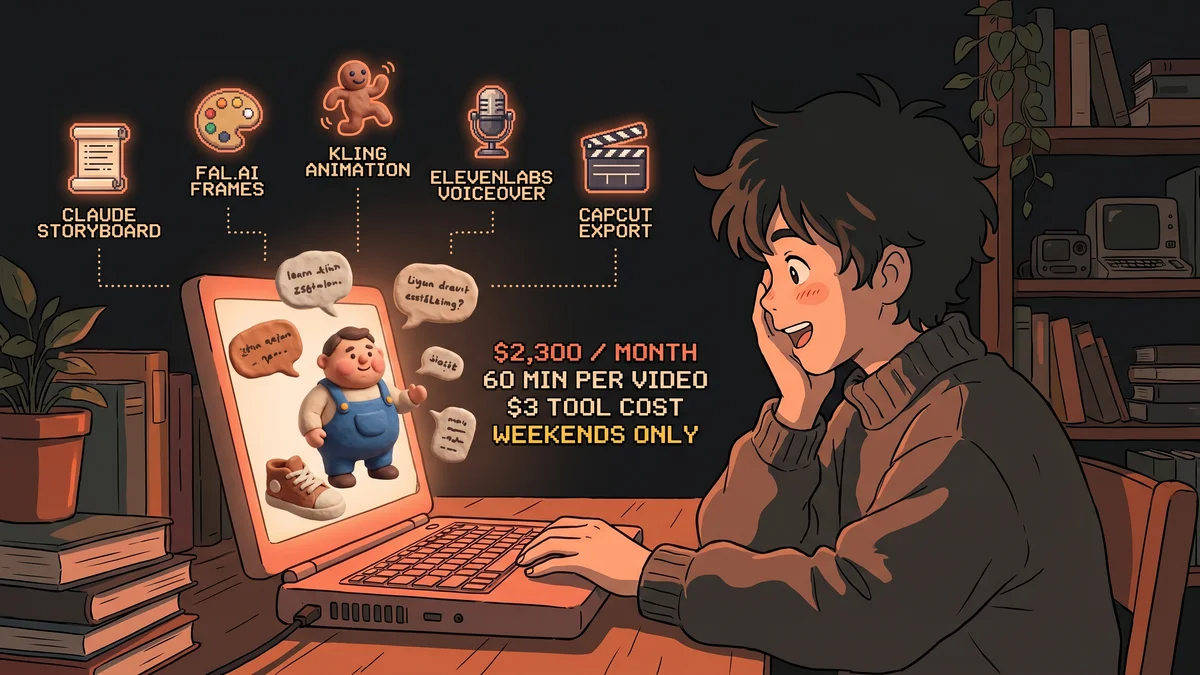
They had no video background. No design training. Just a repeatable workflow built from four tools and a Claude subscription. Nine months later: $2,300 cleared last month, working weekends.
Why Claymation
The aesthetic is the business model.
Small brands run video ads on social feeds that are saturated with the same AI-generated content: sleek product shots, polished animations, stock-footage overlays. The claymation look—chunky, warm, slightly imperfect—stops the scroll because it looks like nothing else in the feed. It reads as crafted rather than generated, even though it’s generated.
Small e-commerce brands and local businesses are the target market. They know they need video. They’re paying agencies $500–$1,000 per video, or they’re not doing video at all. A $150–$300 option that delivers a finished, ready-to-post 9:16 video in 48 hours is a straightforward yes for most of them.
The Workflow, Step by Step
1. Brief collection. Client provides the product and a “vibe”—the tone and feeling they want. That’s the entire brief. It takes five minutes.
2. Storyboard via Claude. Paste the product info and vibe into Claude with a storyboard prompt. Claude generates the full visual sequence: scene by scene, what appears on screen, what the voiceover says, how each shot transitions. This takes about 15 minutes and does the creative work that would otherwise require a human scriptwriter or director.
3. Static frame generation in Fal.ai. Each storyboard scene becomes a prompt for Fal.ai’s image generation. The claymation style is baked into the prompt—specific texture, lighting, and color palette instructions that produce the distinctive look consistently.
4. Animation in Kling. The static frames go into Kling, which animates them. This is where the clay-like movement comes from: the slight wobble, the squash-and-stretch that signals handmade.
5. Voiceover in ElevenLabs. The storyboard script goes into ElevenLabs for voice generation. One pass, one voice, matched to the brand’s vibe.
6. Assembly in CapCut. Scenes, animation, and voiceover assembled in CapCut. Export as a 9:16 vertical video, ready to post on Instagram Reels, TikTok, or Meta Ads.
Total tool cost per video: $2–5. Total time: 60–90 minutes once the system is running.
The Pricing Logic
$150–$300 per video prices against the agency alternative ($500–$1,000), not against the tool cost. Clients aren’t buying a Claude prompt—they’re buying a finished deliverable they don’t have to think about. The margin on each video is high because the inputs are cheap and the output is something the client can put money behind immediately.
The 170 comments on the original Reddit post, almost all of them asking for the full workflow, are a demand signal. There are far more people interested in this service than there are people currently providing it.
What This Is Actually Selling
The claymation workflow is a specific execution of a broader pattern: AI-enabled creative services priced between “too expensive for small business” and “free template they could do themselves.” The gap between $0 and $1,000 is where most small businesses live—and it’s largely unserved because traditional creative services don’t scale down that far profitably.
What changed is the tool cost. When image generation costs cents and animation is a one-click step, a $200 video can be profitable for the producer and affordable for the buyer. That math didn’t exist three years ago.
The claymation aesthetic may not stay novel forever. But the business model—AI-assisted creative services sold to small businesses priced against agency alternatives—is replicable in video, photography, copywriting, and any other medium where AI has pushed the production floor toward zero.