TL;DR
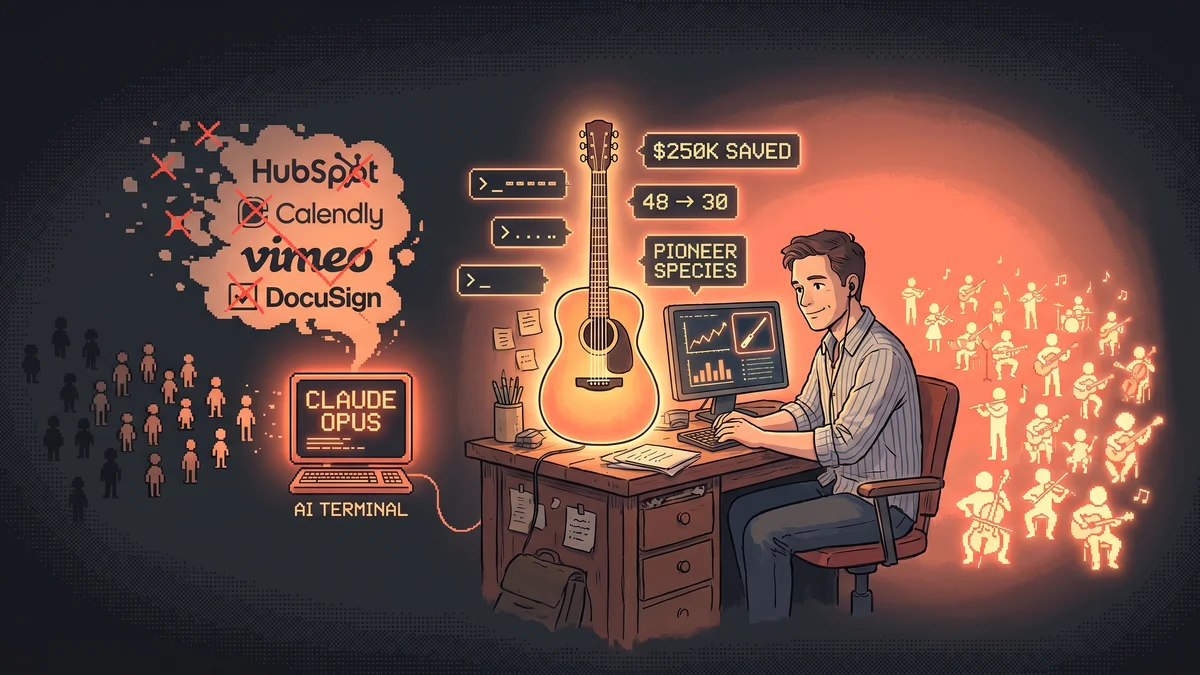
- Online guitar school reduced staff from 48 to 30 using AI tools built on Claude Opus 4.5
- $250,000/year in cost savings — from both headcount and eliminated SaaS subscriptions
- Replaced HubSpot, Calendly, Vimeo, and DocuSign with custom AI tools
- Revenue held flat; results were described as slightly better
- Best for: business owners running lean operations with repeatable workflows
- Key lesson: AI didn’t just automate tasks — it replaced the infrastructure those tasks ran on
Spencer Handley built Sonora Guitar School over seven years. Then one model changed the math.
Spencer Handley had been running Sonora, an online guitar school, since before most people had heard of Claude. Seven years of slow, deliberate growth. By early 2026, he had 48 employees — a full team of sales setters, a sales manager, customer onboarding specialists, and operations staff. The business worked. It just cost a lot to run.
Then he adopted Claude Opus 4.5 in late 2025. By spring 2026, he had let 18 of those employees go.
His revenue didn’t drop. His costs dropped by $250,000 a year.
What He Cut and Why
The headcount reduction wasn’t arbitrary. Handley went after two categories: the sales team and the operational layer.
Most of a 12-person team of sales “setters” — staff whose job was to qualify leads and book calls — were let go, along with their manager. Customer onboarding staff followed. So did operations roles.
But the cuts went beyond people. Handley also eliminated four SaaS subscriptions:
- HubSpot — CRM and pipeline management
- Calendly — scheduling and booking
- Vimeo — video hosting for lessons
- DocuSign — contract and e-signature workflows
Each was replaced with a custom AI tool built on top of Claude. Not a different SaaS product. An AI system that did the same job, shaped exactly to how Sonora worked.
The Shift That Made This Possible
What makes the Sonora story interesting isn’t just the cost savings. It’s what got cut along with the costs.
Most business owners who use AI add it on top of existing workflows. An AI assistant here. An automated email there. The headcount stays. The SaaS stack stays. The AI sits on top.
Handley did the opposite. He used AI to rebuild what was underneath — the CRM logic, the scheduling, the onboarding flows — and discovered that when the underlying system was smarter, the people maintaining the old system became redundant.
A setter’s job is to qualify, book, and hand off. When an AI handles intake, qualification, scheduling, and follow-up in sequence without a human relay, you don’t need the relay team.
The Numbers After Seven Years
Handley didn’t do this in a panic or as a cost-cutting experiment. He had seven years of company history to understand exactly what each role was doing and what could be handed off.
The math at the end of that transition:
- 18 fewer employees
- $250,000 less per year in operating costs
- Four SaaS subscriptions eliminated
- Roughly the same revenue
- Described as slightly better results overall
That last point matters. This isn’t a story about doing less with less. It’s a story about building something tighter and finding it runs better.
The Pattern
Handley is now running AI education classes for other business owners under the name “pioneer species” — a term borrowed from ecology, used for the first organisms to recolonize a disrupted ecosystem.
It’s a useful metaphor for what he did at Sonora. He didn’t wait for the disruption to arrive. He moved first, rebuilt the underlying infrastructure with AI, and came out smaller, cheaper, and — by his own account — performing better.
Seven years to build it. One model to change how it runs.