TL;DR
- Citizen used Claude to write traffic engineer email, got problematic light fixed in days
- Non-coder built company training portal in weeks, boss referred it to VP
- Pattern: AI removes “you need credentials to be heard” gatekeeping
- Best for: Anyone frustrated by bureaucracy or technical barriers
- Key lesson: Most gates aren’t expertise gates—they’re “sounds credible” gates
AI isn’t just making experts faster—it’s making non-experts sound like they belong in the conversation.
Two recent stories show how AI is dismantling credential gatekeeping in civic life and the workplace. Neither person was an expert. Both succeeded because Claude made them sound like one.
The Traffic Light That Got Fixed in Days
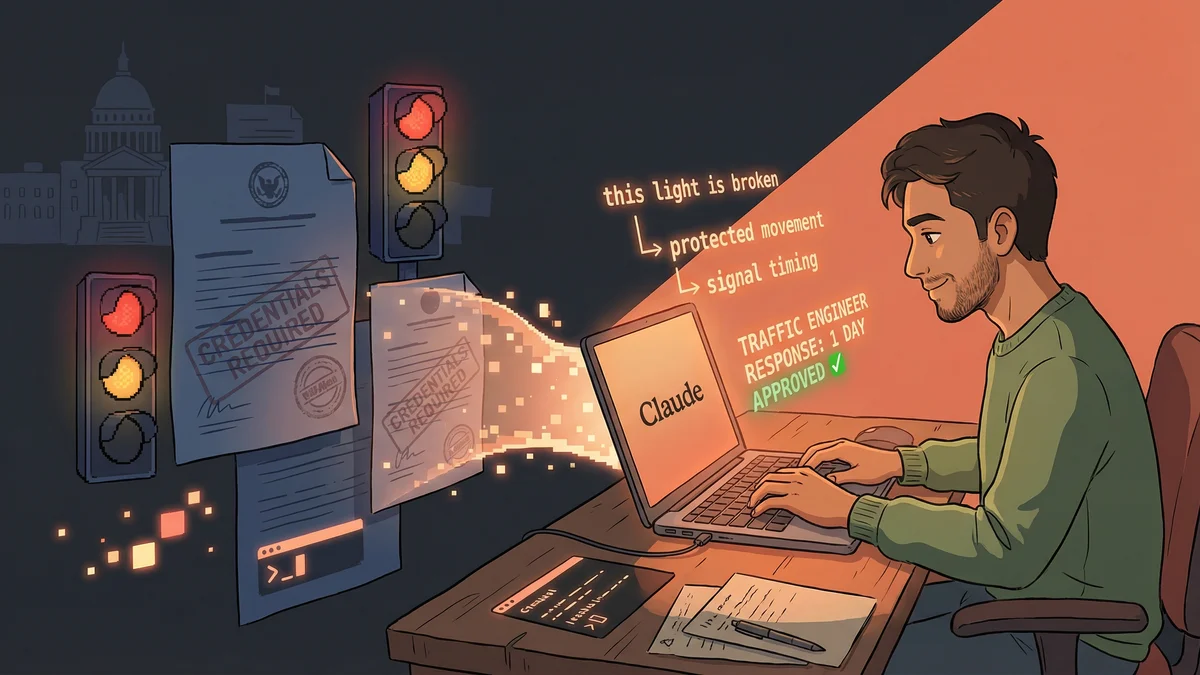
Om Patel had a problem: a right-turn lane with a protected green arrow that flashed red for one second, then back to green. Only 1-2 cars per cycle. Clearly broken.
But how do you get a state traffic engineer to take you seriously when you’re just “some guy who noticed a light is weird”?
Claude as translator. Om used Claude to write an email using proper traffic engineering terminology—“protected movement,” signal timing, cycle analysis. The kind of language that signals “this person knows what they’re talking about.”
State engineer Derek responded within a week. The light was reprogrammed the next day.
Why this worked: As one commenter put it, “most bureaucratic gates are just ‘sounds credible enough’ gates. AI got us a skeleton key.” Om knew the problem. Claude gave him the vocabulary to be heard.
The replies? Thirty-five people saying “I’m doing this too”—for HVAC disputes, city violations, government records requests. The pattern is universal.
The Training Portal That Reached the VP
GunnerMan started a new job two weeks ago. Training materials everywhere: slides, system docs, reference guides. Every time he needed something, he had to hunt through multiple files.
He had zero coding knowledge. So he asked Claude: “Build me an HTML page that consolidates all this training info, with tabs for each topic, matching company branding.”
Claude did it.
The result: A single-page training portal with a tabbed interface, company-branded design, all materials in one place. His boss was astonished. Within days, it was referred to the company VP as “a better and more streamlined way of training new staff.”
“I don’t even know how to code,” GunnerMan wrote. “Claude wins.”
Why this matters: Training and onboarding are universal business problems. HR teams pay thousands for learning management systems. This person built something VP-worthy in an afternoon because AI removed the “you need to be a developer” barrier.
The Pattern Across Both Stories
Neither person was an expert. Om wasn’t a traffic engineer. GunnerMan wasn’t a developer.
But both had real problems. And both succeeded because AI turns domain knowledge into accessible communication.
- Om knew the light was broken—Claude helped him explain why in language engineers respect
- GunnerMan knew what the training portal should do—Claude wrote the code to make it happen
The gatekeeping wasn’t about whether they were right. It was about whether they sounded credible. AI gave them the language and tools to pass that filter.
The philosophical question: Is this “fake expertise”? The replies to Om’s thread debated exactly that. Some praised AI as “the great leveler.” Others warned against sounding too expert without credentials. One noted that in some states, writing like an engineer without a license could be illegal.
But most agreed: AI didn’t fake the expertise. It translated real knowledge into professional language.
The traffic light really was broken. The training materials really needed consolidation. AI just helped communicate those truths in ways that got action.
What This Means for the Rest of Us
If you’ve ever felt ignored because you didn’t sound “official enough,” this is your unlock.
- Frustrated by a city ordinance? AI can draft a formal request.
- Need to dispute an insurance claim? AI knows the terminology.
- Want to build an internal tool but can’t code? AI writes working code from plain English.
- Need to email a school administrator, landlord, or contractor? AI matches the professional tone that gets responses.
The barrier wasn’t your lack of knowledge. It was your lack of access to the language that signals credibility.
AI removed that barrier.
The cautionary note: Some commenters warned that AI-generated communications can be overly formal or redundant. One called Om’s email “slop” because it over-explained terms the engineer already knew. The lesson? Use AI as a draft, then edit like a human. Delete the over-explaining.
The Unlock
Most of what we call “expertise” is really just pattern matching. Does this person sound like they know what they’re talking about? Do they use the right terminology? Does the format look professional?
AI gives you those patterns instantly. You still need the actual insight—the broken traffic light, the messy training docs—but you no longer need years of domain experience to communicate it effectively.
Om’s traffic light is fixed. GunnerMan’s portal reached the VP. Both stories happened because AI turned “I don’t have the credentials” into “I have the language.”
That’s the great leveler at work.