TL;DR
- Santiago Fernández de Valderrama spent week one of his job search applying manually. By week two, he’d stopped applying — he was building a system instead.
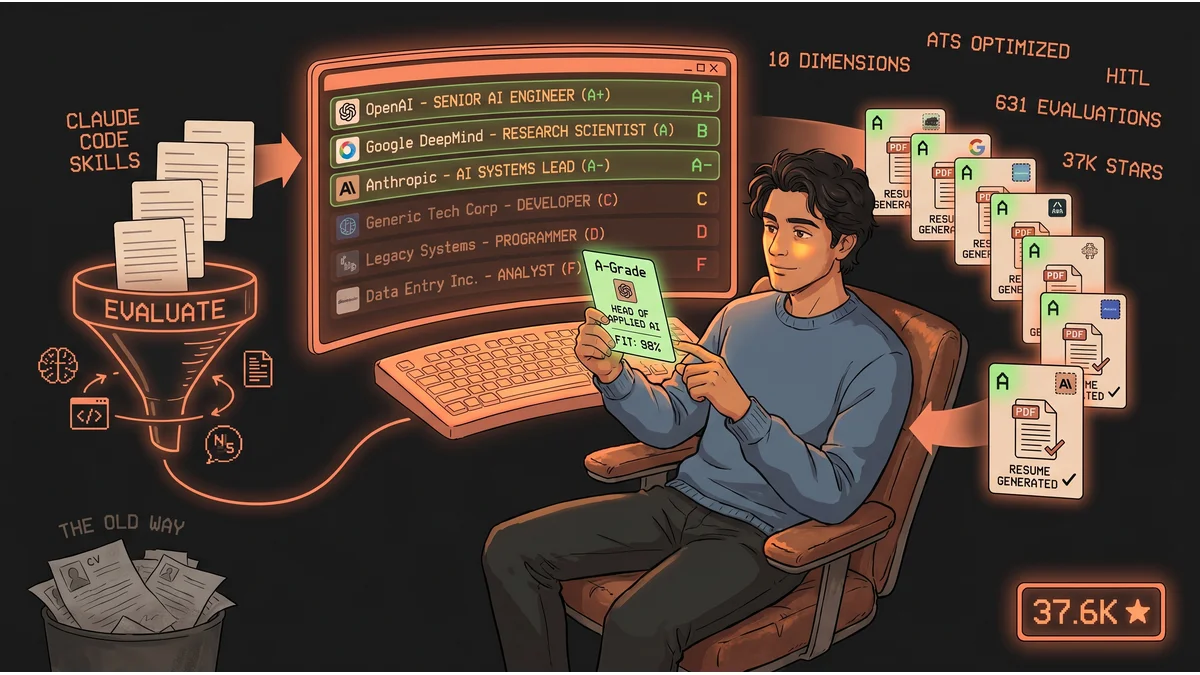
- The system: Claude Code with 12 skill modes that scores job listings across 10 dimensions, generates a tailored resume per listing, and fills application forms automatically.
- It processed 631 evaluations and 302 applications.
- He landed a role as Head of Applied AI.
- Then he open-sourced it. 37,600+ GitHub stars in weeks.
Santiago Fernández de Valderrama needed a new job. He was targeting senior AI engineering roles — the kind where every application requires reading the JD, mapping your skills, rewriting your CV, writing a personalized note, and filling a 15-field form. Multiply that by ten listings a day across six countries. The work wasn’t hard. It was just repetitive.
He spent week one doing it manually. By week two, he’d stopped applying entirely.
He was building Career-Ops.
The Problem He Was Actually Solving
Santiago documented the exact friction: 70% of listings are a poor fit, but you can’t tell until you’ve read 800 words. Generic CVs can’t highlight the proof points relevant to each specific offer. Every platform asks the same questions in different formats. Without a tracking system, you lose follow-up entirely. No feedback loop — you apply, wait, and never know if the issue was fit, the CV, or timing.
None of this requires intelligence. It requires patience and consistency — which makes it exactly the kind of problem AI should handle.
How the System Works
Career-Ops isn’t a script or an auto-apply bot. It’s a multi-agent Claude Code project with 12 operational modes, each implemented as a separate skill file with its own context, tools, and rules. The architecture reason is deliberate: precise context per task, isolated testability, independent evolution.
The core modes:
- auto-pipeline — full pipeline on a single URL: extract the job description, evaluate fit A–F across 10 dimensions, generate a report, create a tailored PDF resume, add a tracker entry
- oferta — deep single-offer evaluation with six analysis blocks: summary, CV match, seniority level, compensation, personalization recommendations, interview prep
- pdf — generates an ATS-optimized PDF personalized per listing, with the specific proof points and keywords that matter for that role
- scan — discovers new listings by navigating job boards and 45+ configured company career pages
- train — generates STAR-format interview stories mapped to the target role
The design principle throughout: AI analyzes, human decides. Santiago reviewed every evaluation before submitting anything. The system’s job was to make that review fast and the applications good, not to replace his judgment.
Scoring used a 10-dimension framework grading each listing A through F. If an offer scored below a threshold, it was filtered out before he ever read it.
The Numbers
By the time he published the Reddit post in April 2026:
- 631 evaluations processed through the pipeline
- 302 applications submitted (after human review)
- 740+ job listings total evaluated
- The filtering ratio meant he was applying to roughly half what he evaluated — quality over volume by design
He landed the role: Head of Applied AI.
The irony he noted in his case study: “I built a multi-agent system to search for multi-agent roles. The system demonstrated the competencies better than any interview could.”
Then It Went Viral
Santiago open-sourced career-ops on GitHub under MIT — free, no paid tiers, no DM gates. The Reddit post hit 2,769 upvotes. Articles appeared in France, China, and Korea. A Discord community formed around the project.
Within weeks: 37,600+ GitHub stars. 7,600+ forks. 1,600+ Discord members.
The reaction in the comments was mixed. Some were impressed. Some pointed out the title said “740+ offers” when he meant “740+ listings evaluated” — Santiago edited the post to clarify. A few noted token costs. One user had already extended it with a /debrief command for post-interview analysis.
But the core reaction was consistent: this is the kind of thing that used to require a recruiter, a resume writer, and hours of manual work. One person built it in their spare time and gave it away.
What This Actually Means
Job searching has always been a numbers game that penalizes the people playing it. Companies use AI to filter candidates. Santiago’s framing flips it: he used AI to filter companies.
The tools were Claude Code, Playwright, and a terminal dashboard built in Go. The investment was two weeks of evenings. The output was a system that’s now been forked 7,600 times by people running the same search.
Career-Ops doesn’t change what it takes to get hired. It removes the part that was never the point.
career-ops is free and open source at github.com/santifer/career-ops. Full case study with architecture at santifer.io/career-ops-system.