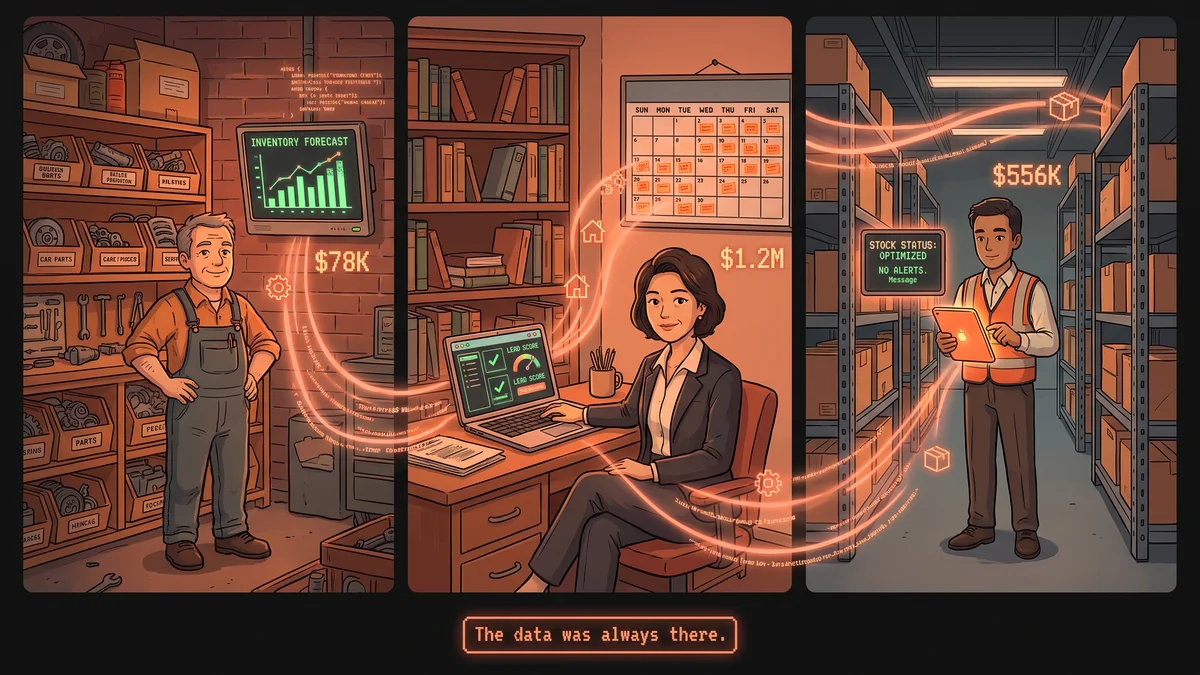
None of these businesses were trying to become AI companies. An Ohio auto repair shop wanted to stop guessing which parts to stock. An Austin real estate agency wanted its agents to spend less time on admin. A California parts distributor wanted to stop paying $180,000 a year in emergency shipping fees. They had operational problems. AI turned out to be the solution.
Three businesses. Three industries. Three documented ROIs. The pattern is worth understanding.
The Auto Repair Shop That Stopped Guessing
Mike Thompson runs a 35-person family-owned shop in Ohio. He knew the parts problem well: either $80,000 tied up in inventory that wasn’t moving, or a two-day wait for a common part because they hadn’t stocked it. “Both scenarios were killing our profitability and reputation,” he said.
The fix was a predictive analytics system built on top of five years of existing POS data. It pulled in local vehicle registration numbers, seasonal demand patterns, supplier lead times, and economic signals. Nothing exotic — just a system that could actually read the data the shop was already generating.
After 12 months: 35% fewer stockouts, 40% fewer emergency parts orders, and a 90% improvement in inventory turnover. The financial result: $47,000 in reduced waste from obsolete parts and $31,000 in new revenue from repairs no longer delayed. Total benefit: roughly $78,000 on a $52,000 implementation. ROI in six months.
Mike’s takeaway: “The system paid for itself in six months, but the real value is peace of mind.”
The asset was always there. Five years of transaction data. AI was the first system that knew how to use it.
The Real Estate Agency That Gave Agents Their Time Back
Sarah Chen’s Austin agency had 12 agents and 200+ leads a month coming in. The math didn’t work. Agents were spending half their time on qualification and admin, which meant less time on what they were actually good at: showing properties and closing deals.
“We were drowning in leads but starving for qualified prospects,” Sarah said.
The AI system scored leads based on website behavior, email engagement, property search patterns, and external data like property ownership history. A personalization engine then adjusted follow-up timing, communication style, and property recommendations to match each lead’s behavior profile.
Eight months in: 42% better lead-to-appointment conversion, 22% more closed transactions, $1.2 million increase in annual commission revenue. Implementation cost: $34,000. ROI in four months.
The unexpected benefit: agents became more strategic. When the admin work disappeared, what was left was the work that required human judgment. The agency started attracting better agent recruits because of it.
Sarah’s note: “The AI doesn’t replace the relationship-building that’s core to our business — it amplifies it.”
The Parts Distributor With $2.3 Million in Inventory and a 15% Stockout Rate
David Martinez is CFO of a family-owned automotive parts distributor in California — 78 employees, 400+ repair shop customers across three states. They were carrying $2.3 million in inventory and still disappointing customers on urgent orders. Fifteen percent of routine orders hit a stockout. Annual emergency shipping bill: $180,000.
“Our forecasting was basically educated guessing based on last year’s numbers,” David said.
The AI system they built runs 13-week rolling demand forecasts across 8,000+ active SKUs. It integrates internal sales history with external data: regional vehicle registration trends, fuel prices, weather patterns, new vehicle sales, economic indicators. It updates weekly and flags unusual deviations before they become stockouts.
After 12 months: stockout rate fell from 15% to 4%, dead stock dropped by 31%, forecasting accuracy improved from 62% to 87%. The financial picture: $340,000 in working capital freed from inventory optimization, $127,000 saved in expedited shipping, $89,000 increase in gross margin from a better inventory mix. Total: roughly $556,000 in measurable return on a $67,000 implementation. ROI in eight months.
The side effects: better supplier negotiations (volume commitments enabled by reliable forecasting), early identification of EV parts demand before customers started asking for it, and the confidence to expand into new geographic markets.
Three industries, one pattern. An auto repair shop, a real estate agency, a parts distributor — none of them had IT departments. All of them had years of operational data they weren’t fully using. The question wasn’t whether the data existed. It was whether there was a system smart enough to read it.
In each case, the AI didn’t transform the business. It fixed the thing that was broken.