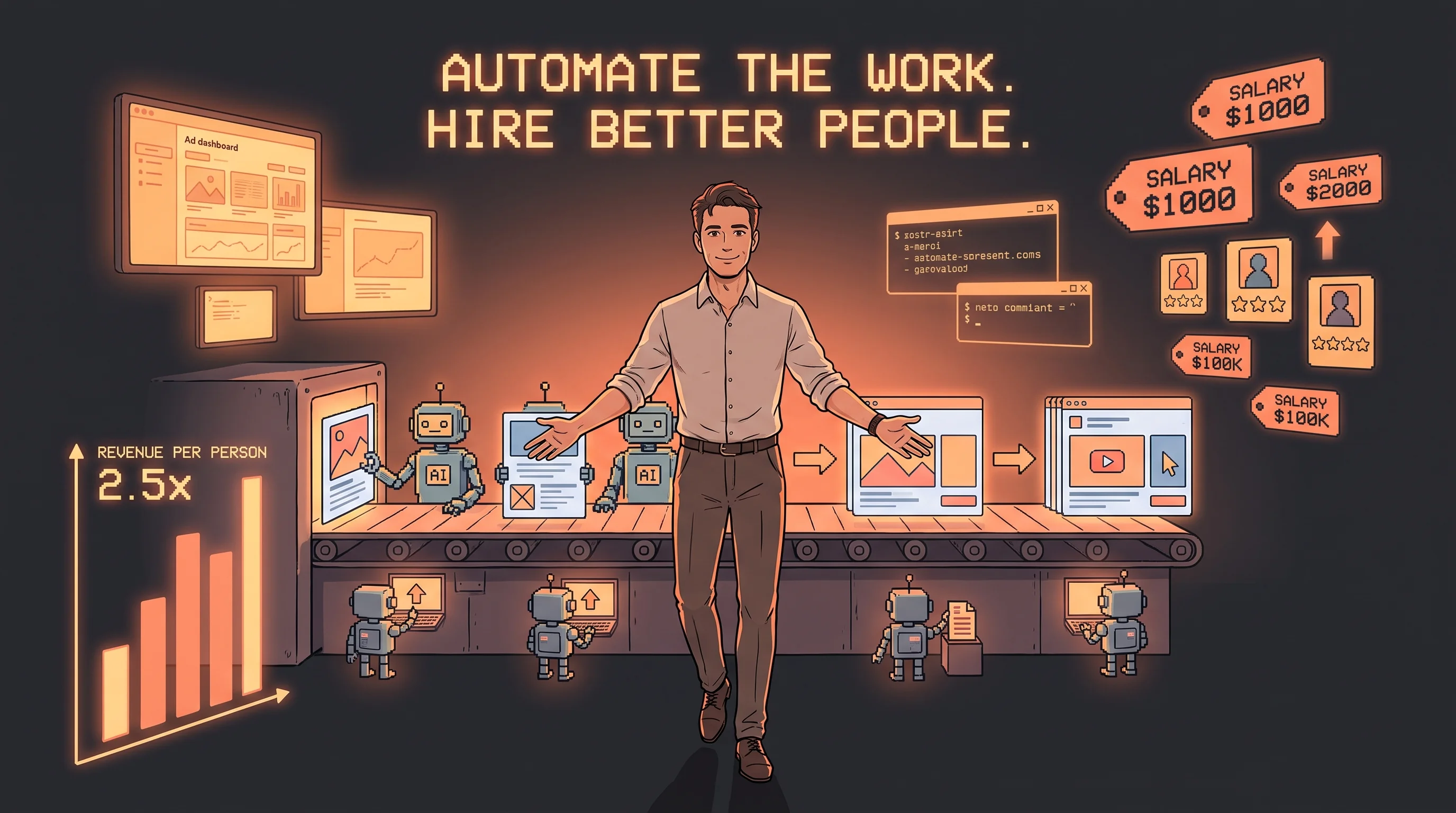
The fear around AI and jobs tends to run in one direction: automate work, eliminate positions. Two companies that went all-in on AI automation this year found the opposite. When you free your team from manual work, you discover what your team is actually worth — and start paying for it.
The Ad Agency That Automated Its Way to Better Hires
Ciaran Finn and Evan Carroll run Linear, a performance marketing agency handling digital advertising for e-commerce and software brands across Google, Meta, and other platforms. Ad creative — the volume and quality of it — is, as Finn puts it, “arguably the biggest lever you have to outperform a competitor.”
Getting that right at scale used to require hours of manual work per client: reviewing which ads were underperforming, briefing the creative team, producing replacements, uploading them. Linear built a system using Claude Code that handles 80 to 90% of that process automatically. It monitors live ad account data across all clients, identifies creative that needs a refresh, generates replacement assets, and uploads them to Meta. What took hours now takes minutes.
The same logic runs across the business. Client sentiment is tracked automatically. Internal reporting compiles itself. Trend analysis that once required significant analyst time now runs continuously, catching underperformance earlier and doubling down on what’s working before a human even looks at the data.
Since incorporating agentic AI: revenue per team member up 2.5x, profitability tripled.
What did they do with the margin? They didn’t pocket it. Average salaries more than doubled. Finn’s explanation: “In the past, if we hired someone on a very high salary who was really skilled, because they’re doing everything manually, the amount of effect they can have isn’t that high. Whereas now with AI, we can leverage that person’s talent much more.”
The lower-skill manual work disappeared. Senior expertise became more valuable — and more leverageable.
The Travel Startup Outrunning 70-Person Teams
Toby Simmons launched ActiveXplore Travel — a wellness and sport retreat booking service — last October. He projected his first million in revenue within months of launch. His former employers, running teams of 65 to 70 people, were watching their sales slide.
The difference isn’t that Simmons is a better technologist. It’s that he never had to change anything.
He built the business entirely around AI from day one. The system updates pricing automatically when retreat centers change their rates or flight costs shift. Trust accounts self-allocate to bookings. Bespoke client quotes go out within 12 hours and are typically confirmed within 48.
Simmons on his former employers: “Every company I worked for pushed back on AI, and now they’re all chasing their tails trying to work out how to integrate it into a team of 70 people who don’t know how to use it — whereas I know full well, when we expand our team, that it’s part of the workflow not something employees have to try and learn.”
The advantage isn’t raw capability. It’s that he designed the work around AI from the start, so there’s nothing to retrofit and no one to convince.
Both Linear and ActiveXplore built what’s becoming a recognizable pattern: AI that owns defined slices of work from trigger to completion, without waiting to be asked. The productivity gains are real. But the structural advantage runs deeper — when AI handles what’s routine, what’s left is what requires judgment, relationships, and expertise. That work is worth more. The businesses willing to automate heavily enough are discovering their best people are more valuable than they were before.
The companies still debating whether to “integrate AI” are the 70-person teams watching someone solo outrun them.