TL;DR
- Non-coder built autonomous YouTube translation pipeline in 30 minutes using Claude Code + HeyGen API
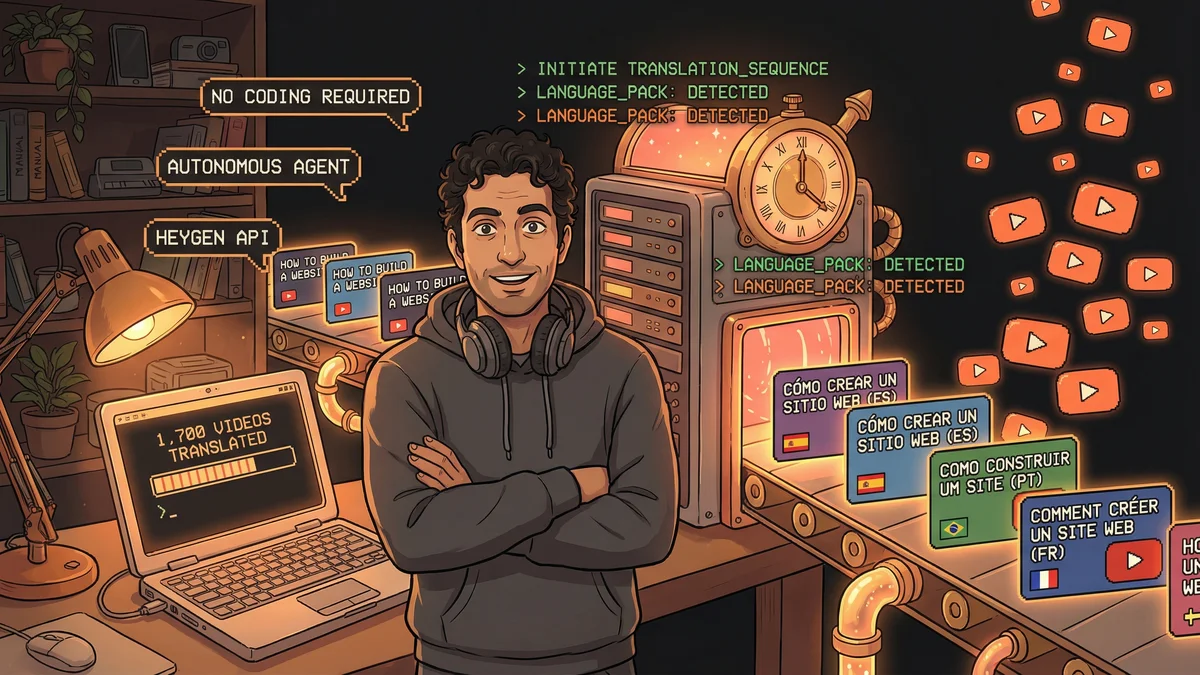
- System downloads videos from 1,700+ video library, translates them, uploads to language-specific channels
- Key insight: Claude Code’s behavior can be modified through natural conversation, including disabling permission prompts
- Best for: Content creators, educators, businesses wanting to reach non-English audiences without manual work
- The agent runs continuously without supervision - set it and forget it
A content creator with zero coding skills built an autonomous agent that’s translating his entire 1,700-video YouTube library into Spanish while he does literally nothing.
Farzad had a problem most creators would envy: too much content. Over 1,700 videos on his YouTube channel. Years of work. Millions of views.
But all in English.
He knew there was a Spanish-speaking audience for his content. And Portuguese. And French. The demand was obvious from comments asking for subtitles, translations, anything.
The problem wasn’t creating value. It was duplicating it across languages without hiring a translation team or spending years on manual work.
The Permission Epiphany
Farzad describes himself bluntly: “I’m literally an idiot when it comes to coding.”
But he’s good at systems. He can envision the end result and design processes to get there. The coding part? That’s where he always hit a wall.
When he started using Claude Code, something annoyed him immediately. Every single command needed explicit permission. Click approve. Click approve. Click approve.
“I asked it if there’s a way for me to have it never do that again.”
Claude’s response surprised him: “Sure, I can do this change to my ‘main’ file so that I never have to ask you again unless I think I’m doing something terrible.”
Wait. He could just… ask it to change its own behavior?
“I said sure, as long as you aren’t deleting files and changing my system settings, you’re good.”
Claude implemented the changes. No more permission prompts for normal operations. Dangerous actions still required approval.
That’s when the real idea hit.
The Agent Architecture
If Claude could modify its own settings through conversation, what else could it do autonomously?
Farzad started thinking bigger: “If that’s the case, in theory, I could build an agent that can run without ever having to check with me unless it’s being completely wrong.”
He described what he wanted:
“Can you build me an agent that goes into my entire YouTube library catalog, downloads videos from a playlist, translates them to different languages, and then uploads them with the translated versions to a new YouTube channel that’s specific for that language?”
Claude’s response: “Sure - I just need you to authorize access to your YouTube channels, and then you need to sign up for HeyGen so it can do the translating for you.”
No “that’s too complex.” No “you’ll need a developer for that.” Just: here’s what I need, let’s do it.
The 30-Minute Build
Farzad signed up for HeyGen’s Scale tier (API access for video translation). He authorized Claude to access his YouTube channels through the YouTube API.
Then he just… talked to it.
“Can you hook up to HeyGen with like an API or something?”
“Sure, just sign up for the Scale tier thing and I got you.”
“Here’s the info and I signed up - you good?”
“Yeah, I’m good.”
Thirty minutes later, Farzad had a working autonomous pipeline.
The agent:
- Reads videos from a designated playlist
- Downloads each video
- Sends it to HeyGen for AI translation
- Receives the translated video back
- Uploads it to a Spanish-language YouTube channel
- Moves to the next video
- Repeats forever
No human intervention required. The agent just processes videos continuously until the playlist is empty.
The Results
That first Spanish-translated video went live while Farzad watched in disbelief.
“And then 30 minutes later I have a Spanish-language YouTube channel that will eventually have my entire catalog on there, automatically transferred, translated, and uploaded by a freaking agent.”
1,700+ videos. Eventually all translated. All uploaded. All without him touching a single file after the initial setup.
The agent doesn’t sleep. It doesn’t take breaks. It doesn’t complain about repetitive work. It just processes.
The Expansion Plan
One language wasn’t enough.
“I’m going to build an agent that can create optimal titles and thumbnails for me that’s optimized for each language.”
Same pattern: describe what you want, let Claude figure out the implementation. The thumbnail agent would:
- Analyze what works in Spanish-language YouTube (different cultural preferences)
- Generate localized titles with proper keywords
- Create thumbnails optimized for each market
Multiple agents working together. A content localization factory built by someone who can’t write code.
The Paradigm Shift
Farzad’s takeaway isn’t about video translation. It’s about the nature of working with AI.
“The craziest thing I realized about Claude Code is that I can talk to it to change its behavior.”
Not through configuration files. Not through documentation. Through conversation.
Want it to stop asking for permission? Ask it. Want it to run autonomously? Describe what that means. Want it to build an entire pipeline? Just tell it what the pipeline should do.
The barrier between “having an idea” and “having a working system” collapsed. The only requirement: being able to articulate what you want.
Building Your Own Automation Agent
The pattern applies beyond YouTube:
Podcast localization: Download episodes, transcribe, translate, generate voiceover, publish to region-specific feeds.
Course translation: Process video lessons, generate translated versions, organize into localized course structures.
Social media repurposing: Take long-form content, translate it, adapt for regional platforms (Weibo, VK, etc.).
The key insight: if you can describe the workflow step-by-step, Claude can implement it. No coding required. Just clear thinking about what should happen.
The Permission Conversation
Before building autonomous agents, have the permission conversation:
“I want you to run commands without asking me each time. The exceptions: anything that deletes files, changes system settings, or seems destructive. For those, always ask. For everything else, just do it.”
Claude modifies its settings. You get an agent that works independently within boundaries you defined.
“As long as you aren’t deleting files and changing my system settings, you’re good.”
Simple guardrails. Maximum autonomy within those guardrails.
The New Economics of Content
Manual video translation costs $50-200 per video through professional services. More for quality dubbing.
At 1,700 videos, that’s $85,000-$340,000 for one language.
Farzad’s approach: HeyGen subscription plus Claude Code usage. A fraction of the cost. And it scales infinitely - Portuguese, French, German, Japanese can all run in parallel once the pattern is established.
The economics of content localization just changed. Not because translation got cheaper. Because the entire workflow got automated.
The Lesson
You don’t need to code to build sophisticated automation.
You need to think clearly about what you want. You need to articulate workflows step by step. You need to define guardrails that let AI work independently.
Farzad can’t write a Python script. But he now has an autonomous agent translating 1,700 videos while he sleeps.
“You guys, I’m pretty sure RAM prices are just going to keep going up forever.”
He’s not wrong. The people who learn to direct autonomous agents will have compute working for them 24/7. Everyone else will wonder how they’re getting so much done.