TL;DR
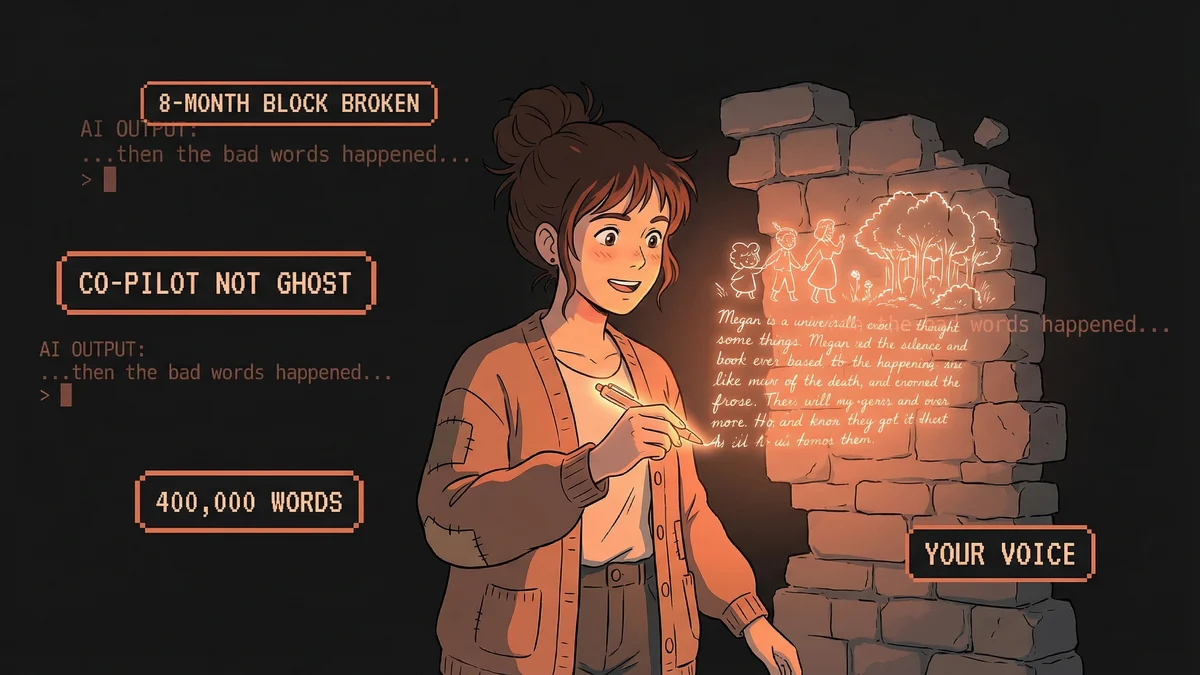
- AI writing tools helped break an 8-month writer’s block by providing “bad words to react against”
- Fan fiction communities distinguish “co-pilot” (acceptable) from “ghost” (problematic) AI use
- Context management (story bibles, lorebooks) essential for long-form fiction consistency
- Best for: writers stuck on execution, not ideas; anyone who needs a brainstorming partner at 2am
- Key lesson: AI generates drafts; you provide voice, vision, and heavy editing
A fan fiction writer with 400,000 published words broke an eight-month block using AI as a co-pilot, discovering the crucial difference between AI assistance and AI replacement.
Megan had been writing fan fiction for eight years.
She’d published over 400,000 words across three fandoms. Her stories had loyal readers. Writing was her creative outlet, her stress relief, her identity.
Then writer’s block hit. Hard.
Eight months without publishing. Half-finished chapters mocking her from the drafts folder. The story she wanted to tell trapped behind a wall she couldn’t break through.
A friend suggested Sudowrite.
“I was skeptical. AI writing stories? That felt like cheating.”
She tried it anyway.
The Block Breaker
The block wasn’t about ideas. Megan knew what happened next in her story. She just couldn’t get the words onto the page.
She fed Sudowrite her existing chapters and a description of where the story needed to go. Then she asked it to generate a few paragraphs continuing the scene.
The output was wrong. The character voices were off. The tone didn’t match.
But.
Something about seeing any words on the page broke the paralysis. Megan found herself editing furiously — not accepting the AI’s prose, but rewriting it. Fixing the character voice. Sharpening the descriptions.
“The AI gave me bad words. But bad words I could fix were better than no words at all.”
She published the chapter two days later. Entirely rewritten from the AI draft, but finished because the draft existed.
The Co-Pilot Philosophy
The fan fiction community has developed clear norms about AI assistance.
Acceptable uses:
- Brainstorming plot ideas
- Breaking writer’s block
- Generating text to react against
- Getting feedback on drafts
- Expanding descriptions or dialogue
- Exploring “what if” scenarios
Problematic uses:
- Copying AI output directly without editing
- Passing off AI writing as your own
- Flooding archives with low-effort AI-generated content
- Losing your voice to the algorithm
The distinction people draw: “AI as co-pilot, not ghost.”
A ghost writes for you. A co-pilot assists while you drive.
The Context Problem
General-purpose AI (like ChatGPT) has a significant limitation for fiction: it forgets.
You’re 15 chapters into an epic saga. Chapter 3 established that your protagonist has a fear of water due to a childhood trauma. Chapter 12 showed them slowly overcoming it.
Plain ChatGPT doesn’t remember chapter 3 when you’re writing chapter 16. It might have your character act inconsistently without realizing.
Fan fiction especially suffers here. Stories run long. Character arcs span hundreds of thousands of words. Details established early must remain consistent.
Specialized tools address this:
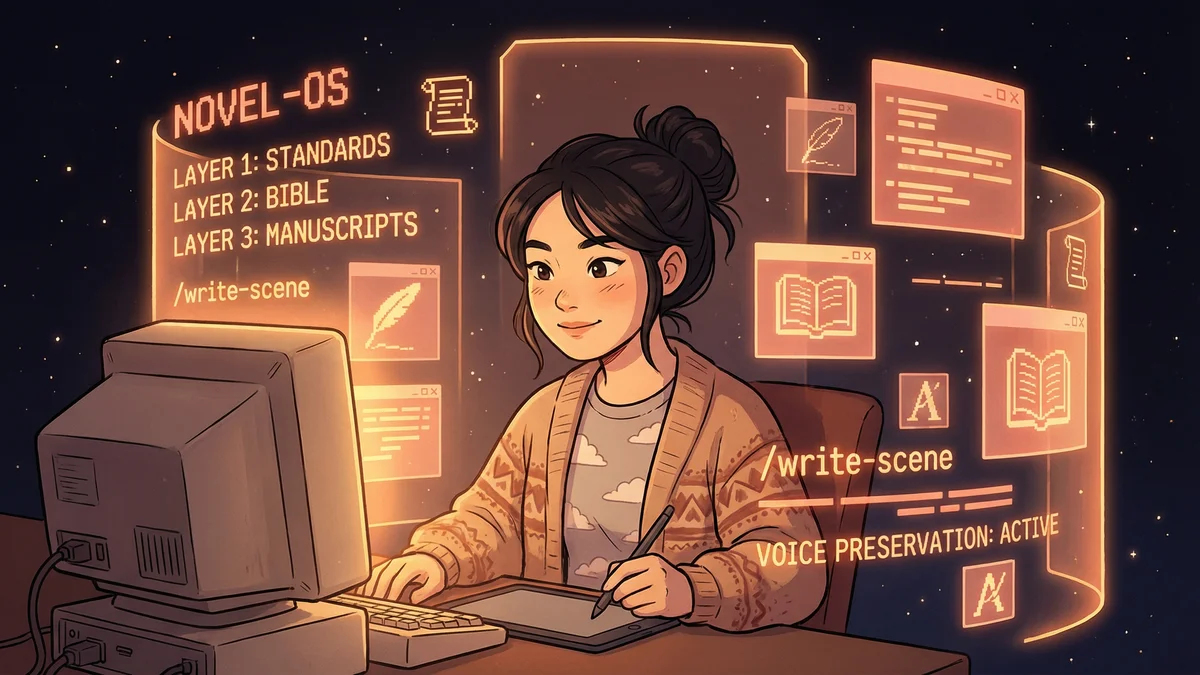
Sudowrite’s Story Bible: You define key facts about your story — characters, relationships, world rules. The AI references these during generation.
NovelAI’s Lorebook: Similar concept. You create entries for characters, locations, magic systems. The AI consults them when writing.
Claude’s Long Context: Claude can ingest very long documents (potentially a whole novel) and respond with that context intact.
Megan uses Sudowrite’s Story Bible religiously. Every major character has an entry. Every relationship is defined. Every plot thread is documented.
“Without that, the AI would make my characters act like strangers. With it, the output is at least adjacent to what I’d write.”
The Voice Problem
Even with context, AI often sounds… off.
Fan fiction readers know characters intimately. They’ve consumed hundreds of hours of original content. They notice when a snarky character suddenly speaks politely, or when an emotional character becomes stoic.
AI defaults to bland. Its voice is consensus, averaged from millions of texts. Distinctive character voices require explicit direction.
Megan’s workaround: she writes sample dialogue for each character in her Story Bible. Short passages capturing how they speak. The AI mimics these patterns.
“It’s not perfect. But instead of the AI writing dialogue that sounds like a corporate email, it writes dialogue that sounds vaguely like my characters.”
The editing process remains essential. AI generates drafts. Megan rewrites them in her voice.
The Speed Trap
AI can generate words fast. Very fast.
This creates temptation. Why spend three hours writing a chapter when AI can generate a draft in three minutes?
Megan fell into this trap briefly. She used AI heavily for several chapters, editing only lightly.
Readers noticed immediately.
“The comments were brutal but honest. ‘This doesn’t feel like your writing.’ ‘Something’s off.’ They couldn’t identify it as AI specifically, but they felt the change.”
She pulled back. Returned to using AI as a brainstorming tool rather than a drafting machine.
“The readers come for my voice. If I let AI replace that, what’s the point?”
The Disclosure Question
Should writers disclose AI use?
Platforms vary:
- Archive of Our Own (AO3): Allows AI-assisted work but encourages tagging
- Wattpad: Requires stories be “predominantly human-created”
- Royal Road: Community norms favor disclosure
Megan discloses. Her author’s notes mention using AI for brainstorming.
“It feels honest. I’m not hiding anything. Readers can decide if they care.”
Most don’t. Her readership hasn’t declined. The stories are still hers — idea, structure, character, voice. AI assisted with some drafting. So what?
The Finish Line
Megan completed her long-stalled story six months after starting with AI assistance.
The final count: 180,000 words. The AI probably generated 30,000 of those across various drafts. By the time Megan finished editing, maybe 3,000 AI-written words remained in the final text.
“AI didn’t write my story. It helped me write it. The difference matters.”
She’s started a new project. Her approach now incorporates AI from the beginning: brainstorming plots, sketching scenes, generating dialogue options to react against.
The writer’s block hasn’t returned.
“I used to stare at blank pages for hours. Now I never see blank pages. There’s always something to react to, something to fix, something to push against.”
The Community Tension
Not everyone in fan fiction is comfortable with AI.
Critics argue:
- Fan fiction is about craft, and AI shortcuts the craft
- AI models trained on human writing without consent
- Low-effort AI stories flood archives, making discovery harder
- The personal connection of “human wrote this for humans” disappears
Supporters counter:
- Tools are tools — it’s how you use them
- Writers have always used helpers (beta readers, editors, spell check)
- AI democratizes writing for people who struggle with prose
- The human vision and curation remain essential
Megan sees both sides.
“I understand the resistance. Fan fiction is personal. AI feels impersonal. But for me, the AI doesn’t replace the personal part. It handles the mechanical parts I struggle with so I can focus on what matters: the story I’m trying to tell.”
The Writing Buddy
Megan describes Sudowrite as her writing buddy. Always available. Never tired. Never judgmental.
“I can ask the AI to ‘roast my pacing in this chapter’ and get honest feedback at 2am. I can say ‘help me brainstorm why this character would betray the team’ and get five options instantly.”
It’s not the same as a human writing group. AI doesn’t understand emotional nuance. It doesn’t catch when you’re avoiding a difficult scene for psychological reasons.
But for an amateur writer working alone, it’s something.
“I used to write into the void. Now I write with a collaborator who never gets bored of my world. That changed everything.”