TL;DR
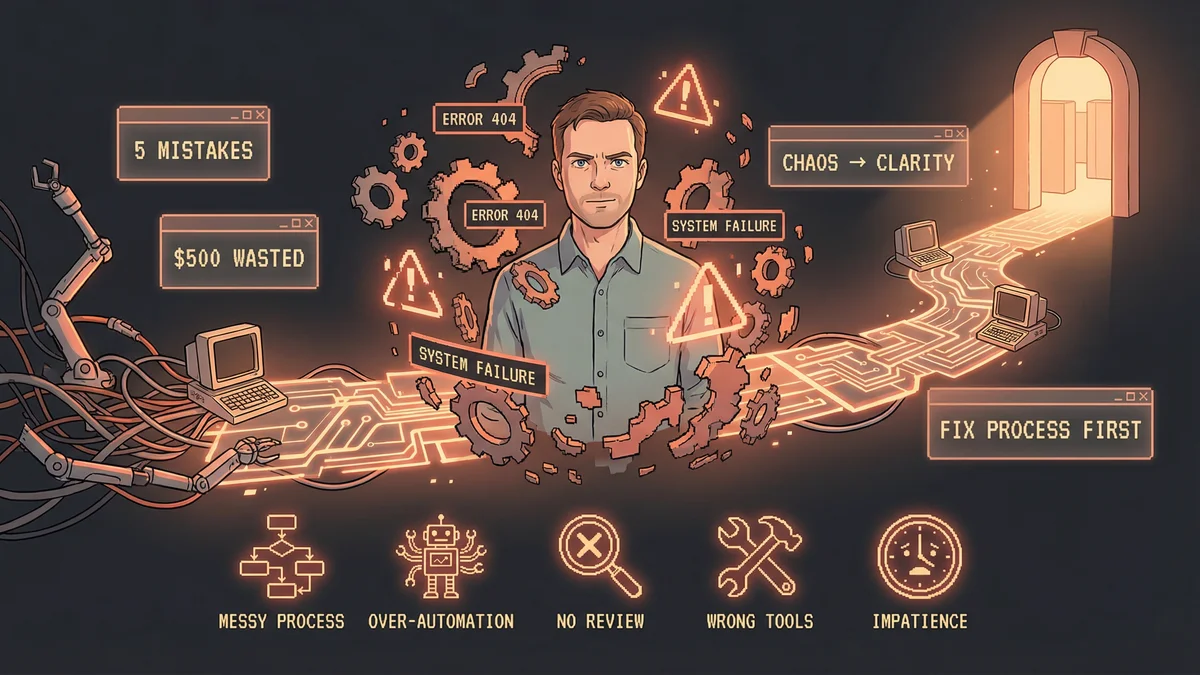
- Business owner spent $500 and 3 months on AI before nearly quitting - then found what works
- Top 5 mistakes: automating messy processes, over-automation, no human review, wrong tools, expecting instant results
- Recovery framework: clean processes first, one problem at a time, 8-week implementation cycle
- Best for: Small business owners considering AI adoption who want to avoid common pitfalls
- Key lesson: AI amplifies whatever exists - clean workflows get faster, messy workflows get messier
A small business owner who wasted $500 and three months on failed AI implementations shares the five mistakes that nearly made him quit - and the systematic approach that finally worked.
Tyler was a believer.
He’d read the articles about AI transforming small business. He’d seen competitors posting about time savings and revenue gains. He decided to go all-in.
Within three months, he was ready to give up on AI entirely.
“I’d spent $500 on tools that weren’t delivering. I had automations that kept breaking. My team was frustrated. My customers were getting weird messages. It felt like I’d made everything worse.”
Then he figured out what he was doing wrong.
Mistake #1: Automating Chaos
Tyler’s first error was fundamental.
His business processes were messy before AI. No clear workflows. No documentation. Different people doing the same task different ways.
He layered automation on top of the mess.
“I thought AI would bring order to chaos. Instead, it automated the chaos. Faster chaos is still chaos.”
When he set up an automated email sequence, it sent at random times because his underlying calendar wasn’t organized. When he connected tools via Zapier, the integrations broke because his data wasn’t consistent.
The lesson: Fix your processes before you automate them. AI amplifies whatever exists. If your workflows are clear, AI makes them faster. If your workflows are confused, AI makes them more confused.
Mistake #2: Over-Automation
Tyler was enthusiastic. He automated everything.
Customer inquiries? Automated. Follow-ups? Automated. Social media posts? Automated. Meeting scheduling? Automated. Email responses? Automated.
The result: customers felt like they were talking to machines (because they were). The personal touch that made Tyler’s business special disappeared.
One customer complaint stuck with him:
“I tried to tell you about a problem with my order and got three automated messages before anyone actually responded. I felt like I was shouting into a void.”
The lesson: Automate logistics, not relationships. AI should handle scheduling, reminders, data entry — the mechanical work. Humans should handle problems, complaints, negotiations — anything with emotional stakes.
Mistake #3: No Human Review
Tyler trusted AI outputs too much.
He let an AI chatbot answer customer questions without human oversight. It gave a wrong answer about his return policy. A customer relied on that answer, then got angry when reality didn’t match.
He let AI draft proposals without careful review. One went out with a pricing error because the AI hallucinated a number. Awkward conversation followed.
He let AI post to social media without approval. One post included a phrase that was grammatically correct but tonally wrong for his brand.
“I kept waiting for AI to be intelligent enough to catch its own mistakes. It wasn’t. It confidently made errors that a human would never make.”
The lesson: AI needs supervision. Review everything that goes to customers. Review everything with numbers. Review everything that represents your brand. Trust, but verify.
Mistake #4: Wrong Tool for the Job
Tyler used ChatGPT for everything.
Need to track inventory? ChatGPT. Need to manage customer relationships? ChatGPT. Need financial forecasting? ChatGPT.
ChatGPT is a general-purpose AI. It’s good at many things, great at few, and specialized at nothing.
“I was trying to use a Swiss Army knife when I needed a power drill. ChatGPT could sort of do inventory management, but an actual inventory management tool was 10x better.”
The lesson: Use specialized tools for specialized tasks. ChatGPT for writing and brainstorming. A real CRM for customer management. A real inventory system for inventory. The AI features built into specialized tools often outperform general AI trying to do the same thing.
Mistake #5: Ignoring the Learning Curve
Tyler expected instant results.
He set up tools, turned them on, and waited for the magic. When things didn’t work perfectly immediately, he blamed the tools.
“I didn’t realize I was the problem. I hadn’t configured things properly. I hadn’t learned how the tools actually worked. I just expected them to read my mind.”
Every AI tool has quirks. Prompts need refinement. Integrations need testing. Automations need edge case handling.
The lesson: Allocate learning time. Budget for a week or two of experimentation before expecting results. Read documentation. Watch tutorials. Test before deploying.
The Turnaround
Tyler didn’t give up. He stepped back and tried again systematically.
Step 1: Fix the foundation. He documented his processes. He cleaned up his data. He created consistent workflows before adding automation.
Step 2: Prioritize one problem. Instead of automating everything, he identified his biggest time sink: email responses. He focused there first.
Step 3: Start simple. He used a basic AI email assistant rather than building complex automation chains. Simple tools that worked beat complex systems that broke.
Step 4: Human in the loop. Every AI output went through human review before reaching customers. No exceptions initially.
Step 5: Iterate slowly. As each piece worked reliably, he added the next. Weeks between additions, not hours.
The Second Attempt
Six months after his reset, Tyler’s relationship with AI was transformed.
His email responses were 50% faster because AI drafted initial replies.
His scheduling was fully automated, working smoothly after he’d cleaned up his calendar system.
His CRM (a real CRM, not ChatGPT) tracked customer interactions and surfaced insights he’d never noticed before.
He saved approximately 8 hours per week. Not the 30 hours the hype promised, but real, sustainable improvement.
“My expectations reset. AI isn’t magic. It’s a tool. Like any tool, it works well when used properly and poorly when misused.”
The Common Pattern
Tyler’s experience is common.
Many small business owners start with AI, get frustrated, and quit. The ones who succeed share patterns:
They start with clean processes. You can’t automate undefined.
They choose one problem at a time. Focused improvement beats scattered experimentation.
They maintain human oversight. AI assists, it doesn’t replace judgment.
They expect iteration. First attempts usually need refinement.
They measure results. Time savings or revenue impact, tracked honestly.
The Survival Framework
For small business owners trying AI:
Week 1-2: Document your biggest time sink. Write down each step. Understand the process before trying to change it.
Week 3-4: Research tools specifically designed for that problem. Not general AI, but purpose-built solutions. Look for case studies from similar businesses.
Week 5-6: Implement the simplest version. Manual review of everything. Track time spent before and after.
Week 7-8: Refine based on what’s working and what’s not. Adjust prompts, configurations, workflows.
Week 9+: Once stable, consider the next problem. Repeat the process.
This is slower than the hype suggests. It’s also more likely to succeed.
The Realistic View
Tyler’s final perspective:
“AI doesn’t transform your business overnight. It makes small improvements that compound over time. The business owners getting results aren’t using magic. They’re using ordinary tools thoughtfully.”
His cautionary tale isn’t anti-AI. It’s anti-hype.
AI works. But it works like every other business improvement: through clear thinking, careful implementation, and continuous refinement.
“If someone tells you AI will instantly change everything, be skeptical. If they tell you AI can gradually improve specific problems, they’re probably right.”