TL;DR
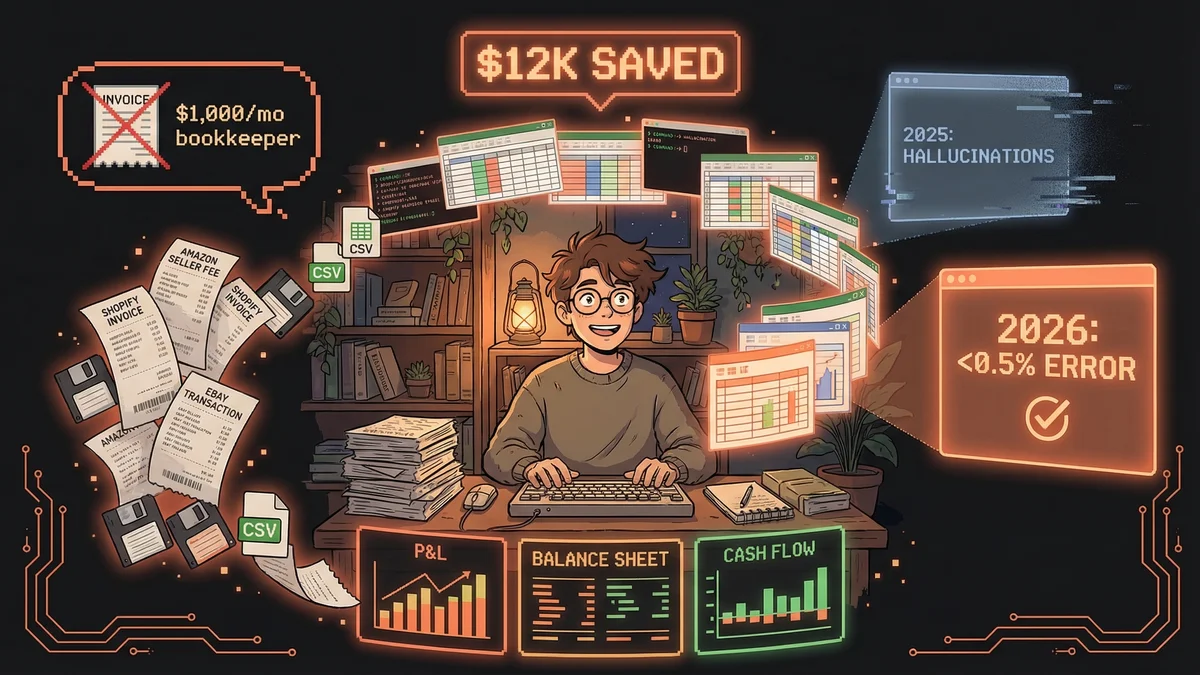
- 7-figure ecom seller replaced $1,000/month bookkeeper with Claude Cowork
- <10 errors in 2,000+ transactions (<0.5% error rate)
- Full setup in ~1 hour: P&L, cash flow, balance sheet auto-generated from 60+ files
- ChatGPT Pro (2025): unusable due to hallucinations
- Claude Cowork (2026): professional-grade accuracy
- Best for: Ecom sellers, inventory businesses, multi-account operations
- Key shift: 2026 is the year AI became accurate enough to replace professional services
A solo ecom entrepreneur fired his $1,000/month bookkeeper and replaced him with Claude Cowork in one weekend. The AI processed 2,000+ transactions across 11 accounts with fewer than 10 errors—and saved $12,000 a year.
The email from the bookkeeper arrived on Friday: “Your monthly books are ready. That’ll be $1,000.”
For the third year running. Twelve thousand dollars a year to categorize transactions, generate P&L statements, and maintain balance sheets for a one-person ecommerce business.
The numbers were always correct. The service was professional. But something had changed in early 2026.
AI had gotten accurate.
The 2025 Failure
He’d tried ChatGPT Pro in 2025. Fed it bank statements, asked it to categorize transactions and build financial reports.
It hallucinated.
Invented expense categories that didn’t exist. Miscategorized transactions so badly the P&L was useless. Mixed up Amazon seller fees with Amazon ad spend. Couldn’t tell the difference between buying inventory and paying for shipping.
“I gave up after 20 minutes. It wasn’t even close to correct.”
ChatGPT Pro in 2025 was a curiosity, not a professional tool. The bookkeeper stayed on the payroll.
The 2026 Breakthrough
Fast forward to March 2026. New Claude Cowork release. Better at spreadsheets. Lower token usage. Contextual intelligence vastly improved.
One weekend. One more attempt.
He opened Claude Cowork and uploaded 60+ files:
- 5 selling platforms (Amazon, Shopify, eBay, Walmart, Etsy)
- 6 credit cards
- 6 bank accounts
- Mix of CSVs and PDFs
Simple prompt: “I need you to retroactively build monthly cash flow statements and balance sheets from all my financial data. I run an inventory based business so most expenses are inventory, software, marketing, and employees.”
What happened next took about an hour—most of it just pulling statements from banks.
What Claude Built
Full transaction ledger:
- Every transaction from every account
- Color-coded categories
- Dropdown menus on every row for manual reclassification
- Linked formulas: change the ledger → auto-updates everything
Monthly P&L for every month:
- Revenue by platform
- Gross profit calculations
- Operating income with margin percentages
- Expense breakdowns by category
Cash flow statements:
- Operating cash flow
- Investing activities
- Financing activities
Balance sheets:
- Assets, liabilities, equity
- Month-over-month tracking
2026 workbook that auto-pulls 2025 closing balances as opening balances.
The entire financial infrastructure of a 7-figure business, built from scratch, in under 90 minutes.
The Accuracy Test
2,000+ transactions processed.
Fewer than 10 miscategorizations.
<0.5% error rate.
How?
Claude looked up every company behind each transaction. It understood context:
- “AMZN MKTP US” = Amazon Marketplace (inventory purchase)
- “AMZN Advertising” = Amazon ad spend (marketing expense)
- “AMZN Seller Fees” = Amazon seller fee (platform cost)
It parsed PDFs as accurately as CSVs. Bank statements, credit card statements, platform exports—all handled correctly.
“I was stunned. I kept checking the numbers against what my bookkeeper had done the previous year. It was right.”
The Before/After
ChatGPT Pro (2025):
- Hallucinated expense categories
- Heavy miscategorization
- Unusable for professional bookkeeping
Claude Cowork (2026):
- <10 errors in 2,000+ transactions
- Understood business context
- Generated professional-grade financial statements
- Interactive correction system (dropdown menus)
The shift wasn’t incremental. It was a phase change.
The $12,000 Question
Bookkeeper: $1,000/month = $12,000/year Claude Cowork subscription: Significantly less Setup time: ~1 hour Ongoing maintenance: A few minutes per month to review categorizations
“This is the first real, easy, and accurate replacement case for AI that I have actually deployed.”
Not an experiment. Not a side project. Not “good enough for a test.”
A complete professional service replacement.
What Changed in 2026
The replies to his post told the real story:
Ex-CFO: “As a long-time Director of Finance/CFO of small and medium sized businesses, I am astounded at what can now be automated.”
Finance director: “The accuracy is what shocked me. We tried this last year and it was a disaster.”
Other ecom sellers: “Wait, it actually works now?”
The consensus: 2025 AI was interesting. 2026 AI is deployable.
The gap between “can do party tricks” and “can replace a professional” closed in the last few months.
The Operating Model
He still reviews the books monthly. Still has dropdown menus to reclassify any transaction Claude got wrong.
But instead of paying $1,000/month for someone else to do it, he spends a few minutes checking the AI’s work.
The formulas auto-update everything:
- Change a transaction in the ledger → P&L updates
- Reclassify an expense → balance sheet adjusts
- Add a new month’s data → prior year rolls forward
It’s not just cheaper. It’s faster and more flexible.
“Creating this X post took longer than replacing my bookkeeper.”
The Pattern
This isn’t about bookkeeping. It’s about accuracy crossing a threshold.
In 2025, AI could approximate knowledge work. Generate plausible-looking output that needed heavy human review.
In 2026, AI can match professional standards on structured tasks.
The accountant isn’t worried yet. But the bookkeeper should be.
When someone running a 7-figure operation can fire their $12K/year service provider and replace them with software in one weekend—with better accuracy—the professional services landscape has fundamentally shifted.
What You Can Do
If you’re paying for bookkeeping:
- Gather your financial exports (bank CSVs, platform reports, credit card statements)
- Open Claude Cowork or similar tool
- Upload everything with a clear prompt about your business type
- Check the output against your current books
- If accuracy is >99%, you have a decision to make
If you’re a bookkeeper:
- Understand this is real now, not speculative
- Move upmarket to complex tax strategy and CFO-level advisory
- Or specialize in industries where context matters more than categorization
The shift happened quietly. No announcement. No headline.
Just a weekend project that saved $12,000 a year.
And 2,000 finance professionals in the replies realizing the implications.