TL;DR
- Zak El Fassi published a complete blog post in the time it took to cook onions
- Pipeline: voice note → Whisper transcription → AI editing → auto-deployed
- No coding required for the basic version; takes five minutes with any transcription tool
- Best for: anyone with ideas they talk about but never sit down to write
- Key lesson: The hard part isn’t writing — it’s starting. Voice removes that blocker entirely.
A developer recorded a voice note while cooking dinner. By the time the onions were done, it was a published blog post.
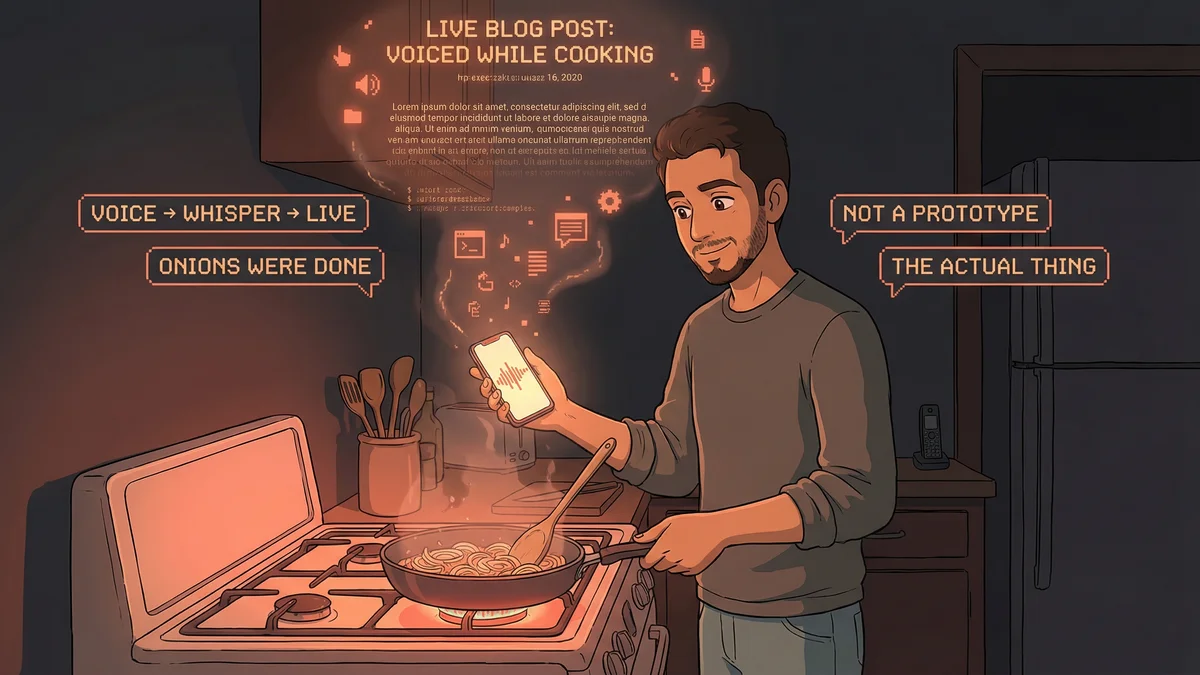
Zak El Fassi didn’t sit down to write. He stood at the stove, phone propped near the spice rack, and talked through an idea while he cooked. A few minutes of rambling. A sizzling pan. And then he posted a tweet that kept circling back to me:
“I recorded a voice note while cooking dinner. By the time the onions were done, it was a published blog post. Not a prototype. The actual thing.”
How the Pipeline Works
Voice → Whisper → AI editing → deployed. Four steps that take less time than a side dish.
Step 1: Record. Zak talks. Not a polished monologue — just thinking out loud. The kind of explanation you’d give a smart friend. Three minutes. Five minutes. Whatever the idea needs.
Step 2: Whisper. The recording goes into Whisper, OpenAI’s transcription model. It produces text — not perfect text, but all of it. Every “um,” every half-sentence, the full shape of the thinking.
Step 3: AI editing. The transcript goes to an AI editor with one instruction: clean this up. Tighten the structure, remove the repetition, make it a blog post. Because the words started as Zak’s speech, they come back sounding like him. Not generic AI prose. His thoughts, edited.
Step 4: Deploy. His pipeline auto-publishes to his blog. No copy-pasting required. By the time the onions finished, the post was live.
Why This Actually Works
Most people’s content pipeline looks like: have an idea → forget to write it down → idea dies.
The bottleneck isn’t lack of ideas. It’s the friction of sitting down to write something complete. The blank document. The pressure for the first draft to be good.
Voice recording removes all of that. You’re not writing — you’re talking. Talking while cooking, walking, or driving is nearly zero friction. You’re already doing something; explaining an idea is just a passenger activity.
Zak put it exactly right: “The overhead of building with AI is the content itself.”
Once you’ve said the thing, AI handles every step after that.
How to Steal This Workflow
You don’t need Zak’s auto-deploy setup. A simplified version:
- Record a voice note about any idea you’ve been “meaning to write about”
- Drop the audio into Whisper (free at whisper.ai) — takes about 30 seconds
- Paste the transcript into Claude: “Edit this voice transcript into a blog post. Keep my voice, clean up the rambling, aim for under 600 words.”
- Read it once, adjust anything that sounds off, and publish
The five-minute post isn’t a compromise. It’s a feature. You’ll publish ideas you’d have left dying in your notes app.
Start with something you said out loud this week — a recommendation, an observation, an opinion. The onion clock is already running.