TL;DR
- AI transcribed an 1890s diary in minutes that had been unreadable for 20 years
- The transcription revealed a family member who died at age 3, erased from oral history by grief
- Ancestry and similar tools use machine learning trained on historical handwriting styles
- Best for: genealogists, family historians, anyone with old documents in illegible scripts
- Key lesson: Treasures locked in boxes for generations can now be read in minutes
A great-grandmother’s diary sat unreadable for 20 years until AI transcription decoded the Victorian cursive in minutes, revealing a lost child the family had never mentioned.
David had his great-grandmother’s diary for twenty years.
It sat on a shelf, precious and untouchable. A leather-bound journal from the 1890s, filled with careful script on yellowed pages.
He couldn’t read a word of it.
Victorian cursive is nearly illegible to modern eyes. The letters connect differently. The flourishes obscure meaning. Even simple words become puzzles when written in a hand from another century.
David had tried. Sat with the diary for hours, squinting at pages, occasionally recognizing a word. “The” appeared frequently. Beyond that, mostly shapes.
His great-grandmother’s voice, preserved in ink, locked behind a script he couldn’t decipher.
Then he learned about AI handwriting transcription.
The Old Script Problem
Genealogists face this constantly. Family history exists in documents: diaries, letters, ship manifests, census records, property deeds.
Documents from before 1950 often use handwriting styles now obsolete:
- Secretary hand (1500s-1600s): Radically different letterforms
- Victorian cursive (1800s): Elaborate flourishes obscure letters
- Spencerian script (late 1800s): Flowing but uniform, hard to parse
- German Kurrent (pre-1941): Angular script unlike modern cursive
Learning to read these scripts takes years. Professional transcription services exist but are expensive and slow.
Most family documents sit unread. Treasures in boxes, their contents guesses.
The Ancestry Upload
Ancestry recently introduced AI-powered handwriting transcription. David learned about it through a genealogy forum.
The process was simple:
- Scan the diary pages (or photograph them clearly)
- Upload to Ancestry’s image transcript tool
- Wait for AI analysis
- Receive machine-readable text
David scanned ten pages as a test. The diary’s condition was excellent — his grandmother had stored it properly. The ink was faded but legible in the scans.
He uploaded and waited.
The Moment of Translation
The AI returned its results within minutes.
Page one: a description of weather, a church event, a neighbor’s visit. Mundane entries. But readable.
David kept going. Page after page, the AI decoded what his eyes couldn’t.
Then page seven.
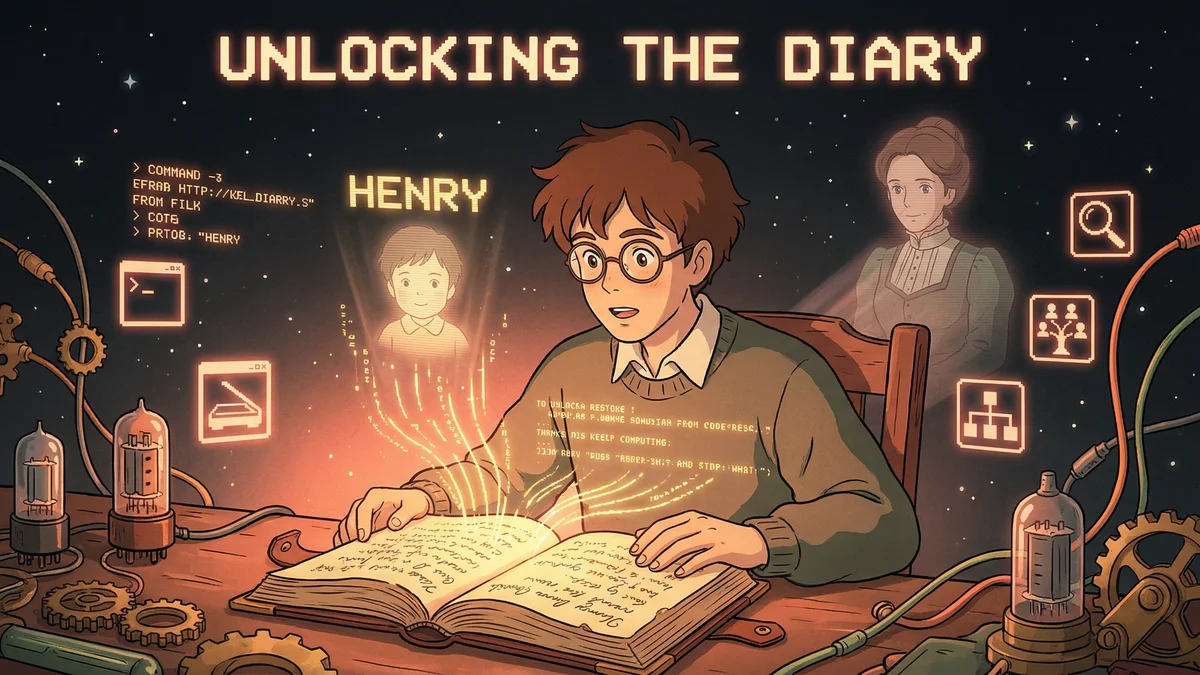
His great-grandmother wrote about a child. A child David had never heard of.
“Little Henry passed in the night. Three years old. God’s will is not ours to question but my heart is broken beyond repair.”
Henry. A great-great-uncle who died before age five. A child never mentioned in family stories. Erased by grief, now resurrected by algorithm.
Processing the Discovery
David sat with the transcription for a long time.
“I learned that she had lost a child I never knew about. It unlocked a whole chapter of family trauma and resilience that was literally locked behind ink squiggles. It felt like magic.”
Magic. That’s what he called it.
His great-grandmother wasn’t just a photograph on a wall. She was a person who had written about her days, her faith, her grief. A person who had loved and lost.
The diary contained more: recipes she collected, opinions about neighbors, hopes for her children, fears about the future. A life, in her own words, available for the first time in over a century.
How the AI Works
Ancestry’s transcription tool uses machine learning trained on historical documents.
The training process involved:
- Scanning thousands of handwritten documents from various eras
- Having human experts transcribe them correctly
- Teaching the AI to recognize patterns between script and text
- Iterating across different handwriting styles and conditions
The resulting model can parse Victorian cursive, Spencerian script, and various historical hands with reasonable accuracy.
It’s not perfect. Unusual spellings, proper nouns, and damaged sections cause errors. But it gets the bulk right — enough to make documents readable and searchable.
For David, the occasional transcription error didn’t matter. He wasn’t preparing a legal document. He was meeting his ancestor.
Beyond Diaries
The genealogy AI revolution extends beyond handwriting:
Photo Enhancement: MyHeritage offers “Deep Nostalgia” — AI that animates old photos, making static faces move. It also colorizes black-and-white images.
These features are gimmicky but emotionally powerful. Seeing a great-grandfather’s face move, even artificially, creates connection across time.
Record Matching: AI now scans census records, ship manifests, and other documents, automatically suggesting matches to your family tree. Instead of searching manually through microfilm, the system proposes: “This entry might be your ancestor.”
DNA Analysis: AI helps parse DNA matches, clustering relatives and suggesting likely relationships. It can identify which matches share common ancestors and how.
Death Record Analysis: Some tools analyze death certificates and newspaper obituaries to extract relationships and details automatically.
The Emotional Dimension
Genealogy is strange. You’re researching people you’ll never meet, who lived in worlds you can only imagine.
AI doesn’t replace that strangeness. It intensifies it.
David now knows more about his great-grandmother than any living relative does. He knows what worried her. What she cooked. Who she gossiped about.
“Reading her actual words — not a summary, not someone else’s interpretation — felt like a conversation. She wrote for herself, never expecting a great-great-grandson to read it 130 years later. But here I am.”
Henry’s existence changed his understanding of his family. Grief explains patterns. Why certain topics were never discussed. Why certain generations seemed emotionally distant.
“A child died. The family buried their grief so deeply it disappeared from oral history. But my great-grandmother wrote it down. AI let me read it. Now I carry that knowledge, and the family story is more complete.”
The Record Keepers
David has become something of an evangelist. He scanned the entire diary, transcribed it, and shared the text with extended family.
Some relatives were emotional. Some were curious. A few asked him to help with their own documents.
“Everyone has boxes. Letters from grandparents. Old photos with writing on the back. Documents in languages their families no longer speak. The AI can help with all of it.”
He’s also become more careful about his own records. Writing clearly. Storing photos properly. Thinking about what might survive him.
“My great-grandmother never expected AI to read her diary. But she wrote anyway. What am I writing that might matter to someone a century from now?”