TL;DR
- AI scanning apps identified $8,500 in value from 4,000 inherited baseball cards; a dealer had offered $600
- Apps like Ludex use computer vision to identify cards, detect variants, assess condition, and pull market prices
- One hidden $400 variant was found in a pile of apparent commons
- Best for: inherited collections, estate finds, anyone with cards they cannot evaluate themselves
- Key lesson: The knowledge barrier to collectibles has collapsed; what took years to learn now takes seconds to scan
A son used AI card scanning apps to find $8,500 in hidden value in his late father’s baseball card collection, turning an impossible sorting task into a weekend treasure hunt.
Mark’s father passed away and left him boxes. Many boxes.
Baseball cards. Thousands of them. Accumulated over decades.
Mark knew nothing about card collecting. He saw stacks of cardboard, some in plastic sleeves, most loose. Names he vaguely recognized mixed with players he’d never heard of.
His options seemed limited: spend months learning the hobby to properly sort and value them, or sell the whole lot to a dealer for whatever they’d offer. Neither appealed.
Then he found Ludex.
The Impossible Task
Card collecting has a knowledge barrier that stops most newcomers cold.
A single card’s value depends on dozens of factors: player, year, manufacturer, edition, print run, condition, centering, corner wear, surface quality, whether it’s a rookie card, whether it’s part of a special set.
The same player’s card might be worth $0.10 or $10,000 depending on details invisible to untrained eyes.
Mark looked at his father’s collection and saw an impossible sorting task. Each card would need to be:
- Identified (player, year, set, variant)
- Assessed (condition, special features)
- Valued (current market price)
- Catalogued (for insurance or sale)
Times thousands. By someone who didn’t know what he was looking at.
The Scanner Solution
Modern card collecting apps use AI computer vision to do what Mark couldn’t.
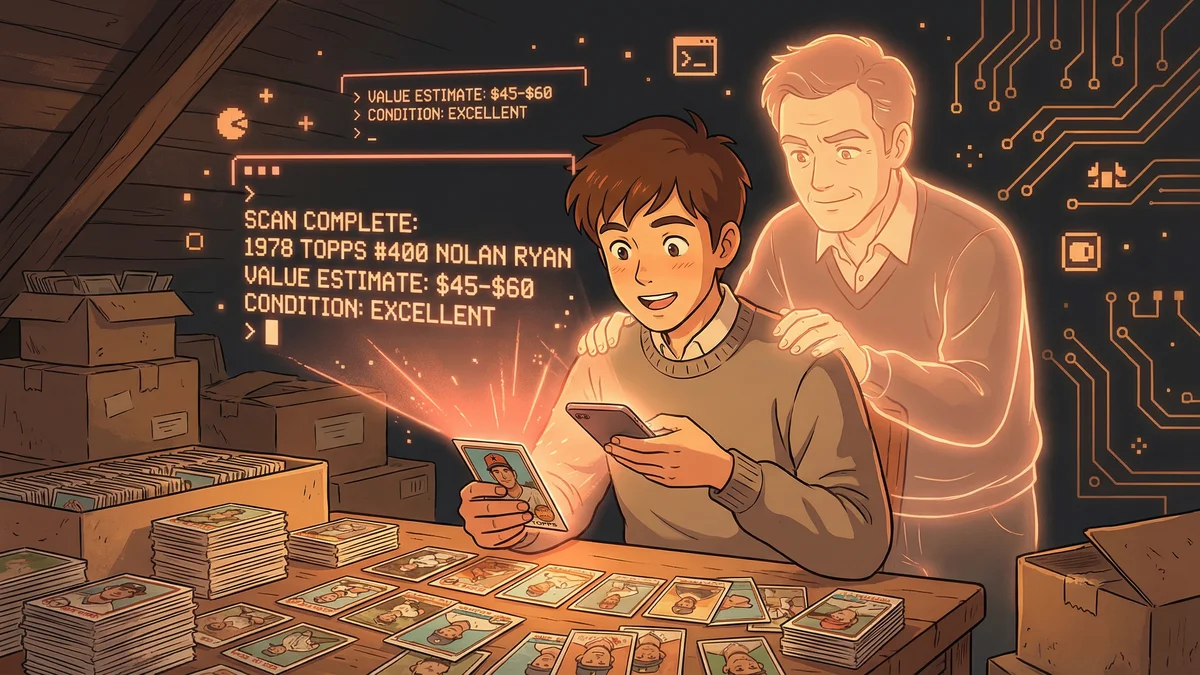
He downloaded Ludex and pointed his phone at the first card.
The app scanned it instantly. “1978 Topps #400 Nolan Ryan. Estimated value: $45-$60 based on visible condition.”
Mark blinked. That took two seconds.
He tried another. Another. The app identified cards as fast as he could position them, pulling up player info, set details, market comparisons, and estimated values.
“It felt like cheating,” Mark says. “My father spent years learning this stuff. I downloaded an app.”
The Treasure Hunt Weekend
What started as a chore became a game.
Mark set up a scanning station: good lighting, neutral background, his phone on a small tripod. He worked through boxes methodically.
Most cards were worth little — common players, worn condition, base sets with no premium. That was expected. The treasure hunt was finding the exceptions.
And he found them.
“There was a card in a stack of commons that I almost missed. The app identified it as a special parallel variant — different border finish, limited print run. Market value: $400.”
Four hundred dollars. In a pile he would have sold for pocket change at a garage sale.
What the AI Sees
These apps use several AI capabilities:
Image Recognition: The primary technology. The AI identifies the card by analyzing its visual features — layout, colors, text positioning, logos. It matches against a database of known cards.
Variant Detection: The sophisticated part. Many cards look nearly identical but differ in small ways: holographic borders, alternate photography, numbered print runs. The AI distinguishes these variants, which often differ dramatically in value.
Condition Assessment: Some apps (like CardGrader.AI) analyze the card’s condition. They measure centering (is the image properly aligned?), examine corners (are they sharp or rounded?), detect surface issues. This mimics what professional grading services do.
Market Integration: The apps pull recent sales data from marketplaces like eBay, showing what similar cards actually sold for — not asking prices, but completed transactions.
Mark used multiple apps to cross-reference. If one said a card was valuable, he’d check with another. Agreement built confidence.
The Pre-Grade Game
Beyond identification, Mark discovered he could assess which cards were worth submitting for professional grading.
Professional Grading Services (PSA, BGS, SGC) evaluate cards and seal them in cases with grades from 1-10. A PSA 10 (gem mint) card can be worth 10x or more than an ungraded copy.
Grading costs money and takes months. You don’t want to submit cards that will come back as low grades.
CardGrader.AI offered a solution. Mark could photograph a card and get an AI prediction: “Estimated PSA grade: 7-8. Centering is off left. Corners show minor wear.”
This let him triage. Cards likely to grade highly went in one pile for submission. Cards with visible issues stayed ungraded, valued appropriately.
“The AI basically gave me expert eyes. It saw what I couldn’t — the subtle flaws that affect value.”
The Final Count
Over two weekends, Mark scanned approximately 4,000 cards.
The haul:
- 3,800 cards worth $0-$5 each (sold as lots)
- 180 cards worth $5-$50 each (sold individually)
- 15 cards worth $50-$200 each (carefully listed)
- 5 cards worth $200+ (sent for professional grading)
Total estimated value: around $8,500.
A dealer’s blind offer for the whole collection had been $600.
“The app paid for itself several thousand times over. But honestly, that’s not the best part.”
The Real Discovery
Going through his father’s collection, card by card, became something Mark didn’t expect: a connection to his dad.
“I found cards from the 1970s in mint condition — Dad must have known to protect them even back then. I found duplicates of certain players, probably his favorites. I found cards from the year I was born, like he was documenting time.”
The AI handled the identification. Mark handled the memories.
“I know more about my father’s hobby now than I ever did while he was alive. The scanning turned a chore into a conversation with the past. Every valuable card made me wonder: did Dad know this was special? Did he keep it safe on purpose?”
The New Hobby
Mark kept some cards. His father’s favorites. The ones that felt like inheritance, not inventory.
He also kept scanning.
“I catch myself at estate sales now, flipping through card boxes. The app is always on my phone. Last week I found a $80 card in a dollar bin. That little hit of discovery — I understand why Dad collected now.”
The AI made an overwhelming task manageable. In doing so, it opened a door Mark hadn’t known existed.
His father’s hobby became his own.