TL;DR
- Three professionals stopped delegating specific tasks to humans
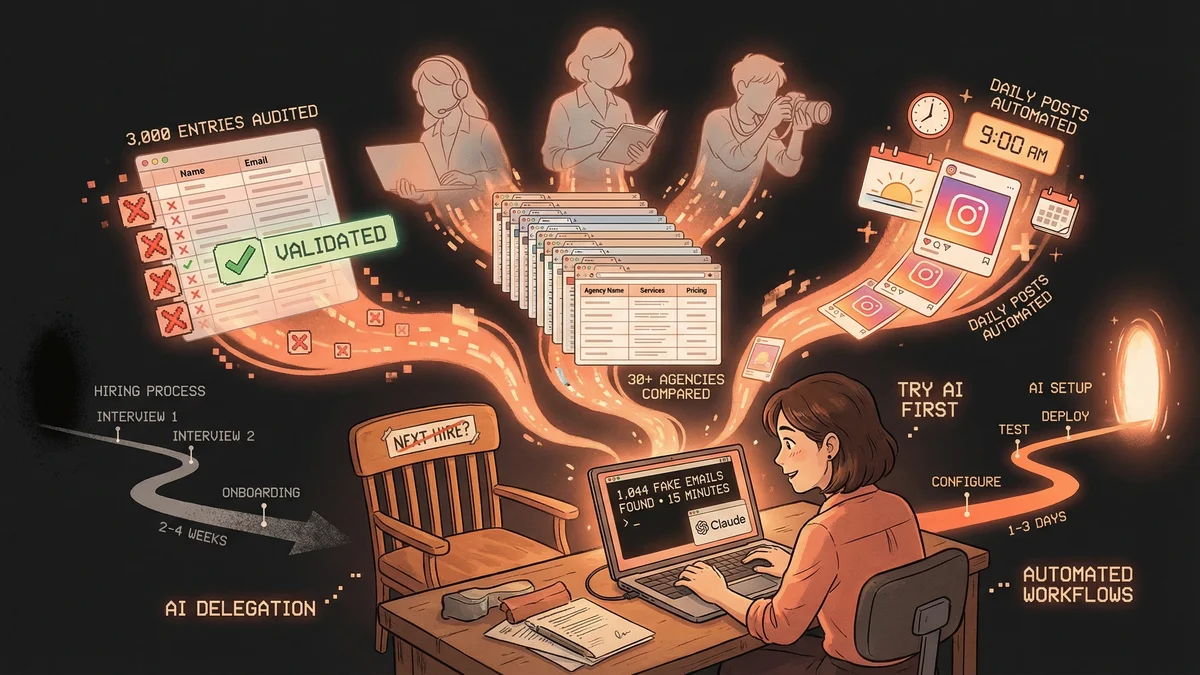
- Miriam: 3,000-entry email audit in 15 minutes (found 1,044 fakes)
- Demetri: 30+ agency competitive analysis automated from inbox
- Sibin: Social media posts daily before he wakes up
- Best for: Business owners evaluating hiring vs automation
- Key lesson: Try AI delegation before adding headcount
The question changed from “Should I hire someone?” to “Should I try AI first?”
The Marketing Data Problem
Miriam (@miriam_ferd) is a professional marketer. She had a 3,000-entry email list that needed cleaning.
This week, she gave it to Claude. 15 minutes later:
- 1,044 fake signups detected (34.8% of the list)
- Phone numbers validated against carrier networks
- Pattern recognition humans would miss in spreadsheet scanning
- Clean list of verified contacts ready
The task would have gone to a VA or intern. “Sort through this, flag anything suspicious, validate the phone numbers.”
Instead: paste data, ask Claude, get results.
But caption writing gets all the attention. Email list auditing doesn’t make LinkedIn posts. Yet it saved actual money — paying to email 1,044 fake addresses compounds monthly.
“AI does not replace the strategy,” she wrote. “It makes building the strategy 10x faster.”
Three other use cases she runs regularly:
- System building: Map customer journeys, design segmentation, plan automation timing
- Performance analysis: Paste campaign metrics, ask “What patterns do you see?”
- Campaign planning: Build tracking dashboards before writing emails
The 95% of AI marketing nobody posts about.
The Research Assistant Task
Demetri Panici had 30+ PR agency emails in his inbox. He was about to delegate: “Read these, compare their services, give me a breakdown.”
Then he connected Claude to Gmail via MCP. One prompt.
It read every email, scraped every agency website, compared their services, and delivered a full competitive breakdown.
The task that would’ve taken an employee 2-3 hours of manual work got automated into a single instruction. Email triage + website research + competitive analysis in one flow.
This is the new research assistant baseline. Not “Can you summarize this?” but “Can you read 30 sources, cross-reference them, and build me a comparison table?”
And it doesn’t get tired at source #18.
The Social Media Manager Role
Sibin Arendran (@sibinarendran) built “Somi” — an AI agent that runs his entire social media presence.
The daily routine (all autonomous):
- Research the brand (Dooza)
- Plan content
- Write the post
- Generate a matching image
- Post to Instagram
Runs every morning at 9 AM IST. By the time Sibin wakes up, content is live.
Zero scheduling tools. No content calendars. No Canva. No copywriter.
One setup instruction: “Every morning, research Dooza, plan content, write it, generate a matching image, and post it.”
This is the “AI employees not AI tools” philosophy in practice. Tools help you work faster. Employees do the work.
Sibin isn’t asking “Should I hire a social media manager?” He already has one. It runs on dooza.ai, the platform he’s building for small businesses.
The mental model shift: AI that owns a function end-to-end, not assist-mode AI.
The Pattern
All three eliminated delegation:
- Miriam: Would’ve tasked an assistant with data cleaning → 15-minute Claude session
- Demetri: Was about to delegate research to employee → one prompt to Gmail MCP
- Sibin: Hired “Somi” instead of a social media manager → daily autonomous posts
The common thread: tasks that follow rules, use data, and repeat regularly.
Email list auditing follows rules (phone format validation, signup pattern matching). Competitive research follows a process (read, extract, compare). Social media posting follows a workflow (research, write, design, publish).
These aren’t creative strategy roles. They’re execution roles. And execution that follows structure is AI-delegatable.
What This Means
The business owner’s calculus changed:
Old question: “Should I hire someone to handle this?”
New question: “Should I try AI delegation first, and hire only if it doesn’t work?”
Time to answer:
- Hiring: 2-4 weeks (post job, interview, onboard, train)
- AI delegation: 1-3 days (set up tool, test workflow, iterate)
Cost difference:
- Virtual assistant: $15-25/hour, ongoing
- AI tool: $20-200/month flat rate
Risk difference:
- Hiring: Commitment, management overhead, offboarding if wrong fit
- AI delegation: Cancel subscription, zero friction
Not every task works. Creative strategy, relationship-building, and judgment calls still need humans. But data cleaning, research aggregation, and rule-based content? Try AI first.
The “next hire” might not be a person anymore.