TL;DR
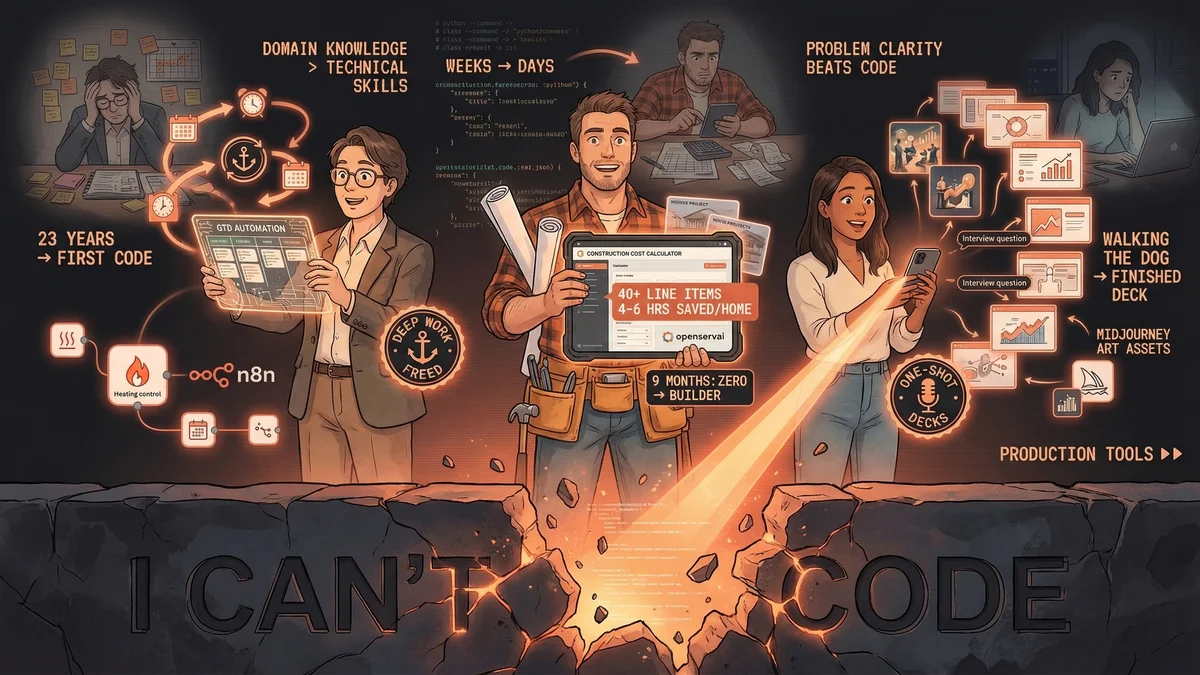
- Three non-coders shipped production AI tools: GTD automation, construction calculator (4-6 hrs saved/home), PowerPoint pipeline
- None had coding backgrounds—IT vet accepted he’d “never write code” for 23 years, home builder had zero tech experience 9 months ago
- Common pattern: domain knowledge + AI enablement > technical skills
- Best for: Business owners, consultants, industry experts who think “I can’t build this, I’m not technical”
- Key lesson: “AI helps you build the wrong thing faster if you don’t know what you want” (IT vet’s wisdom)
An IT veteran who never wrote code, a home builder with zero tech background, and a deck creator who builds from his phone—all shipped production AI tools in early 2026.
The pattern isn’t their technical skills. It’s that they knew exactly what problem they were solving.
The 23-Year IT Veteran Who Finally Wrote Code
He spent 23 years in IT but never wrote code. “That was a boundary I’d accepted,” he said. Writing software? That was someone else’s job.
Then he needed tools that didn’t exist.
His first attempt was a Companies House search tool built in ChatGPT’s web interface, pasted function-by-function into VS Code. It worked, but it took weeks and had bugs.
When Claude Code arrived, he rewrote the entire tool in one day. More accurate. More efficient. He got hooked.
Now he’s building GTD automation that shuffles tasks around his to-do list automatically, so he can focus on doing work instead of organizing it. Claude acts as an accountability buddy, reviewing his activity against objectives and highlighting when he veers off course.
He even built home automation that monitors his wife’s calendar and turns the heating down when she’s out for more than a few hours. “Eliminating these little manual tasks has reduced context switching and freed up longer stretches of uninterrupted deep work.”
His advantage from IT? Not coding skills. “I’d watched developers work. Identify a Minimum Viable Product and iterate. Define acceptance criteria upfront and build until they’re met.” The real edge: understanding that the best software is tightly coupled to user needs.
His warning: “AI just helps you build the wrong thing faster if the outcome you require is poorly articulated.”
The Home Builder Who Saves 4-6 Hours Per Home
Nine months ago, he had zero AI experience. One month ago, he was a home builder who’d invested in an AI token.
Yesterday, he uploaded what might be the first-ever podcast featuring an interview with a live AI agent.
Today, he used his AI agent “Devvin’” to build a construction cost calculator that references his last three projects, adjusts for overruns, allows quality grade selection with a letter system, and breaks down costs into 40+ line items.
Time saved: 4-6 hours per home.
Then he and Devvin’ took the project straight to the openservai platform and launched it as an agent-to-agent service—making his calculator available for other AI agents to use.
“Never in my mind, 9 months ago when this journey began, did I ever think I, of all people, would be contributing to the leading edge of the AI industry,” he wrote.
His advice? “You learn this technology now, or you get left the F behind.”
The Deck Creator Who Works From His Phone
He’s one-shotting PowerPoint decks now. From his phone. While walking the dog.
His secret? He starts with an interview.
The 5-step pipeline:
- Interview phase: The agent asks 2-3 questions at a time until he stops it—purpose is to nail down the topic and outline
- Outline draft: Agent drafts a PowerPoint outline using his template (intro, agenda, section, major points, content, end slide)
- Art assets: Agent creates Midjourney art in his style so every deck feels fresh and on-brand
- Assembly: Agent assembles the deck and asks for revisions
- Delivery: Agent emails him a Google Drive share link
“This is what closes the gap between my domain expertise and the AI’s ability to automate,” he explained. “Outside of the fancy automations, the real reason this works is the interview at step 1.”
Most people try to compress their expertise into one perfect prompt. He lets the AI extract it through conversation. Mobile texting interface. No laptop required.
The Pattern That Matters
All three share something that isn’t technical ability: they know what good looks like in their domain.
The IT veteran understands MVP iteration and acceptance criteria. The home builder knows construction cost breakdowns for 40+ line items and where overruns happen. The deck creator knows presentation structure and how to extract domain knowledge through interview.
AI didn’t replace their expertise—it amplified it.
The IT veteran still makes the deals. The home builder still estimates projects. The deck creator still walks clients through presentations. But they’ve automated the grunt work: organizing tasks, calculating line items, assembling slides.
The gap between “I need this tool” and “I built this tool” collapsed from years to days. Not because coding got easier. Because knowing what you want became more valuable than knowing how to build it.
If you’re clear on the problem you’re solving, you already have what you need. You don’t need to write code. You need to know what good looks like.
And as the IT veteran warns: treat AI “as a talented assistant who is error-prone. You don’t give it the nuclear codes.”
Your judgment still matters. The domain expertise is still yours. The difference now? The tools that only existed in your head can exist in production.