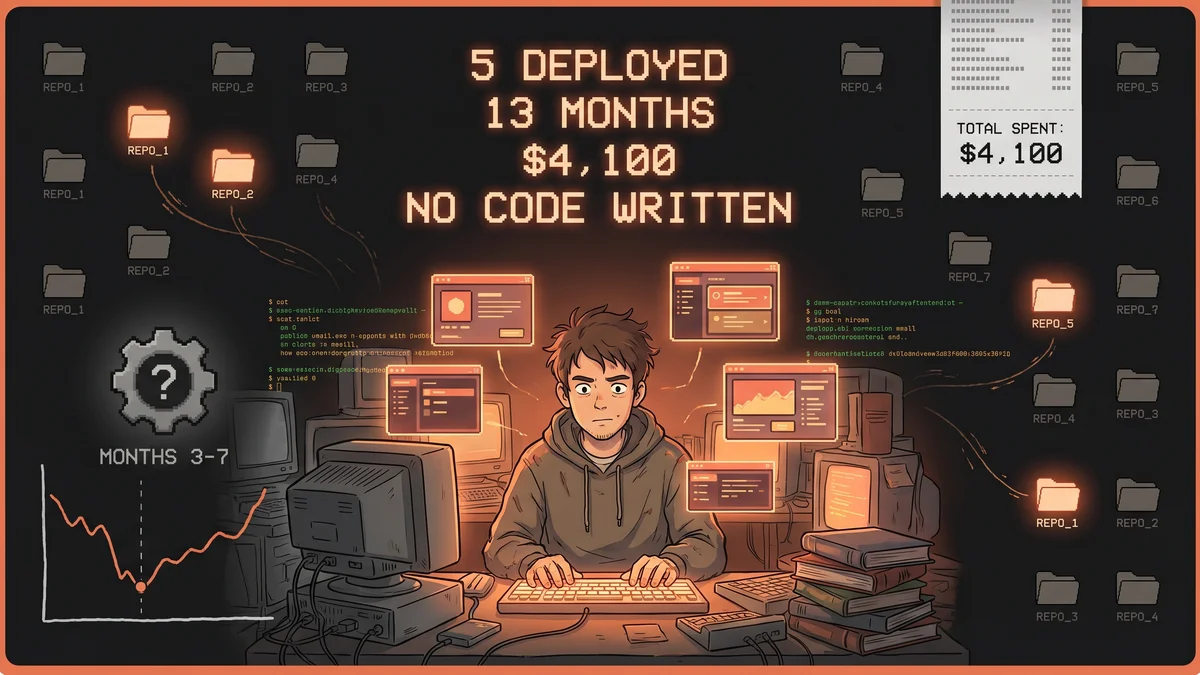
In March 2025, a developer who goes by u/Studio2C made a decision: no more hand-written code. Every line from that point forward would come from AI agents. Thirteen months later, he had 5 deployed products, roughly 20 repositories, $4,100 in invoices, and a retrospective that’s unusual for one reason — he didn’t sanitize the bad parts.
What He Built
The five products have a coherent logic behind them. Scrivibe turns AI-generated content into eBooks formatted for Amazon KDP. Draftto handles automated WordPress posts and X threads. Chetmail sends content digest emails. Smartcontract runs AI-powered smart contract auditing. Wipelist manages YouTube playlist organization.
None are moonshots. All solve specific problems. That’s intentional — Studio2C’s rule is to only build what he personally uses. “If I’m not the target user,” he noted, “I don’t feel the friction, I don’t know what actually matters, and I’ll abandon it when I hit a wall.”
The cost across 76 invoices averaged $250-400 per month. The heaviest month — $1,100 — corresponded to active development cycles. At launch, two products were generating around $100/month combined. The other three were either too new to have revenue or winding down.
Months 3-7: When It Nearly Broke
This is the section most retrospectives skip. Studio2C didn’t.
As projects grew larger, the AI started losing coherence. It would contradict architectural decisions made weeks earlier. It would generate fixes that worked in isolation but broke three other things. It would burn cycles confidently heading in the wrong direction.
“A major update dropped, and it was night and day,” he wrote. He doesn’t specify which model update, but the implication is clear: the quality floor rose significantly, and projects that had been stuck became unstuck. The difficult months weren’t a reason to quit — they were an artifact of a tool that was still maturing.
This matters for anyone considering the same path. The rough patch wasn’t from bad prompting or bad product ideas. It was from asking an early version of the tool to hold context across a codebase it wasn’t designed to handle. The tool caught up. The projects survived.
What 20 Repositories Actually Looks Like
Most failed. That’s not a criticism — it’s the model. The goal was never to make every project work. It was to ship fast enough that the ones worth continuing revealed themselves before months of investment were already sunk.
The economics work differently than traditional development. The barrier to starting something is so low that the cost of killing it is also low. Studio2C could spin up a new repo, test an idea for $300 in compute time over a few weeks, and shut it down if it didn’t have legs. The ~$67/month per deployed product includes all infrastructure, compute, and development time in AI costs.
A comment in the thread put it well: “I built a SaaS in 4 days spending $20. I am a developer so I create the flows and AI does the work.” That’s the ceiling case. Studio2C’s numbers show what the non-developer middle looks like — slower, more expensive, but achievable.
The One Rule That Explains the Whole Thing
Every product he kept building is something he actively uses. Every project he abandoned had a moment where he realized he was building for a user he’d only imagined.
That’s not a new idea in indie hacking circles. But the AI-first context makes it sharper. When AI is doing the implementation work, the temptation to keep going is high — it’s fast, it’s cheap relative to hiring, it doesn’t argue back. The only reliable filter for “should I keep building this” is whether you would be genuinely annoyed if the product disappeared tomorrow.
Thirteen months of building this way didn’t produce a unicorn. It produced five real products, two generating revenue, one developer with a clear methodology, and a retrospective honest enough to be useful to the next person who wants to try it.
That might be more valuable than a moonshot story.