TL;DR
- 79% faster time-to-market: features delivered in 5 days instead of 24
- Claude Code ran autonomously for 7 hours, refactoring hundreds of files
- 99.9% accuracy on complex code modifications
- Best for: large-scale codebase modernization, pattern migration, legacy refactoring
- Requires: clear specifications, automated validation, checkpoint commits
Autonomous AI coding can refactor hundreds of files in a single 7-hour session with 99.9% accuracy—but only with clear specifications and automated validation in place.
The refactoring project had stalled.
Rakuten’s engineering team faced a massive codebase modernization. Legacy patterns needed updating. Dependencies needed migrating. Hundreds of files needed changes that were consistent but tedious.
Traditional approach: assign developers, estimate weeks, watch progress crawl.
“We’d been through this before. Big refactoring projects are demoralizing. Engineers spend days on mechanical changes. The actual intellectual work takes 10% of the time.”
They decided to try something different.
The Seven-Hour Benchmark
What surprised everyone wasn’t just that Claude Code could refactor.
It was that it could refactor continuously for seven hours.
Not quick prompts and responses. Not human-in-the-loop every few minutes. Seven hours of sustained autonomous operation. File after file. Pattern after pattern.
“We set it up at night. Checked in the morning. It had been working the whole time.”
The Results That Mattered
The numbers were dramatic.
Time to market: 79% improvement. Features that previously took 24 days to deliver now took 5 days.
Accuracy: 99.9% on complex code modifications. The refactored code worked.
Coverage: Hundreds of files processed. Patterns applied consistently across the entire codebase.
“We’d estimated three months for this refactoring. It was done in weeks.”
The Setup That Enabled It
Seven hours of autonomous operation didn’t happen by accident.
Clear specifications: Before starting, the team documented exactly what transformations were needed. Which patterns to change. What the new patterns should look like. Edge cases to handle.
Validation gates: After each batch of changes, automated tests ran. Failing tests triggered review and correction before continuing.
Checkpoint commits: Progress saved regularly. If something went wrong, rollback was possible without losing everything.
Context management: The session used techniques to maintain coherence over hours — periodic summarization, strategic context clearing, focused scopes.
The Workflow Architecture
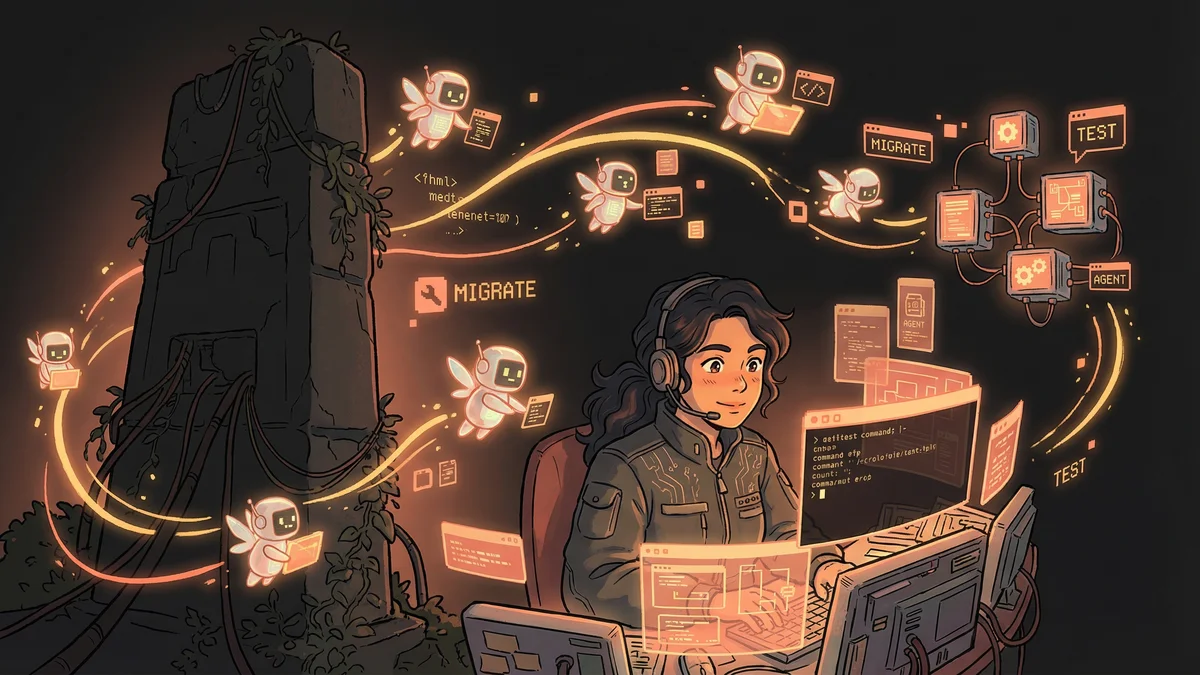
The refactoring ran as a structured workflow.
Phase 1 — Analysis: Claude analyzed the codebase. Identified all files matching the legacy patterns. Generated a task list.
Phase 2 — Transformation: For each file, Claude applied the specified refactoring. Updated imports. Changed patterns. Adjusted dependencies.
Phase 3 — Validation: After each transformation, automated tests verified correctness. Static analysis confirmed code quality.
Phase 4 — Iteration: Failed validations triggered rework. Claude diagnosed the issue and tried alternative approaches.
The four phases looped continuously. File after file. Hour after hour.
The Consistency Advantage
Human developers are inconsistent.
Different people apply patterns differently. Fatigue introduces variation. Attention wavers over long sessions.
“Claude applied the same transformation pattern to file 500 as it did to file 1. No fatigue. No variation.”
The consistency was almost unsettling. Perfectly uniform changes across hundreds of files.
The Enterprise Context
Rakuten isn’t a startup experimenting.
It’s a global technology company with production systems serving millions of users. The code being refactored wasn’t a side project — it was critical infrastructure.
“This was real production code. Real business impact. Real risk if it went wrong.”
The fact that they trusted Claude for this workload said something about the maturity of the technology.
The 99.9% Accuracy Number
The accuracy claim needed unpacking.
99.9% meant: of the hundreds of transformations applied, virtually all produced correct, working code.
“We did have to fix things. But the fix rate was less than 1%. That’s better than most human-to-human code handoffs.”
The errors that did occur were edge cases. Unusual patterns Claude hadn’t seen. Interactions between systems the specification hadn’t anticipated.
The Developer Experience Shift
Engineers who had dreaded the refactoring project felt differently about it afterward.
“Instead of spending weeks on mechanical changes, we spent days reviewing Claude’s work and handling exceptions.”
The tedious part was automated. The interesting part — edge cases, architectural decisions, complex integrations — remained for humans.
“Our job became quality assurance and exception handling. Not typing.”
The Cost Analysis
Seven hours of continuous Claude operation cost money.
But compare to the alternative: dozens of developer-days. Engineers pulled from feature work. Opportunity cost of delayed releases.
“The API costs were a fraction of what the developer time would have cost. Not even close.”
The ROI wasn’t subtle. It was obvious to anyone who did the math.
The Reproducibility
Could other organizations replicate this?
“Yes, with the right setup. The key ingredients: clear specifications, validation automation, checkpoint discipline.”
Organizations without these foundations would struggle. Claude could run for seven hours, but without tests to validate its work, you wouldn’t know if it succeeded.
“Autonomous operation requires autonomous validation. You can’t have one without the other.”
The Scaling Implications
If seven hours worked, what about fourteen? Twenty-four? Longer?
“We’re exploring more extended sessions. The theoretical limit isn’t clear yet.”
Other organizations reported even longer autonomous runs. The pattern suggested hours were just the beginning.
The Human Role Evolution
The project changed how Rakuten’s engineers thought about their work.
“We used to think in terms of ‘how do I implement this?’ Now we think in terms of ‘how do I specify this so AI can implement it?’”
The specification skill became the valuable skill. Clear requirements. Testable criteria. Edge case documentation.
“If you can write a spec that a machine can follow, you can leverage machine scale.”
The Quality Assurance Emphasis
More time went into validation than generation.
“Claude could produce changes fast. Our bottleneck became reviewing and testing those changes.”
QA processes adapted. More automated testing. More comprehensive validation. The human effort shifted from creation to verification.
The Competitive Advantage
79% faster time to market wasn’t just an internal metric.
“We could ship features while competitors were still planning. The velocity difference was strategic.”
In competitive markets, speed matters. The ability to execute refactoring projects that would paralyze other teams was a capability advantage.
The Cultural Impact
The success changed the organization’s attitude toward AI-assisted development.
“Before this project, AI coding was experimental. After, it was strategy.”
More teams adopted similar approaches. The seven-hour benchmark became a reference point. “Can we do for X what we did for refactoring?”
The Lessons Extracted
Rakuten documented what they learned:
Specification quality determines outcome quality. Vague requirements produce vague results. Precise specifications produce precise transformations.
Validation infrastructure is mandatory. Without automated tests, you can’t trust autonomous operation.
Scope management matters. Even within a large project, breaking into focused scopes improved results.
Human oversight is strategic, not tactical. The human role is designing the process and handling exceptions, not watching every step.
The Ongoing Journey
The refactoring project was one application.
“We’re applying the same pattern to other areas. Test generation. Documentation. Migration projects.”
Each success expanded the scope of what they attempted. The seven-hour benchmark was a proof point that enabled larger experiments.
“This is how enterprise AI adoption actually works. Prove it on one project. Expand from there.”