TL;DR
- Claude Code automatically fixes 87% of trivial CI failures (formatting, imports, type errors)
- Engineering time on CI fixes dropped from 15% to 3% of total hours
- Cost: ~$60/month for 400 failures; ROI of 50x vs developer time
- Best for: High-velocity teams with frequent trivial build breaks
- Key constraint: Limit auto-fixes to 3 lines max, require human approval before merge
A development team built a CI/CD pipeline where Claude Code analyzes build failures and automatically commits fixes for trivial errors — reducing mean time to green build from 12 to 4 minutes.
Jake’s team had a rule: broken builds get fixed immediately.
The problem: builds broke constantly. Linting failures. Dependency conflicts. Type errors from hasty commits. Each break meant someone dropped what they were doing to investigate and fix.
“We spent 15% of our engineering time just fixing CI failures. Most were trivial — someone forgot to run the formatter before committing. But trivial breaks still required human attention.”
Jake wondered: what if the pipeline could fix itself?
The Hypothesis
Most CI failures fell into predictable categories:
- Formatting violations — fixable by running prettier/eslint
- Import errors — fixable by adding missing imports
- Type errors — often fixable by correcting obvious mistakes
- Dependency conflicts — fixable by updating lock files
“These aren’t creative problems. They’re mechanical corrections. Why does a human need to do them?”
Jake proposed an experiment: when CI fails, trigger Claude Code to analyze the failure and attempt a fix.
The Architecture
The self-healing pipeline had four components:
1. The Failure Webhook When GitHub Actions detected a failure, it triggered a secondary workflow that downloaded the build log and invoked Claude Code.
2. The Analyzer Prompt Claude received the build log with instructions: “Analyze this CI failure. Identify the root cause. If this is a trivial fix (formatting, simple type error, missing import), make the fix. If it requires architectural changes or human judgment, report the issue without attempting repair.”
3. The Fix-and-Push Logic
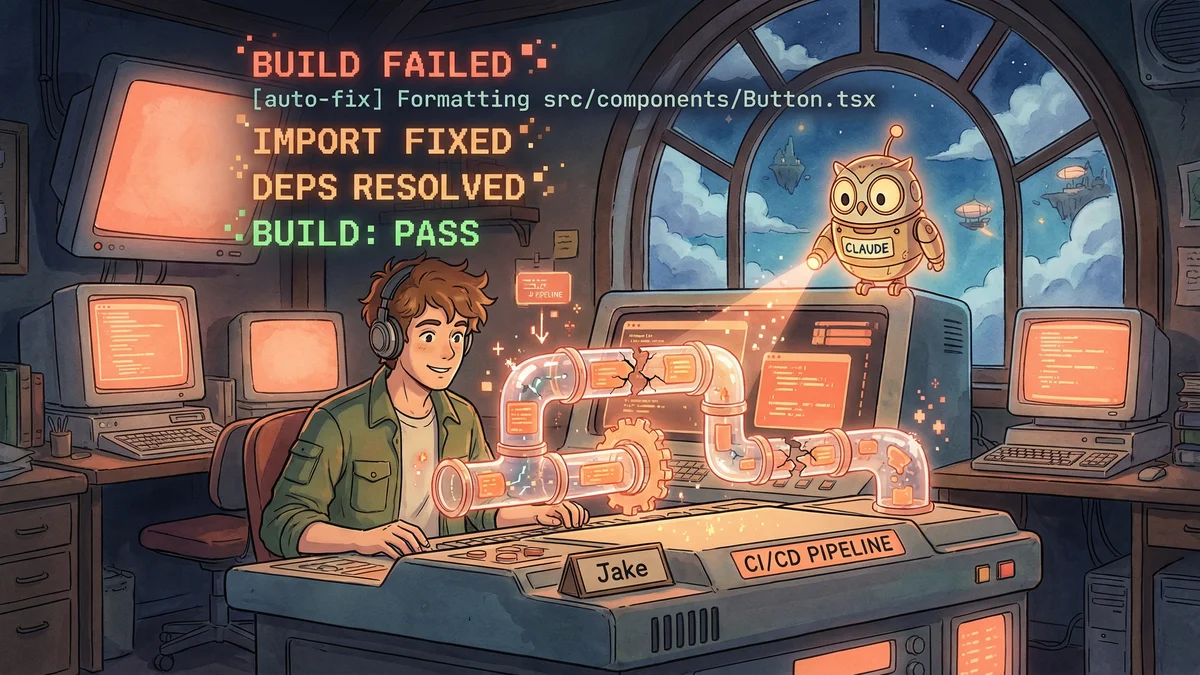
When Claude identified a trivial fix, it made the change, ran local verification, and pushed a commit with the prefix [auto-fix].
4. The Guard Rails
- Maximum 3 auto-fix attempts per PR
- Fixes limited to specific file patterns (no touching configs or sensitive files)
- All auto-fix commits required human approval before merge
“We weren’t building autonomous deployment. We were building autonomous triage.”
The First Week
Jake enabled the system on a trial branch.
Monday morning, a developer pushed code with a formatting violation. The build failed. Seven minutes later, a commit appeared: [auto-fix] Format src/components/Button.tsx.
The fix was correct. Build passed. No human intervention required.
“The developer didn’t even notice. They pushed, went to get coffee, came back to a green build. The friction disappeared.”
By Friday, the self-healing pipeline had automatically fixed:
- 12 formatting violations
- 4 missing imports
- 2 obvious type errors
That’s 18 developer interruptions prevented.
The Learning Curve
Not every fix attempt succeeded.
Claude sometimes misdiagnosed problems. A type error that looked trivial actually required a structural change. Claude would “fix” the immediate error, creating a new error downstream.
“We learned to limit the fix scope. If Claude’s change touched more than 3 lines, it probably wasn’t trivial. Those got escalated to humans.”
The team refined the analyzer prompt: “Only fix problems where a single line change resolves the issue. If the fix requires multiple related changes, report but don’t attempt repair.”
Conservative limits prevented cascading mistakes.
The Pattern Recognition
After a month of data, patterns emerged.
Most common fixable errors:
- Prettier formatting (45%)
- ESLint auto-fixable rules (30%)
- Import statement ordering (15%)
- Trailing commas/semicolons (10%)
Most common non-fixable errors:
- Business logic type mismatches
- Test assertion failures
- Build configuration issues
- Dependency version conflicts
“We didn’t try to make Claude fix everything. We made it fix the boring stuff and escalate the interesting stuff.”
The Developer Experience
Developers adapted their workflow.
Before: Push → Wait for CI → Get notified of failure → Context switch → Fix → Push again → Wait
After: Push → Wait for CI → Either green build or [auto-fix] commit already made
“The cognitive load of CI maintenance dropped to near zero. Developers trusted that trivial breaks would heal themselves.”
Code reviews now focused on logic, not formatting. The pre-commit discussion of “did you run the linter?” became unnecessary.
The Metrics
After three months:
- Developer time on CI fixes: 15% → 3%
- Mean time to green build: 12 minutes → 4 minutes
- Auto-fix success rate: 87%
- False positive rate: 2% (fixes that introduced new issues)
The 2% false positive rate was acceptable because all fixes required human approval before merge. Bad auto-fixes got rejected; good ones got approved without thought.
The Edge Cases
Some scenarios required special handling.
Flaky Tests: Tests that failed randomly couldn’t be auto-fixed. The system learned to detect flakiness (same test fails inconsistently across runs) and alert rather than attempt repair.
Dependency Updates: When package.lock conflicts occurred, the system regenerated the lock file rather than trying to resolve conflicts manually. Simple but effective.
Type Errors in Generated Code: Auto-generated files sometimes had type issues that required regenerating, not patching. Claude learned to detect generated file patterns and invoke regeneration scripts.
“Every edge case taught us to constrain Claude’s autonomy in that area. Fewer auto-fix capabilities, but higher reliability.”
The Team Dynamics
The self-healing pipeline changed team culture.
Junior developers felt less anxiety about breaking builds. The safety net caught trivial mistakes. They experimented more freely.
Senior developers spent less time on maintenance. CI baby-sitting time became feature development time.
“Nobody missed the old way. Arguing about formatting in code review was never fun. The robot handling it was pure upside.”
The Cost Analysis
Running Claude Code on every CI failure added cost.
Average analysis: ~$0.10 per failure Average fix attempt: ~$0.05 additional Monthly CI failures: ~400
Total monthly cost: ~$60
Developer time saved: ~30 hours/month at ~$100/hour effective cost = $3,000
ROI: 50x
“This is the cleanest ROI I’ve ever calculated for a tool. The math isn’t even close.”
The Extension
Success bred ambition.
Jake’s team extended the concept:
- Auto-updating dependencies: When security patches released, Claude evaluated compatibility and proposed upgrade PRs
- Auto-documentation: When API endpoints changed, Claude updated the corresponding docs
- Auto-changelog: When features merged, Claude wrote changelog entries
“The pipeline became a teammate. It handled the mechanical work that nobody wanted to do.”
The Philosophy
Jake reflected on what the project taught him:
“CI failures aren’t problems to solve. They’re categories of problems, some trivial, some complex. The trivial ones shouldn’t require human attention.”
The insight applied beyond CI. Any repetitive task with clear patterns and verifiable outcomes could be automated. The key was knowing where to draw the line.
“We automated the 80% that was boring. We preserved human judgment for the 20% that was interesting.”
The Current State
Two years later, the self-healing pipeline is infrastructure.
New developers don’t even know builds used to fail and stay failed until someone fixed them. The concept seems obvious in retrospect.
“Every team should have this. Not because it’s sophisticated — because it’s obvious. Machines should fix machine problems. Humans should solve human problems.”
The builds stay green. The developers stay focused. The robot handles the rest.