TL;DR
- AI processed 3,847 papers to find patterns, gaps, and contradictions across the corpus
- Found obscure cross-domain connections that keyword search missed entirely
- Identified implicit assumptions shared by thousands of papers—one became a new research direction
- Best for: gap analysis, cross-field connections, contradiction mapping, hypothesis generation
- Limitation: Claude tells you what papers say, but domain expertise is still needed for interpretation
AI corpus analysis can find research patterns, hidden connections, and gaps across thousands of papers that no human could read—transforming literature review from months to days.
Troy had a research question no search engine could answer.
Not “what papers exist about X” — that was easy. But “across thousands of papers, what patterns connect X to Y in ways nobody has explicitly studied?”
He needed synthesis across a corpus, not retrieval from it.
“I wanted to find the weird cross-connects. The unexpected bridges between fields. The insights hiding in the gaps between papers.”
Google Scholar gave him papers. He needed understanding.
The Research Unit Concept
Troy discovered Claude Code while looking for better research tools.
“Someone described it as a ‘monster research unit.’ Not just search — synthesis. The ability to actually read papers and find patterns across them.”
The idea was appealing. Feed Claude thousands of papers. Ask questions that span the corpus. Get answers that no single paper contained.
“Traditional literature review is reading papers one at a time and building patterns in your head. What if AI could hold all the papers simultaneously and build patterns computationally?”
The arXiv Experiment
Troy started with arXiv, the preprint server for physics, mathematics, and computer science.
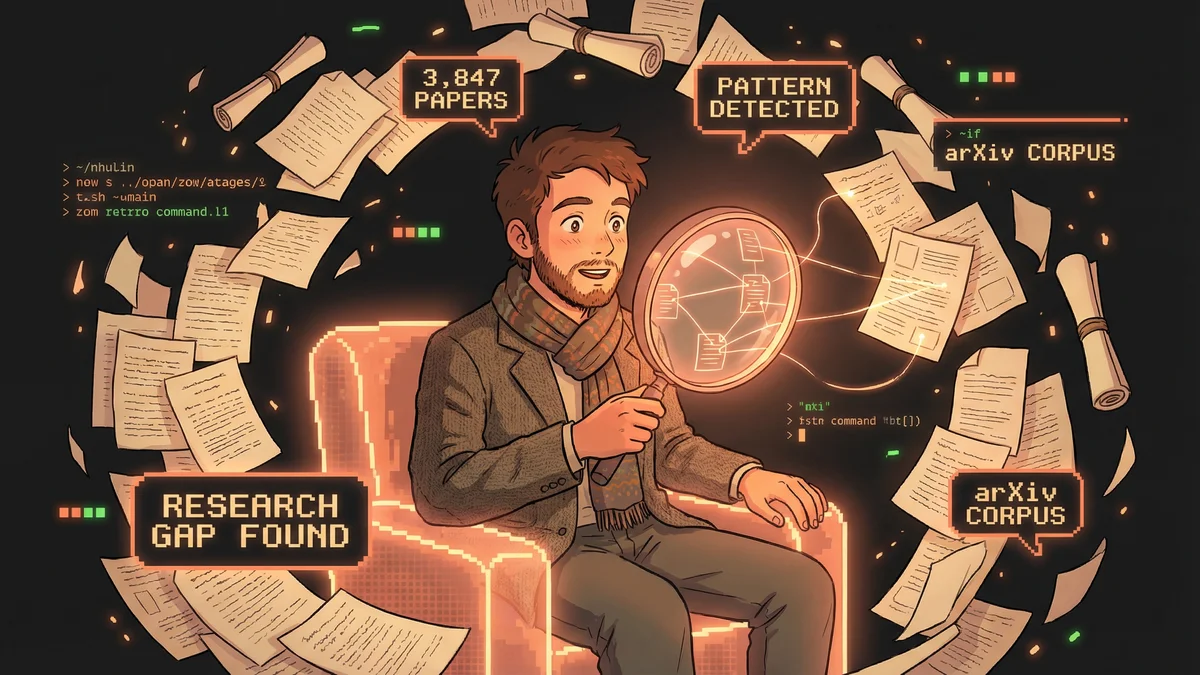
He downloaded every paper from 2023 in his subfield. 3,847 papers. PDFs sitting in a folder.
“I pointed Claude Code at the folder and asked: ‘Read all of these. Tell me what problems researchers keep encountering but nobody has solved.’”
Claude processed the papers. Took hours. But then reported back with a list of recurring challenges — problems mentioned in paper after paper, often in the “future work” or “limitations” sections.
“Nobody had compiled this list before. It existed distributed across thousands of papers. Now it existed in one document.”
The Needle-in-Haystack Pattern
The first use case was finding obscure references.
“I was looking for papers that mentioned a specific technique applied to a specific problem. Maybe three papers in the entire corpus.”
Keyword search failed — the technique had multiple names, the problem was described differently by different authors.
“Claude understood what I meant, not just what I typed. ‘Find papers that use X-type approaches for Y-type problems, regardless of what they call it.’”
The three relevant papers surfaced. One used terminology Troy had never encountered. He wouldn’t have found it with keyword search.
The Cross-Connect Discovery
The more powerful application was finding unexpected connections.
“I asked: ‘What papers in this corpus cite research from outside my field? What connections are researchers making to adjacent domains?’”
Claude mapped the cross-citations. Physics papers citing biology research. Computer science papers referencing economics. The interdisciplinary bridges.
“One paper cited a 1987 study from cognitive psychology. The connection was brilliant but buried. Nobody in my field was discussing it.”
That citation led Troy to a new research direction. An approach from psychology that nobody had applied to his problem.
The Commonality Analysis
Pattern recognition across papers revealed implicit consensus.
“What assumptions do all these papers share? What do they all take for granted that might be questioned?”
Claude identified shared assumptions across the corpus. Things so obvious to the field that nobody stated them explicitly. Troy listed them out.
“One assumption had weak empirical support. Everyone cited the same two papers from 2008. When I read those papers closely, the evidence was thinner than I’d assumed.”
Questioning that assumption became a paper. The insight came from seeing what thousands of researchers took for granted.
The Methodology Evolution
Research with Claude Code developed its own patterns.
Troy built preprocessing workflows:
- Convert PDFs to text
- Extract key sections (abstract, methods, results, discussion, references)
- Clean formatting artifacts
- Organize by topic/date/author
“Clean input produced better analysis. Garbage in, garbage out. But even garbage in was better than nothing in.”
He created prompt templates for different research questions:
- Problem identification prompts
- Gap analysis prompts
- Methodology comparison prompts
- Citation mapping prompts
The Contradictions Finder
Academic literature contains contradictions. Studies that reach opposite conclusions. Methods that conflict.
“I asked Claude: ‘Find papers in this corpus that reach conflicting conclusions about [topic].’”
The analysis revealed debates Troy hadn’t known existed. Two schools of thought, each with supporting evidence, each citing different foundational work.
“I’d assumed consensus existed. It didn’t. The field was divided, but nobody explicitly acknowledged the division.”
Understanding the contradiction led to better research design — experiments that could differentiate between the competing hypotheses.
The New Discovery Pipeline
Troy formalized his approach:
- Corpus assembly: Gather all potentially relevant papers
- Initial scan: Ask Claude for high-level patterns and themes
- Deep dives: Follow interesting threads with focused queries
- Gap identification: Ask what’s missing, unstudied, assumed
- Cross-reference: Find connections to adjacent fields
- Contradiction check: Identify conflicting findings
- Synthesis: Build novel understanding from the analysis
“Traditional literature review could take months. This pipeline took days. Not because it was shallow — because computation handled the breadth while I provided the depth.”
The Quality Concerns
Claude made mistakes. Misread papers. Drew incorrect connections. Stated things with confidence that weren’t supported.
“I verified everything. Every claim Claude made about a paper, I checked against the actual paper. Found errors maybe 5% of the time.”
The errors were usually minor — wrong year, confused authors, misattributed methods. Occasionally significant — claiming a paper supported X when it actually found evidence against X.
“Trust but verify. Claude’s synthesis was a starting point, not an ending point. But it was a much better starting point than keyword search.”
The Citation Network
Troy pushed into advanced analysis.
“Build me a citation network. Which papers in this corpus are most central? Which are outliers that cite nobody and nobody cites?”
Claude analyzed citation patterns within the corpus. Found the foundational papers everyone built on. Found isolated papers that connected to nothing.
“Some isolated papers were irrelevant. But some were hidden gems — good work that hadn’t been discovered. I found three papers that should have had impact but didn’t.”
The Hypothesis Generation
The ultimate test was generating new ideas.
“Based on everything you’ve read, what research questions seem promising but unstudied?”
Claude generated hypotheses. Some were obvious. Some were already being pursued. But a few were genuinely novel — combinations nobody had tried, gaps nobody had explicitly identified.
“One suggestion led to my next paper. Claude didn’t write the paper. But Claude suggested the direction that became the paper.”
The Field Transformation
Troy saw implications beyond his own research.
“Every researcher reads papers too slowly. We’re all bottlenecked by human reading speed. AI doesn’t remove the need for human understanding — but it changes what humans need to understand.”
Instead of reading thousands of papers superficially, researchers could get AI-assisted synthesis and read key papers deeply.
“The shape of literature review is changing. Not replaced. Changed. The bottleneck moves from ‘have I read enough?’ to ‘am I asking the right questions?’”
The Limitations Acknowledged
The approach worked best for certain research types.
Good for: Pattern finding across large corpora, gap identification, cross-domain connection Limited for: Deep interpretation of individual papers, nuanced methodological critique, field-specific expertise
“Claude could tell me what papers said. Claude couldn’t always tell me what papers meant in context. That still required domain expertise.”
The Advice for Researchers
“Start with a well-defined corpus. Not ‘all papers ever’ but ‘all papers about X from Y sources in Z timeframe.’ Specific beats comprehensive.”
Questions mattered more than papers. The better your questions, the better the synthesis.
“Don’t ask ‘summarize these papers.’ Ask ‘what do these papers collectively reveal that no single paper states explicitly?’ The synthesis question is where value lives.”