TL;DR
- Fantasy writer tripled output from 500-800 to 1,500-2,000 words per session using Claude Code
- Three-layer context system (standards, bible, active) eliminated all continuity errors in 120K-word manuscript
- Voice preservation through few-shot examples kept prose personal, not generic AI
- Best for: novelists, fiction writers, anyone managing complex long-form creative projects
- Key lesson: Structure your context into persistent layers; AI remembers what you design it to remember
A fantasy novelist built a three-layer context system with Claude Code that tripled her writing speed, eliminated continuity errors, and preserved her unique voice across a 120,000-word manuscript.
Mei had written three novels the hard way.
Each took two years. Hundreds of pages of character notes. Timeline spreadsheets. World-building documents that grew beyond usefulness. By the end, she’d forget details she’d established in chapter three while writing chapter forty.
“Novel writing is information management. The longer the work, the harder it is to keep everything consistent. Character eye colors change. Timelines contradict. Magic systems break their own rules.”
AI writing tools promised help. They delivered generic prose that sounded nothing like her voice.
“Every AI story sounded the same. Florid. Generic. Not me.”
Then she discovered context engineering — and built a system that worked.
The Core Problem
Standard AI assistance failed for novels because it lacked persistence.
“I’d describe my character in one session. Next session, the AI had forgotten everything. I’d re-explain. It would forget again.”
Even within long sessions, quality degraded. By page 50 of discussing a novel, Claude would mix up character names, forget established rules, contradict earlier decisions.
“The context window is an attention span. A 200-page novel exceeds any attention span.”
The Three-Layer Architecture
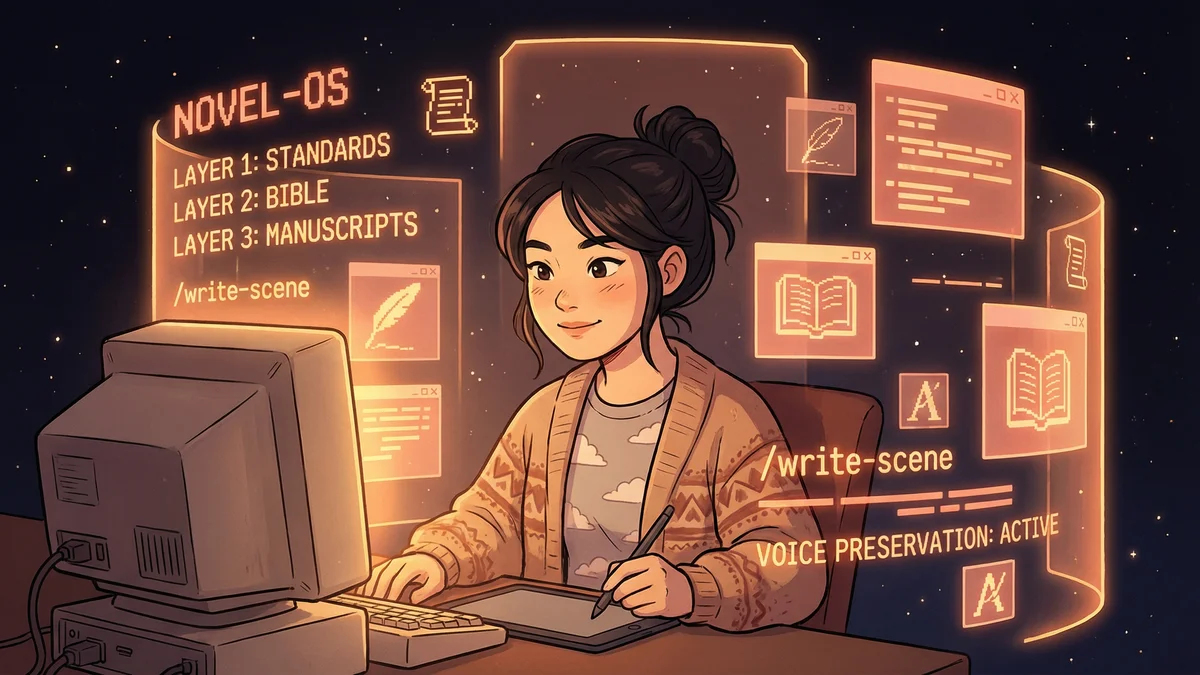
Mei designed a system she called Novel-OS — a structured approach to maintain consistency across hundreds of pages.
Layer 1: Standards Global rules that never changed. Her writing style. Prohibited tropes (no “chosen one” prophecies, no love triangles). Sentence structure preferences. Pacing guidelines.
Layer 2: Novel Bible Book-specific information. World-building rules. Character sheets. Plot outline. Timeline. Magic system constraints.
Layer 3: Active Manuscripts Current working documents. Scene outlines. Beat sheets. The actual chapters being drafted.
“Each layer loaded into context based on what I was doing. Writing dialogue? Load Layer 1, the relevant character sheets from Layer 2, and the current scene from Layer 3.”
The Standards Document
Mei’s standards file (STANDARDS.md) encoded her voice:
# Writing Standards

## Voice
- Third person limited POV, deep immersion
- Present tense interior monologue
- Avoid adverbs ending in -ly
- Prefer active verbs over passive
- No semicolons in dialogue

## Prohibitions
- No "chosen one" narratives
- No love triangles
- No convenient amnesia
- No deus ex machina rescues
- Characters must earn their victories

## Pacing
- Scene-sequel structure
- Action scenes: 2-3 pages maximum
- Conversation scenes: end before exhaustion
- Chapter breaks at tension peaks
“The standards file was my contract with the AI. Follow these rules, always.”
The Character Sheets
Each character had a detailed profile:
# Character: Venna

## Core
- Age: 34
- Role: Protagonist
- Fatal flaw: Pride masks deep insecurity
- Want: Power
- Need: Connection

## Physical
- Height: Tall for her culture
- Eyes: Deep brown, almost black
- Distinctive: Scar across left palm (from oath-binding)

## Speech patterns
- Formal vocabulary
- Avoids contractions when calm
- Contractions increase with emotion
- Uses rhetorical questions as deflection

## Arc
- Opens: Isolated, powerful, secretly lonely
- Midpoint: Forced to accept help
- Closes: Power redefined as collective strength
“When I wrote Venna scenes, her sheet loaded. Claude maintained her voice, tracked her arc, kept her consistent.”
The Scene Command
Mei built a workflow command: /write-scene
She’d define the beats:
- Venna enters the council chamber, expecting confrontation
- Elder Marsh unexpectedly supports her proposal
- Venna’s reaction reveals her discomfort with alliance
- End on decision: accept help or refuse out of pride
Claude drafted prose hitting each beat while maintaining character voice and world consistency.
“I directed. Claude drafted. I revised. The collaboration produced pages faster than I’d ever written alone.”
The Consistency Checker
Before starting each writing session, Mei ran a consistency check.
Claude would review:
- Do new scenes contradict established timeline?
- Are character behaviors consistent with their profiles?
- Do magic system uses follow established rules?
- Any continuity errors with previous chapters?
“The checker caught things I’d miss. A character can’t be in two cities on the same day. Magic can’t do something I’d said it couldn’t do. The system policed itself.”
The Voice Preservation
The hardest part: keeping Claude from homogenizing her voice.
“Default AI prose is competent but bland. I needed my prose — with its specific rhythm, specific word choices, specific structural patterns.”
The solution: few-shot examples.
Layer 1 included paragraphs of her previous writing, annotated with what made them “her”:
## Example (good):
"Venna's hands found the cold stone wall before her eyes
adjusted. The dark was absolute, the kind that made geometry
uncertain. She could be in a cavern or a closet; the air
offered no clues."

Why this works: Concrete sensory detail. Short punchy sentences.
Uncertainty as narrative driver. Active protagonist.
“The examples trained Claude on my patterns. Output started sounding like me, not like generic AI.”
The Revision Loop
First drafts were never final.
Mei would draft a scene with Claude, then revise with Claude’s help:
- “This dialogue feels flat. Punch it up while keeping Venna’s formal register.”
- “The action sequence drags. Compress it.”
- “The emotional beat isn’t landing. What’s missing?”
“Claude became an editor who knew my world intimately. The feedback was specific because the context was specific.”
Month Three: The Turning Point
Three months into the project, Mei hit a milestone.
She’d drafted 150 pages. Same timeline. Same characters. Same rules. Zero contradictions.
“That had never happened before. By page 150 of a manual draft, I’d have a dozen continuity errors to fix later. The system prevented them from happening.”
More importantly: she wasn’t burned out. The cognitive load of tracking everything had been offloaded. She focused on creativity.
The Word Count
Mei tracked her productivity.
Before Novel-OS:
- 500-800 words per writing session
- Heavy mental effort
- Frequent stops to check notes
After Novel-OS:
- 1,500-2,000 words per writing session
- Creative energy preserved
- Notes always available in context
“I tripled my output without sacrificing quality. The system carried the burden of memory.”
The Collaboration Philosophy
Mei was explicit about the collaboration balance.
“Claude doesn’t write my novel. I write my novel with Claude as a sophisticated tool. Every sentence gets my review. Every plot decision is mine.”
The AI handled:
- Maintaining consistency
- Drafting prose to my beats
- Checking for contradictions
- Offering revision suggestions
The human handled:
- Story decisions
- Character arcs
- Emotional truth
- Final approval
“I’m the author. Claude is the world’s most helpful assistant.”
The Final Product
Eighteen months later, Mei had a complete manuscript.
- 120,000 words
- Three POV characters
- Complex magic system
- Zero continuity errors (unprecedented for her)
The prose was hers. The story was hers. The system had enabled her to execute a vision that previously required years of painful tracking.
“I wrote a better book faster. That’s the only metric that matters.”
The Open Source Decision
Mei released Novel-OS as an open-source framework.
The repository included:
- Template file structures
- Example character sheets
- The /write-scene command structure
- Guidelines for voice preservation
“Other writers should be able to do what I did. The system isn’t secret sauce — it’s a methodology.”
Writers adapted it. Some built extensions. A community formed around the concept of structured AI fiction collaboration.
The Current Work
Mei is writing her fifth novel now.
Novel-OS has evolved through two more books. The standards are refined. The character sheets are more detailed. The consistency checking is more rigorous.
“I’ll never go back to the old way. Keeping a novel in my head alone was exhausting. Keeping it in a system with AI assistance is sustainable.”
The stories are still hers. The voice is still hers. The tool just makes them possible.