TL;DR
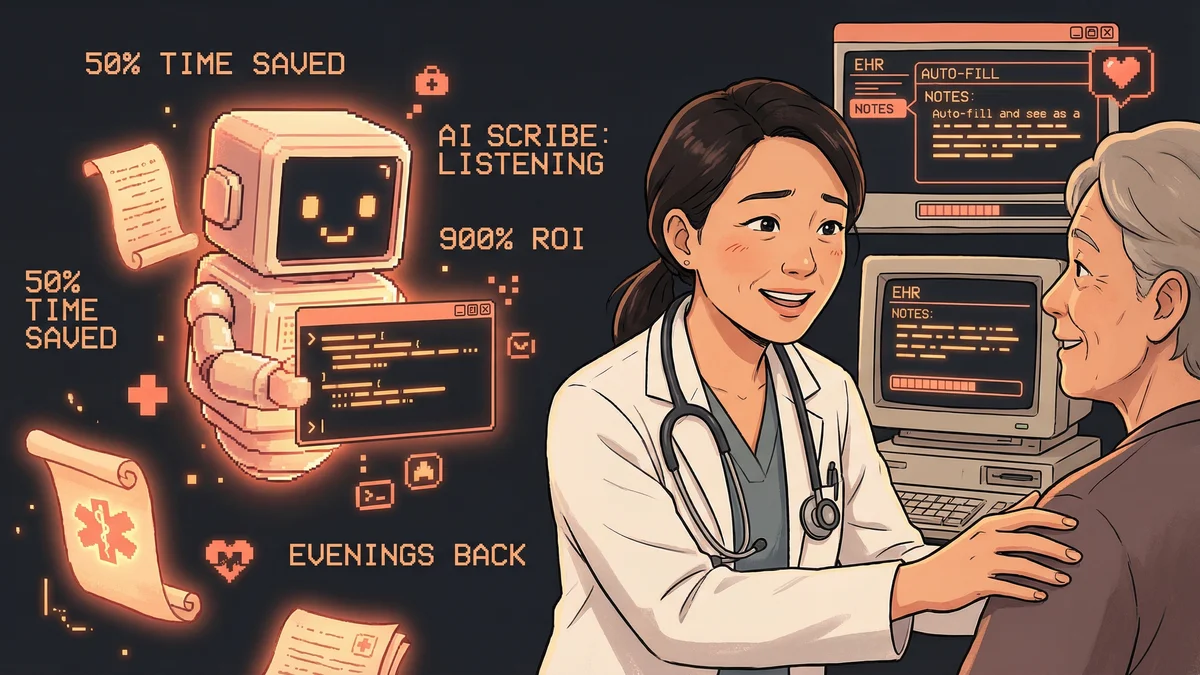
- AI scribes cut physician documentation time by 50%+ and deliver up to 900% ROI
- Practices recover $10,000+ monthly in productivity; burnout drops 20%+
- AI listens to patient conversations and generates structured medical documentation automatically
- Best for: physicians drowning in EHR documentation across all specialties
- Key insight: doctors get their evenings back for $200-300/month vs $30-50K for human scribes
AI medical scribes are returning doctors to medicine, cutting documentation time by more than half while delivering 900% ROI and reducing physician burnout by 20%.
Dr. Sarah Chen became a doctor to help patients. She spent most of her time typing.
“I’d see a patient for 15 minutes. Then I’d spend 20 minutes documenting the visit. Notes, orders, prescriptions, billing codes. The paperwork was killing me.”
She wasn’t alone. Studies show physicians spend 5.8 hours per day on electronic health records. More time typing than treating.
“I went into medicine to practice medicine. I became a data entry clerk with a medical degree.”
The burnout was real. Doctors across the country were leaving the profession. Not because of the medicine — because of the documentation.
The Documentation Crisis
Electronic health records promised efficiency. They delivered bureaucracy.
Every patient interaction requires documentation. Chief complaints, histories, physical findings, assessments, plans, prescriptions, referrals, billing codes.
“A simple checkup generates pages of notes. Regulations require it. Insurance requires it. Legal liability requires it.”
Doctors learned to type while talking to patients. They learned to document after hours. They learned to sacrifice their evenings to paperwork.
“I’d come home, eat dinner, then spend two hours finishing charts. My kids called it ‘mommy’s homework time.’ That broke my heart.”
The Human Scribe Option
Some practices hired scribes — people who followed doctors and handled documentation.
It worked. Doctors could focus on patients while scribes typed.
“Having a scribe was life-changing. I could actually look my patients in the eye instead of staring at a screen.”
The problem: cost. Scribes earn $15-25 per hour. Full-time scribing for one physician costs $30,000-50,000 annually. For a small practice, that’s prohibitive.
“I ran the numbers. A scribe would eat half my profit. I couldn’t justify it.”
The AI Alternative
AI medical scribes changed the economics.
The concept: an AI listens to patient conversations, understands the medical content, and generates documentation automatically. No human scribe needed.
“At first I was skeptical. How could AI understand medical terminology? How could it capture nuance?”
Early versions were rough. They missed context. They generated errors. Doctors still had to heavily edit.
Then the technology matured.
How It Works
Modern AI scribes use multiple technologies:
Voice recognition: Converting speech to text with medical vocabulary awareness.
Natural language understanding: Parsing what was said to identify clinical content.
Structured extraction: Pulling out diagnoses, symptoms, medications, instructions.
EHR integration: Formatting output to match the specific electronic health record system.
“The AI doesn’t just transcribe. It understands. It knows that ‘the patient reports occasional chest pain with exertion’ should go in the history section, not the physical exam.”
The doctor speaks naturally to the patient. The AI converts conversation to documentation.
The Results
The numbers validated the technology.
Documentation time reduced by more than 50%. Hours of typing became minutes of review.
Some practices recovered $10,000+ monthly in physician productivity.
ROI reached 900% or more in top implementations.
“I got my evenings back. I see my kids now. That’s worth more than any ROI calculation.”
The Burnout Impact
Beyond productivity, AI scribes addressed burnout.
Studies showed physician burnout dropped by more than 20% after AI scribe adoption. Doctors reported higher job satisfaction.
“I like being a doctor again. I’m not drowning in paperwork. I have time to actually care for patients.”
One practice reported 30% revenue increase alongside 90% reduction in burnout. The doctors were happier AND the business performed better.
The Patient Experience
Patients noticed the difference.
“My doctor used to type constantly during visits. Now she looks at me. She listens. I feel like she actually cares.”
Documentation quality improved because doctors weren’t rushing to type while talking. They could focus on the conversation, knowing the AI would capture it.
“I give better care when I’m not distracted by the computer. The AI lets me be fully present.”
The Learning Curve
Adoption required adjustment.
Doctors needed to speak clearly and include relevant clinical information verbally. Natural conversation worked, but some structure helped.
“I learned to summarize key points out loud. ‘So your main concern is the recurring headaches, which started about two weeks ago.’ The AI picked that up perfectly.”
Initial review time was high. As doctors learned to trust the output, review time dropped.
The Accuracy Question
AI isn’t perfect. Medical documentation has high stakes.
“A medication error in the notes could lead to wrong prescriptions. We had to verify everything initially.”
Error rates varied by specialty. Primary care documentation was highly accurate. Complex surgical cases required more editing.
“I review everything before signing. It’s faster than writing from scratch, but I never blindly accept AI output.”
The best implementations used AI as a draft generator, not a final output. Human review remained essential.
The Scale
The AI medical scribe market exploded.
$600 million in 2025 — 2.4x growth year-over-year. Companies like Abridge and Ambience Healthcare reached unicorn valuations.
Microsoft’s Nuance DAX Copilot became the market leader, deployed across major health systems.
“Every hospital is evaluating this technology. It’s not a question of if, but when.”
The Specialty Variations
Different specialties saw different benefits.
Primary care: High documentation volume, straightforward visits. AI excels here.
Psychiatry: Nuanced conversations requiring careful interpretation. AI helps but requires more review.
Surgery: Pre-op and post-op documentation. AI handles standard cases well.
“The technology isn’t one-size-fits-all. It works better for some specialties than others.”
The Practice Economics
Small practices saw the biggest relative impact.
Large health systems could afford human scribes. Solo practitioners couldn’t. AI scribes democratized the capability.
“For $200-300 per month, I get scribe-equivalent functionality. That’s 10% of what a human would cost.”
Practices that adopted AI scribes could see more patients. The time saved on documentation became time available for care.
The Integration Challenge
Connecting AI to existing EHR systems required work.
“My electronic health record is ancient. Making the AI output compatible took IT support I didn’t have.”
Vendors improved integration over time. The best solutions now connect to major EHR platforms automatically.
“Setup used to be painful. Now it’s plug-and-play for most systems.”
The Privacy Consideration
Patient conversations are sensitive. AI processing raised concerns.
“I had to explain to patients that a computer was helping document our conversation. Most were fine with it.”
HIPAA compliance required careful vendor selection. Not all AI scribes met healthcare privacy standards.
“I only use vendors with proper certifications. Patient privacy isn’t negotiable.”
The Future Direction
AI scribes are evolving toward fuller assistance.
Future versions might suggest diagnoses, flag potential drug interactions, recommend follow-up tests based on the conversation.
“The scribe function is just the beginning. AI could become a clinical assistant, not just a documentation tool.”
The Broader Pattern
The medical scribe revolution illustrates a pattern applicable beyond healthcare.
Identify high-burden documentation. Where do skilled professionals waste time on paperwork?
Deploy AI to draft, not replace. Human review remains essential for high-stakes content.
Measure beyond productivity. Satisfaction and burnout matter as much as efficiency.
“We didn’t just automate documentation. We restored medicine to what it should be: doctors caring for patients.”