TL;DR
- Siemens Industrial Copilot deployed to 100+ companies, available to 120,000+ engineers
- Engineers create visualizations in 30 seconds; generated code needs only 20% adaptation
- Operations Copilot saves 30% of reactive maintenance time with natural language troubleshooting
- Best for: Manufacturing operations struggling with skilled labor shortages and complex machinery
- Key shift: Workers talk to machines in plain language instead of decoding error codes
Siemens Industrial Copilot lets factory workers ask machines “Why did you stop?” and get answers in plain English—cutting reactive maintenance time by 30% and making 120,000 engineers dramatically more productive.
The machine stopped.
Red light. Error code. Cryptic number that meant something to someone, somewhere, once.
The operator reached for the manual—a 400-page PDF that might or might not contain the answer. If it did, finding the right section would take 20 minutes. Then interpreting what it meant for this specific configuration. Then figuring out the fix.
Meanwhile, the production line sat idle. Every minute cost money.
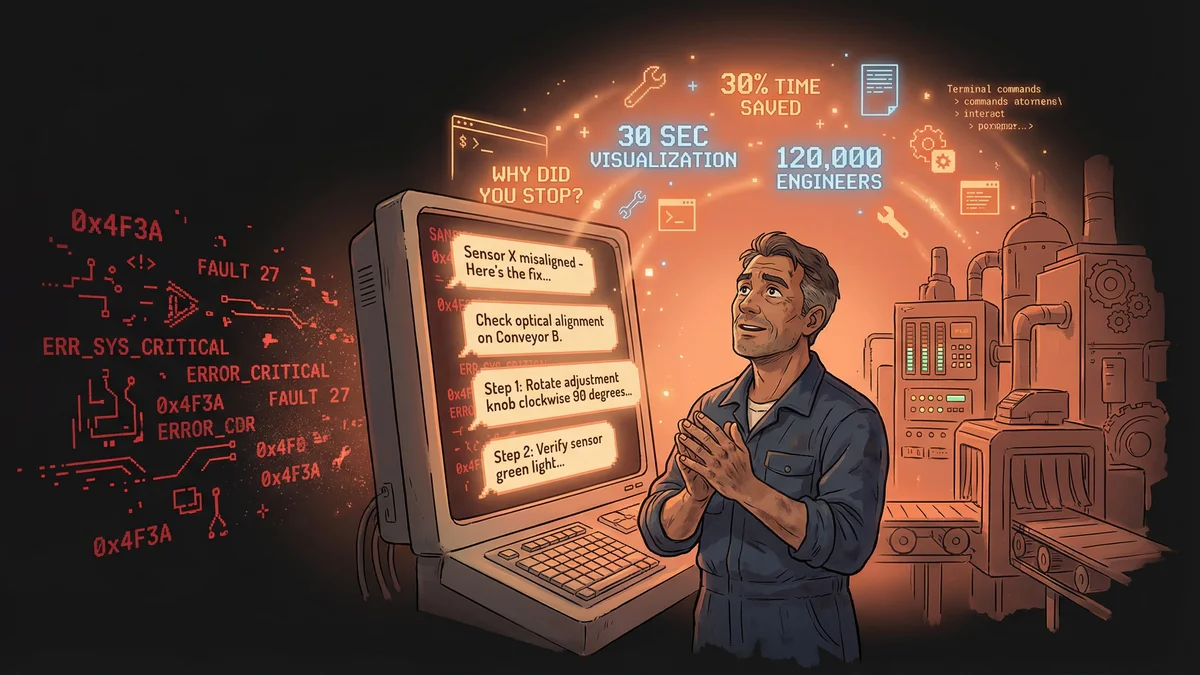
“Why is station 4 stopped?”
That’s what the operator wanted to know. That’s what they typed into the Industrial Copilot.
“Sensor X is misaligned. The recommended fix is to recalibrate the position sensor on the input conveyor. Here’s the procedure…”
The machine started again three minutes later.
The Language Barrier
Factories are filled with machines that speak in codes.
Error 0x4F3A. Fault 27. Status code that requires cross-referencing three documents to decode.
“Workers spend enormous time translating between human problems and machine language,” said Cedrik Neike, CEO of Siemens Digital Industries. “That translation overhead is pure waste.”
Skilled operators learn to decode these languages over years. But skilled operators are retiring faster than new ones can be trained. The knowledge walks out the door.
“The pressing challenges of labor shortages and increasing complexity in battery testing,” as thyssenkrupp’s Dr. Volkmar Dinstuhl described it. The same story in every manufacturing sector.
How Microsoft Azure OpenAI Powers the Copilot
Siemens built an AI that speaks both languages—human and machine.
The Industrial Copilot connects to:
- Static knowledge: Manuals, maintenance documents, training materials
- Dynamic data: Machine controllers, sensors, ERP systems, real-time production metrics
When a worker asks a question, the Copilot searches both layers. It knows what the manual says AND what the machine is actually doing right now.
“We are equipping companies with cloud-based AI tools to simplify complex challenges,” said Judson Althoff, Microsoft’s Chief Commercial Officer. Microsoft Azure OpenAI Service powers the language understanding; Siemens Xcelerator provides the industrial context.
The result: natural conversation with factory equipment.
The Engineering Revolution
The first deployment targeted engineers, not operators.
120,000+ engineers use Siemens software to design and configure industrial automation. They write code for PLCs (Programmable Logic Controllers). They create visualization panels. They configure sensors and data flows.
All of this requires deep expertise. All of this takes time.
With the Industrial Copilot:
Panel visualization creation: 30 seconds instead of hours of manual configuration.
Code generation: Produces code that requires only 20% adaptation. Engineers review and refine rather than write from scratch.
Documentation: Automatically generates technical documentation from system configurations.
“Siemens Industrial Copilot will prospectively ease our workload,” Dr. Dinstuhl explained. thyssenkrupp Automation Engineering became the first company to roll out the Copilot globally, beginning in early 2025 across their entire product range.
The Operations Deployment
Engineering was the start. Operations was the destination.
The Industrial Copilot for Operations targets the factory floor directly—the operators, technicians, and maintenance workers who keep production running.
Three capabilities define it:
Troubleshooting assistance: Workers describe problems in natural language. The Copilot diagnoses and recommends fixes.
Process optimization: AI analyzes production data and suggests adjustments. “Your throughput dropped 12% after the last changeover. Here’s what changed and how to correct it.”
Video analysis: Cameras feed the system; AI flags manufacturing issues in real-time. “Defect detected on line 3, position 47. Likely cause: temperature variance in zone 2.”
The impact: 30% reduction in reactive maintenance time. Problems that once consumed hours now resolve in minutes.
The On-Premises Imperative
Factory data is sensitive. Production secrets, quality metrics, customer specifications—none of this should leave the building.
Siemens designed the system for on-premises deployment.
“Sensitive production data never leaves the factory site,” the architecture guarantees. Cloud models are replaced with optimized edge versions. Small language models handle specialized tasks. NVIDIA NIM microservices optimize inference on local hardware.
The Copilot runs on industrial PCs at the edge. NVIDIA RTX PRO 6000 Blackwell Server Edition GPUs provide the compute. Everything stays inside the firewall.
This matters for adoption. Manufacturers who would never send data to the cloud can still use AI. The security concern that blocked deployment in sensitive facilities simply vanishes.
The Audi Example
Audi’s car body shops perform 5 million welds daily.
Each weld needs inspection. Defects caught late—after paint, after assembly—cost exponentially more to fix. The earlier you catch problems, the cheaper the correction.
Audi deployed AI-assisted weld inspection integrated with Siemens’ Industrial AI Suite. The system achieved 25x faster inference compared to previous methods.
Now cameras watch every weld. AI evaluates quality in real-time. Defects trigger immediate alerts. The feedback loop closes in seconds, not shifts.
“What previously required specialized knowledge now becomes accessible to any operator,” the implementation demonstrated. The AI doesn’t replace welding expertise. It distributes it across the workforce.
The Expansion
Siemens isn’t stopping at one Copilot.
At CES 2026, they announced nine new industrial copilots—each specialized for different manufacturing domains:
- Product data navigation
- Engineering workflow optimization
- Quality assurance automation
- Supply chain coordination
- Maintenance prediction
The vision: an “Industrial AI Operating System” that reinvents the entire value chain. Design, engineering, manufacturing, production, operations, and supply chains—all AI-augmented.
“Together with Microsoft we scale industrial AI,” Neike explained, “empowering our customers throughout the industry to become more resilient, competitive and sustainable.”
The Adoption Curve
Over 100 companies now use Siemens Industrial Copilot across Europe and the United States.
Early adopters include:
- Schaeffler — Automotive supplier using AI for engineering productivity
- thyssenkrupp Automation Engineering — Global rollout across all products
- Electronics manufacturers — Defect detection with minimal training data
- Metal forming companies — Quality inspection automation
The pattern: start with one use case, prove value, expand across operations.
The Skilled Labor Reality
Every manufacturing executive knows the same fear: retirements.
Experienced operators who understand the machines—really understand them—are aging out. New workers don’t have decades to accumulate that knowledge. The expertise gap widens every year.
Industrial Copilots don’t replace that expertise. They capture it.
When the system explains how to fix error code 0x4F3A, it’s drawing on knowledge encoded from thousands of previous fixes. When it suggests a calibration procedure, it’s applying patterns learned from across the installed base.
“The AI becomes a repository of institutional knowledge,” the implementation philosophy explains. Knowledge that once existed only in a veteran operator’s head becomes available to every worker on every shift.
The Pattern for Manufacturing
Siemens’ approach offers lessons for any manufacturing operation.
Start with documentation. Feed the AI your manuals, procedures, and training materials. This knowledge layer costs nothing to create.
Connect to real-time data. The AI becomes useful when it knows what’s actually happening on the floor, not just what should happen.
Deploy at the edge. Latency matters in manufacturing. Decisions need to happen in milliseconds. Cloud round-trips are too slow for production-critical systems.
Prove value in one area. Pick the most painful problem—the error that causes the most downtime, the configuration that takes the longest. Solve that first.
Expand systematically. Each successful deployment builds confidence and capability. The 100+ companies using Siemens Copilots didn’t start with full-factory rollouts.
The machine that stopped? It’s running again. The operator who fixed it? They typed a question in English and got an answer they could act on.
That’s the revolution: machines that explain themselves.