TL;DR
- Logistics giant reduced quote response time from hours to 32 seconds average
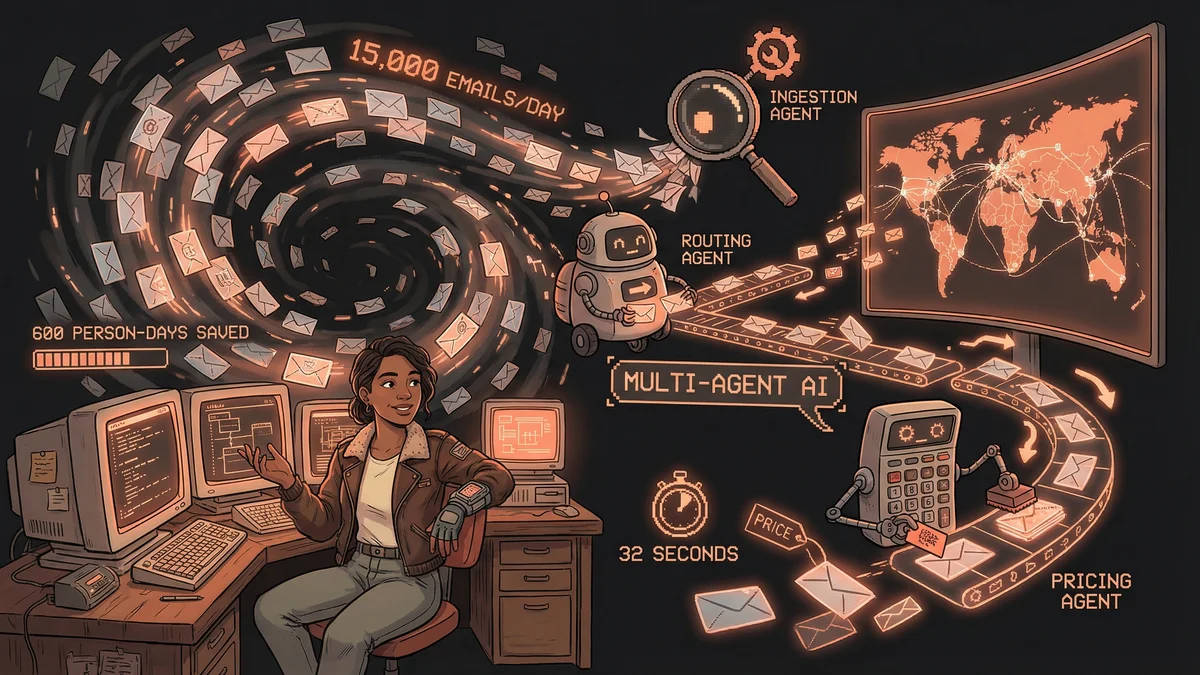
- Multi-agent AI system processes 15,000 emails daily without human intervention
- Saves 600 person-days per month; generates 2,600 automated quotes daily
- Best for: high-volume email processing in logistics, sales, support, or compliance
- Key insight: specialized AI agents working together outperform single monolithic systems
A global logistics provider transformed email chaos into competitive advantage, cutting quote response time from hours to 32 seconds and saving 600 person-days monthly using multi-agent AI.
C.H. Robinson moves freight. A lot of freight.
As one of the world’s largest logistics providers, they coordinate shipments across continents. Their business runs on communication — emails from shippers, carriers, customs agents, warehouses.
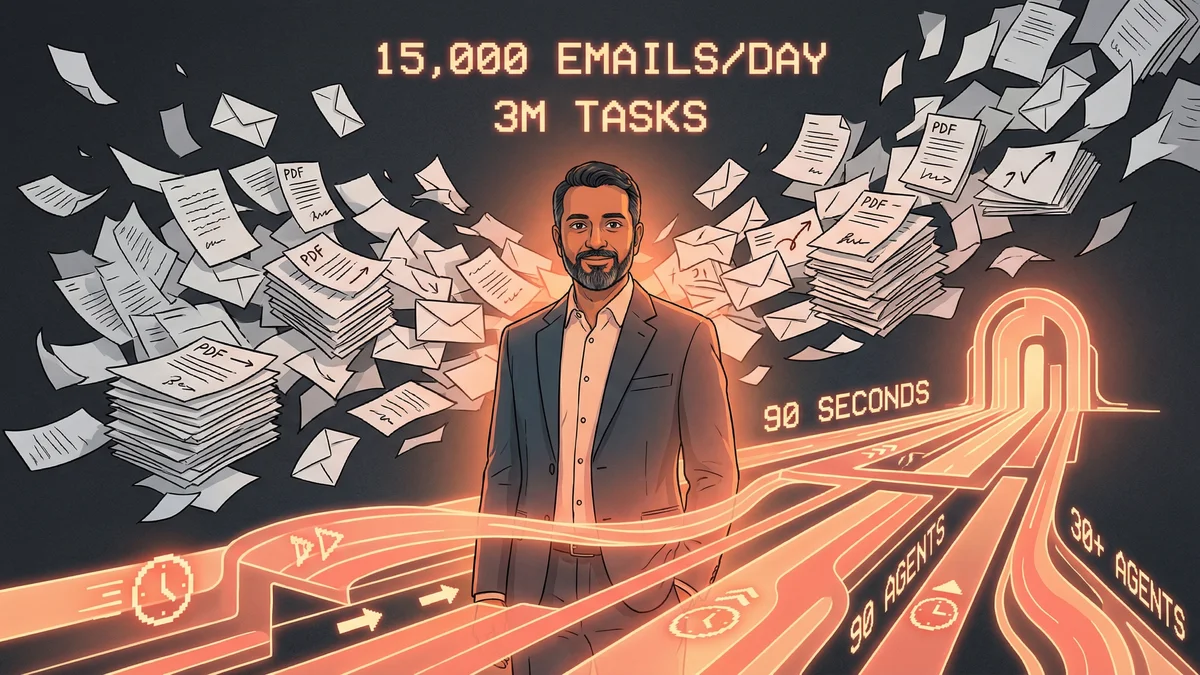
Fifteen thousand emails. Every day.
“Each email contains critical information. Origins, destinations, weights, commodities, deadlines. Missing a detail doesn’t just cause inconvenience — it strands cargo.”
For decades, humans read every email. Extracted the data. Typed it into systems. Checked for errors. Called senders when information was missing.
It worked, but barely.
The Breaking Point
Volume kept growing. Email traffic increased 20% year over year. Hiring couldn’t keep pace.
“We had trained specialists whose entire job was reading emails and extracting shipping details. High-value human labor doing data entry.”
Response times stretched. Hours became the norm for quote requests. Some inquiries slipped through entirely.
“A shipper emailing at 4 PM might not hear back until the next morning. In logistics, that delay can cost the deal.”
The team knew automation was the answer. They didn’t know how to automate unstructured chaos.
The Chaos Problem
Logistics emails aren’t standardized.
Some arrive as formal RFQs with tables and headers. Others are casual messages: “Hey, need to move 40 pallets from Chicago to Miami by Friday. What’s this gonna cost?”
Some include attached PDFs — invoices, bills of lading, customs declarations. Others embed information in email signatures. Some are replies buried in thread chains.
“Traditional automation failed because there’s no template. Every email is different. Every sender has their own format.”
Rule-based systems couldn’t handle the variation. They needed something that could understand language the way humans do.
The Multi-Agent Architecture
C.H. Robinson built a “Lean AI” system using multiple specialized agents. Not one AI doing everything — a team of AIs with distinct roles.
The Ingestion Agent: First line of defense. Intercepts incoming emails, uses OCR and natural language understanding to extract raw data. Identifies email type — is this a quote request, a load tender, a status inquiry?
The Router Agent: Classification specialist. Categorizes each email and sends it to the appropriate downstream agent. Quote requests go one direction. Status updates go another.
The Pricing Agent: For quote requests, this agent checks extracted details against internal pricing models, carrier availability, and rate databases. Constructs preliminary quotes.
The Clarification Agent: When data is incomplete, this agent drafts a response asking for the missing information. Sends it automatically. No human involved.
The Injection Agent: Once data is complete and validated, this agent writes the structured information directly into the ERP system.
“Each agent has one job. They’re excellent at that job. Together, they replicate what a team of specialists used to do.”
The Results
The numbers changed dramatically.
Before: Quote requests took hours. Sometimes a full day.
After: 32 seconds average response time for standard quotes.
“Thirty-two seconds. From email arrival to quote delivery. Our customers thought we’d hired an army.”
Daily quote volume: 2,600 automated quotes generated without human intervention.
Data entry hours saved: 600 person-days per month.
“We didn’t just speed things up. We freed our people to handle the complex cases — the negotiations, the relationship building, the exceptions that actually require human judgment.”
The Learning Loop
The system learned from mistakes.
When a quote was rejected or a shipment went wrong, the team traced the issue back through the agent chain. Where did the data extraction fail? Where did classification go wrong?
Each failure became a training example. The agents improved continuously.
“After six months, error rates dropped 70%. The system was getting better at understanding our customers’ language, their shortcuts, their assumptions.”
Agents learned that “Chi” meant Chicago. That “ASAP” usually meant 48 hours. That certain customers always needed lift gates even when they didn’t mention it.
The Human-AI Partnership
Automation didn’t eliminate humans. It elevated them.
Junior coordinators who previously spent hours on data entry now handled exception cases. They became problem solvers instead of typists.
Senior logistics experts focused on complex negotiations, custom solutions, and strategic accounts. Their expertise mattered more, not less.
“We promoted people into roles that actually used their brains. The AI handles the mechanical work. Humans handle the judgment calls.”
The Edge Cases
Some emails still needed human eyes.
Unusual cargo. Hazardous materials. Multi-leg international shipments with customs complexity. Political situations affecting certain routes.
The system recognized its limits. When an email matched certain patterns — specific keywords, unusual origins, flagged customers — it escalated to humans instead of processing automatically.
“The AI doesn’t pretend to know everything. It knows what it knows and asks for help on the rest.”
The Competitive Advantage
Speed became a market differentiator.
“Shippers send quote requests to multiple providers. The first response often wins. We were responding in 32 seconds while competitors took hours.”
Win rates increased on time-sensitive shipments. Customer satisfaction scores improved. The service level created loyalty.
“Logistics is a commodity business. Everyone moves boxes. Our edge wasn’t cheaper prices — it was faster, more reliable communication.”
The Pattern for Others
C.H. Robinson’s architecture offers a template for any business drowning in unstructured communication.
Step 1: Identify the email types. What categories exist? What information does each type contain?
Step 2: Build specialized extractors. Each email type gets its own parsing logic, trained on real examples.
Step 3: Create a router. Classification at the front end sends emails to the right processor.
Step 4: Automate responses. For standard inquiries, generate and send replies without human involvement.
Step 5: Build escalation paths. Recognize what the system can’t handle and route appropriately.
“The multi-agent pattern works because it mirrors how humans actually process information. We don’t have one person doing everything. We have specialists. AI should work the same way.”
The Technical Stack
The implementation used LangChain and LangGraph for agent orchestration. Multiple Claude instances running specialized roles. Integration with existing ERP and pricing systems.
“We didn’t replace our infrastructure. We built an AI layer that reads from and writes to our existing systems. The AI is the interface between unstructured email and structured data.”
OCR handled attachments. Custom NLP handled industry jargon. API integrations handled external lookups like pricing and availability.
The Ongoing Evolution
The system keeps expanding.
New email types get added to the classification system. New carriers get integrated into pricing lookups. New customers get their preferences learned.
“It’s not a project that ends. It’s a capability that grows. Every month we handle more volume with the same resources.”
The team that built the system now handles internal improvements. They’re becoming AI specialists, not just logistics specialists.
The Business Transformation
C.H. Robinson’s AI investment changed what kind of company they are.
“We’re not just a freight broker anymore. We’re a logistics intelligence company. Our competitive advantage is how fast and accurately we process information.”
The 15,000 daily emails that once overwhelmed the team now fuel the business. Each email is an opportunity captured in seconds instead of hours.
“Our old model was throwing people at email. Our new model is throwing intelligence at email. The second model scales.”