TL;DR
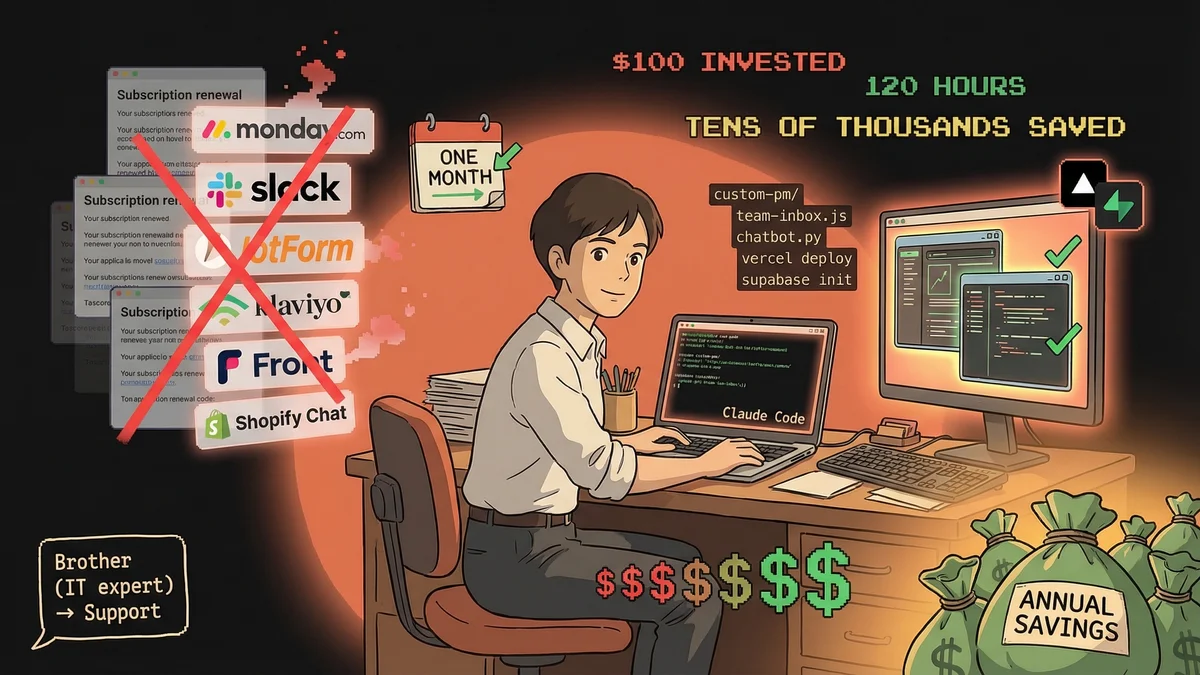
- Non-developer business owner replaced Monday, Slack, JotForm, Klaviyo, Front, and Shopify Chat with custom apps
- Investment: $100 in Claude API costs + 120 hours over one month
- Savings: tens of thousands annually in SaaS subscriptions
- Tech stack: Claude Code, Vercel, Supabase, Shopify, Google Workspace
- Learning path: started with simple webview apps, built complexity over time
- Team onboarding: not a solo experiment, rolling out to the full team
- Best for: business owners frustrated by SaaS costs and inflexible integrations
- Key lesson: custom integration beats off-the-shelf features when systems need to talk to each other
A business owner with zero coding background spent $100 and 120 hours to replace six SaaS tools with custom apps that saved tens of thousands annually.
When someone on Twitter challenged the idea that “normal people” could build real software with AI, a business owner stepped into the thread with a response that shut down the skeptic cold.
“I’m a random business owner and although I’m not making public software, using Claude (as a non dev), I’ve replaced multiple saas pieces we used and built a homebase that all talks to each other with the tools we use daily in ways that weren’t possible for us before and will save us ten of thousands a year. All built in one month on $100.”
The skeptic pushed back. “Send proof of what you built and how.”
What followed was one of the most detailed breakdowns of a SaaS replacement strategy I’ve seen from a non-developer. Not vague claims. Not engagement bait. A specific list of tools, technical choices, cost savings, and time investment. Real enough that it deserves the full story.
The Problem: SaaS Sprawl and Integration Gaps
The business owner’s company was running on a typical stack of modern SaaS tools:
- Monday for project management
- Slack for team communication
- JotForm for custom forms
- Klaviyo for email marketing
- Front as a team inbox
- Shopify Chat for customer support
Each tool cost money. Monthly subscriptions that add up to tens of thousands annually when you’re running a business at scale.
But the bigger problem wasn’t the cost. It was the gaps.
SaaS tools don’t talk to each other the way your business needs them to. Sure, you can use Zapier or Make to connect them. But those integrations are surface-level. They trigger actions based on simple events. They don’t share context. They don’t adapt to your workflow.
When your project management tool can’t trigger a notification in your team chat based on a custom action in your form system, you’re stuck with manual work. When your email platform doesn’t know what’s happening in your support chatbot, you’re sending generic messages instead of personalized ones.
The business owner wanted something different. A “homebase that all talks to each other with the tools we use daily in ways that weren’t possible for us before.”
That meant building it themselves.
The Solution: Claude Code and 120 Hours
The owner had a brother who’s an IT expert. But the owner wanted to learn, not outsource.
They started with Claude Code.
First step: learn the basics. They built two webview mobile apps for the Solana mobile store and Android. Nothing revenue-critical. Just simple apps to understand how the Claude CLI worked, how to structure projects, how to deploy.
Then they started replacing tools.
Monday → Custom Project Management
Built a custom project management system tailored to how their team actually works. Not how Monday thinks teams should work. How theirs works.
Slack → Customized Google Chat with Triggers
Instead of paying for Slack, they customized Google Chat (already included in Google Workspace) with triggers that notify channels from actions happening in the custom project management system. Monday couldn’t do that. But custom code can.
JotForm → Custom Forms with Full Integration
Built custom forms that integrate directly with their database and project management system. No more exporting CSVs or setting up fragile Zapier connections. The form data flows straight into the system.
Klaviyo → Custom Email Flows Using Shopify
Instead of paying for Klaviyo, they built custom email flows on top of Shopify’s email client, pulling data from their custom systems to personalize messages based on actual customer behavior.
Front → Custom Team Inbox Using Gmail
Built a custom team inbox on Gmail (again, already included in Google Workspace) instead of paying for Front. Integrated with their support chatbot so the team sees full context when replying.
Shopify Chat → Custom Claude-Powered Chatbot
Replaced Shopify Chat (which they described as “terrible”) with a custom chatbot trained on their site content using Claude. The off-the-shelf alternatives would have cost $50-100/month. The custom version costs API usage only.
Total tech stack: Claude Code, Vercel, Supabase, Shopify, Google Workspace.
Total build time: 120 hours over one month.
Total cost: $100 in Claude API usage.
Total savings: Tens of thousands annually.
The Results: Team Onboarding and Real Savings
This wasn’t a solo side project. The business owner built it to run their actual business.
“Ive been using it all week and the team onboards tomorrow.”
That’s the proof that matters. Not a portfolio piece. Not a demo. A production system that the entire team is about to start using.
The skeptic who challenged them went quiet after that breakdown.
The cost savings are immediate and ongoing. Every month they’re not paying for Monday, Slack, JotForm, Klaviyo, Front, and Shopify Chat is money saved. Over a year, that adds up to tens of thousands.
But the bigger win is the integration. All the systems talk to each other. Actions in one trigger updates in another. Data flows without exports or manual transfers. The team works in one unified system instead of jumping between six different tools.
That’s impossible with off-the-shelf SaaS, no matter how much you pay.
Lessons Learned
1. Start simple to learn, then build for real
The owner didn’t jump straight into replacing Monday. They built two webview mobile apps first. Simple projects with no business pressure. Just learning. Once they understood the tools, they tackled the real work.
2. Integration is the real value, not features
SaaS tools have great features. But features don’t matter if the tools can’t talk to each other the way your business needs. Custom apps can share data, trigger actions, and adapt to your workflow. That’s the advantage.
3. Non-developers can build production tools
The owner had an IT expert brother for support. But they did the building. 120 hours. One month. No prior coding experience. Claude Code made that possible.
“It’s not easy and takes a lot of patience, but I wanted to learn.”
4. Time investment is realistic
120 hours sounds like a lot. But it’s 4 hours a day for a month. Or 15 hours a week for two months. For tens of thousands in annual savings and a custom-integrated system that does exactly what your business needs, that’s a reasonable trade.
5. The barrier between “I need this” and “I built this” collapsed
Six months ago, this business owner would have been stuck choosing between expensive SaaS subscriptions or hiring developers. Now they built it themselves. In a month. For $100.
That’s the shift. The barrier didn’t just get lower. For non-technical business owners with patience and Claude Code, it collapsed entirely.
The Bigger Picture
This story matters because it’s not special. It’s replicable.
A business owner with zero coding background, 120 hours, and $100 replaced six SaaS tools with custom apps that save tens of thousands annually and integrate better than any off-the-shelf stack could.
If you’re running a business and frustrated by SaaS costs, inflexible integrations, or tools that don’t quite fit your workflow, you have the same option now.
You don’t need to hire developers. You don’t need to accept whatever off-the-shelf SaaS offers.
You can build it. And Claude Code will help.
The question is whether you’ll invest the 120 hours.