TL;DR
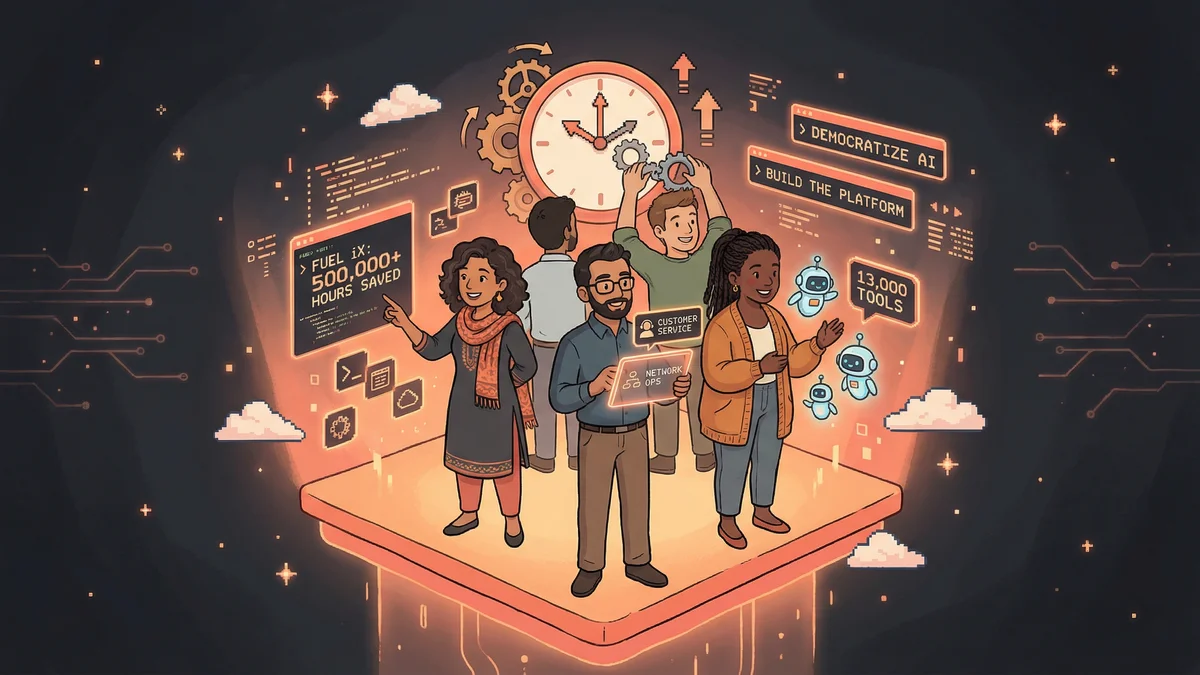
- TELUS saved 500,000+ staff hours with 13,000 internal AI tools built by employees
- 47 enterprise-grade applications generated $90M+ in documented business benefit
- Built on Fuel iX platform processing 100 billion tokens per month
- Best for: Large enterprises wanting bottom-up AI adoption instead of top-down mandates
- Key lesson: Build the platform, not the applications—let employees build what they need
TELUS proved enterprise AI transformation works at scale by empowering 57,000 employees to build their own tools, resulting in 13,000 applications and 500,000 hours saved.
TELUS had a scale problem most companies would envy.
As one of Canada’s largest telecom and healthcare providers, they employed 57,000 people. Those people spent their days on tasks that varied wildly—customer service, network operations, healthcare administration, billing support.
“Every department had different workflows. Different bottlenecks. Different inefficiencies. Standardizing AI across all of them seemed impossible.”
So TELUS didn’t standardize. They built a platform that let every team create their own AI tools.
The result: 13,000+ internal AI-powered applications.
The Fuel iX platform
TELUS didn’t deploy AI. They democratized it.
The Fuel iX platform gave teams across the organization the ability to build Claude-powered applications for their specific workflows. Not generic chatbots—purpose-built tools that understood each team’s context.
“A customer service rep’s needs differ from a network engineer’s needs differ from a healthcare administrator’s needs. One-size-fits-all AI doesn’t work. Thirteen thousand custom tools do.”
The platform processed 100 billion tokens per month across the organization. That’s not a typo. One hundred billion.
The numbers
The documentation on TELUS’s deployment is remarkably specific:
500,000+ staff hours saved. Work that used to require human attention—research, summarization, documentation, analysis—now handled by AI assistance.
47 enterprise-grade applications from the Fuel iX platform generating $90+ million in measurable business benefit.
30% improvement in code delivery velocity for developer teams using AI assistance.
“We don’t estimate savings. We measure them. The finance team tracks AI impact the same way they track any other investment.”
How 13,000 tools happen
The number seems staggering until you understand the model.
Traditional enterprise AI: Central IT builds tools. Departments request features. Months pass. Tools arrive that don’t quite fit.
TELUS model: Central IT provides the platform. Departments build their own tools. Days pass. Tools fit perfectly because the users designed them.
“We gave people guardrails, not requirements. The platform ensured security, compliance, and best practices. Within those boundaries, teams built what they needed.”
A customer service team built a tool that summarizes call history before representatives pick up. A network operations team built monitoring alerts in plain English. A healthcare team built patient intake pre-processing.
Thirteen thousand tools because 57,000 employees have 13,000 different workflow variations worth optimizing.
The enterprise-grade requirement
Not all 13,000 tools are equally polished. Many are quick utilities that save a few minutes per use.
But 47 applications reached enterprise-grade status—fully supported, audited, and deployed across large portions of the organization.
“Enterprise-grade means it works reliably, fails gracefully, logs appropriately, and serves hundreds or thousands of users without breaking. Getting 47 tools to that level across different departments took real engineering.”
Those 47 applications generate the $90+ million in documented benefit. The other 12,953 tools contribute smaller savings that compound across half-million hours.
The token economy
One hundred billion tokens per month reveals something about AI deployment at scale.
Each query, each response, each document processed consumes tokens. At TELUS volumes, token efficiency matters.
“We optimized prompts ruthlessly. A 20% reduction in tokens per query, multiplied by hundreds of millions of queries, is real money.”
The infrastructure to handle that volume required partnerships with Claude Enterprise and careful architecture. Rate limits, fallback systems, caching strategies—the invisible work that makes AI feel instant.
Lessons for enterprise
TELUS succeeded where many enterprises fail because they made three unusual choices:
Empower instead of control. Rather than gatekeeping AI access, they gave everyone the tools to build. More tools meant more experiments. More experiments meant more winners.
Measure obsessively. The $90 million figure isn’t marketing. It’s accounting. Every major application tracks its impact quantitatively.
Build the platform, not the applications. Central IT’s job wasn’t building 13,000 tools. It was building the platform that let others build 13,000 tools.
“AI transformation isn’t something IT does to an organization. It’s something an organization does to itself, with IT providing the foundation.”
The compounding effect
The 500,000 hours saved this year become baseline for next year.
Teams that saved time find new inefficiencies to attack. Tools that worked for one team get adapted by others. The platform that enabled 13,000 tools can enable 26,000.
“We didn’t hit a ceiling. We built an elevator.”
TELUS proved enterprise AI works at scale—not through top-down mandates, but through bottom-up empowerment.