TL;DR
- A developer built a complete invoice management SaaS (auth, upload, OCR, PDF generation, email) in 12 hours
- Total cost: under $4 for 5.8 million tokens—less than the price of lunch
- Tech stack: Next.js, Prisma, PostgreSQL, Next-Auth, plus MCP servers for filesystem, database, and API access
- Best for: Developers who want to validate ideas fast with working prototypes instead of mockups
- Key insight: AI gets you 80% in one day; the remaining 20% takes another week of polish
Claude Code with MCP integrations can build a full-stack SaaS application in a single day—with working authentication, file handling, OCR, and email notifications—for less than the cost of coffee.
Rohit had an idea for an invoice management tool.
Simple concept: businesses upload invoices, the system extracts data, generates PDF summaries, sends notifications. Nothing revolutionary. The kind of SaaS that usually takes a team months to build.
“I figured it would be a good side project. Something to work on over a few weekends.”
Then he decided to see how far Claude Code could take him in a single day.
The Stack Decision
Rohit didn’t want to fight infrastructure. He wanted to build product.
He chose familiar technologies: Next.js for the frontend, Prisma for database access, Next-Auth for authentication. Standard choices. The kind of stack he could debug if something went wrong.
The difference: he wouldn’t write most of the code himself.
“I described the architecture to Claude. Database schema, API routes, authentication flow, PDF generation. Claude implemented while I reviewed.”
The MCP Integration
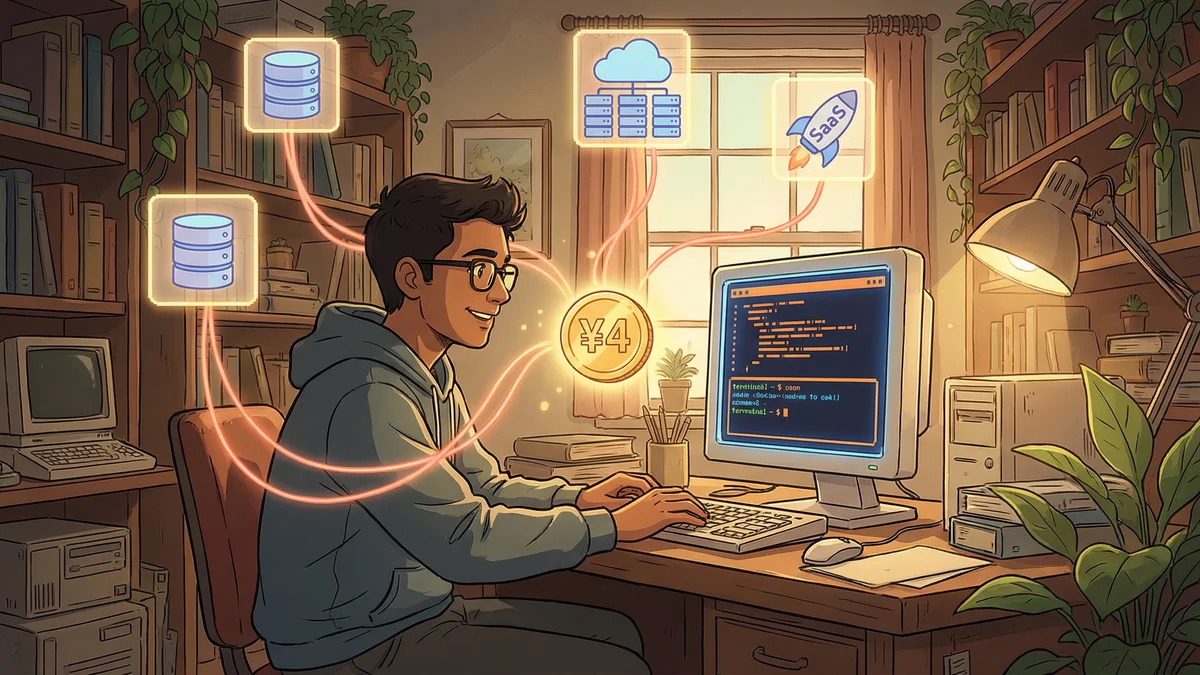
What made this possible wasn’t just Claude’s coding ability. It was the MCP servers connecting Claude to real tools.
Rohit configured multiple integrations:
Filesystem access: Claude could create, read, and modify project files directly.
Database connection: Claude could interact with the PostgreSQL database, running migrations, checking schemas.
API tools: For external services — PDF generation, email sending — Claude had the ability to call APIs directly.
“Claude wasn’t just writing code in isolation. It was actually testing database queries, verifying file structures, confirming API responses.”
The Morning Sprint
8 AM: Rohit described the project.
“Build an invoice management system. Users authenticate via Google OAuth. They can upload invoice images. The system extracts key data: vendor, amount, date, line items. Users can edit extracted data. Generate PDF summaries. Send email notifications.”
Claude asked clarifying questions. What should the data model look like? How should permissions work? What email service to use?
Rohit answered. Claude started coding.
By 10 AM: Database schema complete. User model, Invoice model, LineItem model. Migrations run. Tables created.
By noon: Authentication working. Login with Google. Session management. Protected routes.
“I was reviewing code faster than I could have written it. Every file Claude produced, I’d scan for logic issues, then approve or request changes.”
The Afternoon Build
The afternoon tackled the hard parts.
Invoice upload: File handling, storage, thumbnail generation.
Data extraction: Using OCR APIs to parse invoice images. Claude integrated with the extraction service, handled the API calls, parsed the responses, stored the structured data.
PDF generation: Rendering invoice summaries as downloadable PDFs. Layout, styling, data binding.
Email notifications: Triggering emails when invoices were processed. Templates, delivery confirmation.
Each feature: describe, implement, test, refine. The cycle repeated dozens of times.
“Claude would write a feature. I’d test it in the browser. Something wrong? I’d describe the issue. Claude would fix it. Five-minute cycles.”
The Token Economics
At the end of the day, Rohit checked his Claude usage.
5.8 million tokens processed. The entire application — hundreds of files, thousands of lines of code — generated through that token flow.
Total cost: under $4.
“Four dollars. For a working SaaS application. The same build with contractors would have cost thousands. With a team, tens of thousands in salary.”
The economics were almost absurd. The cost of the AI assistance was less than his lunch.
The Working Product
By 8 PM — twelve hours after starting — Rohit had a functional application.
Users could sign up, upload invoices, see extracted data, edit mistakes, generate PDFs, receive notifications. The core loop worked.
“It wasn’t production-ready. No load testing, no security audit, no edge case handling. But the functionality was there. In one day.”
He deployed to a staging environment. Sent the link to a few friends. They uploaded test invoices. The system processed them correctly.
The Architecture Decisions
Claude had made reasonable architectural choices throughout.
Database structure: normalized appropriately. Not over-engineered with excessive joins, not under-engineered with repeated data.
API design: RESTful patterns. Consistent naming. Proper error handling.
Authentication: Secure session management. No obvious vulnerabilities.
“I was worried Claude would make weird choices I’d have to undo later. Instead, the architecture matched what I would have done manually — just faster.”
The Learning Curve
Rohit noticed something about his own process.
“I learned by reviewing. Claude would implement something using a pattern I hadn’t seen. I’d read it, understand it, and now I knew that pattern too.”
The day wasn’t just building — it was education. Claude’s implementations taught Rohit new approaches to problems he’d solved differently before.
“In traditional development, you learn by doing. With AI-assisted development, you learn by reviewing. Different process, same outcome.”
The Remaining Work
The one-day build wasn’t the end.
Rohit spent the following week on refinement: edge cases Claude hadn’t considered, UX improvements based on tester feedback, security hardening, performance optimization.
“Claude got me 80% of the way in one day. The last 20% took another week. But 80% in one day versus 80% in three months? That’s the difference.”
The math was compelling. Even accounting for polish time, the total effort was a fraction of traditional development.
The Reproducibility Question
Was this repeatable, or was Rohit’s result a fluke?
He documented his process. Shared the approach with developer friends. Several replicated similar builds — different applications, comparable timelines.
“The pattern works: choose a simple stack, configure MCP tools, describe clearly, iterate fast. The specific project doesn’t matter.”
The constraint was scope. A twelve-hour build needed a focused MVP, not an enterprise system. Features had to be achievable. Ambition had to be bounded.
The Junior Developer Paradox
Rohit reflected on what this meant for the industry.
“People say AI will replace junior developers. I think it’s more nuanced. AI replaces the tedious parts of junior work — the typing, the syntax lookup, the boilerplate. But someone still needs to understand what’s being built.”
The day required Rohit’s architectural knowledge, his understanding of web development patterns, his ability to spot bugs in reviews. Claude accelerated execution, but didn’t replace judgment.
“If you know nothing about development, AI won’t magically make you a developer. But if you understand the concepts, AI removes the friction of implementation.”
The Future Projection
Rohit saw one-day builds becoming normal.
“What I did with MCP servers and Claude Code, that’s version 1.0. The tools will get better. The integrations will get smoother. The token costs will drop.”
In five years, he expected a working prototype in an hour. Full applications in an afternoon. The current one-day timeline was just the beginning.
“The question isn’t ‘can AI build software?’ It’s ‘how fast can AI build software?’ And the answer keeps getting faster.”
The Takeaway
For developers considering AI-assisted building:
“Start with something simple. A CRUD app. A tool you actually need. Configure MCP servers so Claude can do more than just write code — let it interact with your database, your file system, your APIs.”
“Review everything. Fast doesn’t mean careless. Every line Claude writes, you should understand.”
“Time yourself. See what you can build in a day. The result might surprise you.”
Four dollars and twelve hours. A working SaaS. The math had changed.