TL;DR
- Claude Code digitized 125 years of handwritten family recipes in hours instead of years
- 95% of faded, century-old handwriting was successfully transcribed with context preserved
- AI OCR plus organizational intelligence turned chaos into a searchable family website
- Best for: family archives, handwritten documents, recipe collections, personal history projects
- Key lesson: Scan originals now before they fade further; AI can read what humans struggle to decipher
One family used Claude Code to rescue 125 years of fading handwritten recipes, transforming a terrifying box of deteriorating paper into a searchable website that reunited 47 family members with their culinary heritage.
Margaret had a box that terrified her.
Inside: 125 years of family recipes. Handwritten on index cards, scraps of paper, the backs of envelopes. Some were her great-grandmother’s. Some were from relatives she’d never met.
“Every holiday, I’d think about digitizing them. Every holiday, I’d put the box back in the closet. The task was too overwhelming.”
The problem wasn’t just the recipes. It was everything attached to them.
The True Contents
The recipes weren’t just instructions. They were history.
Aunt Ruth’s pie crust had a note: “Only make this when the men are out of the house — they don’t need to know about the lard.”
Grandma’s Christmas cookies included: “Your grandfather proposed to me while these were in the oven. They burned, but I said yes anyway.”
“Every card had stories. Memories. Context that would be lost if I just typed up ingredients.”
But handwriting faded. Paper deteriorated. Some cards were already illegible.
The Previous Attempts
Margaret had tried before.
“I’d set aside a weekend. Start transcribing. Get through maybe fifteen cards. Then life would interrupt and I’d stop.”
At that rate, the box would take years to process. And the stories kept getting harder to read as memories faded and paper aged.
“My mom was the only one who could read some of the handwriting. She was 84. The project had a deadline I didn’t want to think about.”
The Discovery
Margaret’s nephew mentioned Claude Code at a family dinner.
“He said it could process files. Even handwritten documents. I didn’t believe him. My handwriting samples were 100 years old.”
But she was desperate enough to try.
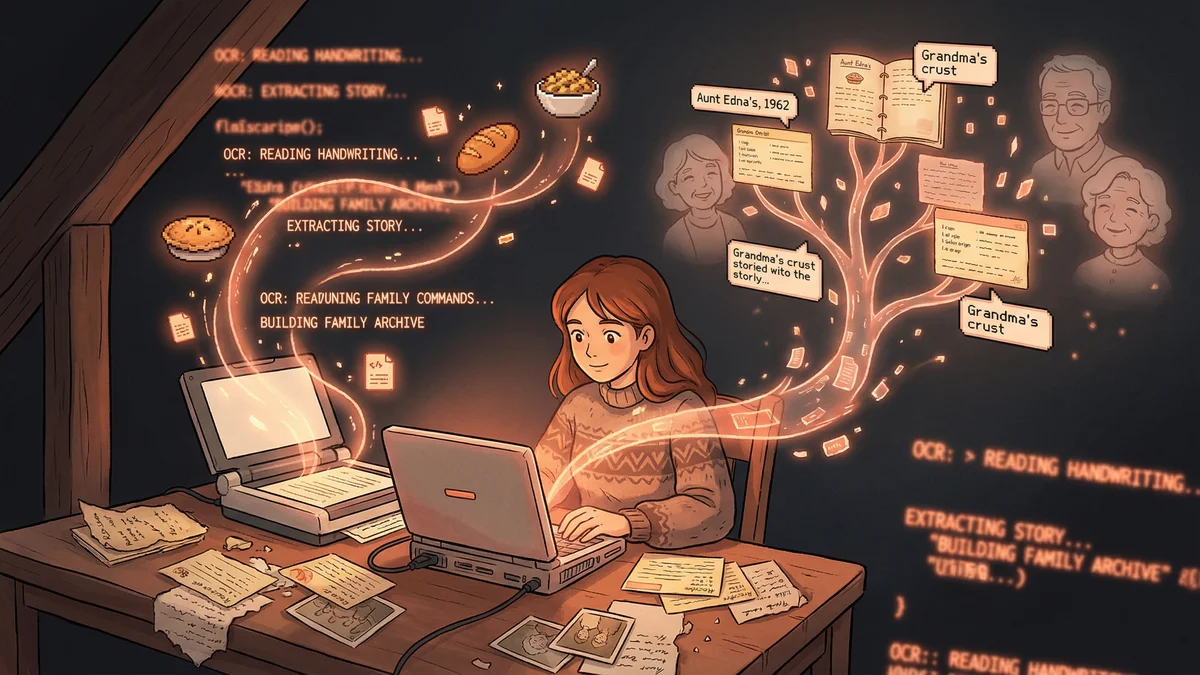
“I scanned everything. Hundreds of images. Index cards, notebook pages, envelope backs. Just got it all into digital form.”
Then she pointed Claude at the folder.
The First Surprise
Claude could read the handwriting.
“I showed it a card from 1923. Faded pencil on yellowed paper. Claude transcribed it perfectly — including the flourishes on the capital letters.”
But more importantly, Claude understood what it was reading.
“It didn’t just transcribe words. It recognized this was a recipe. It structured the output: ingredients, instructions, notes. From completely unstructured handwritten text.”
The Extraction Process
Margaret set Claude working on the full collection.
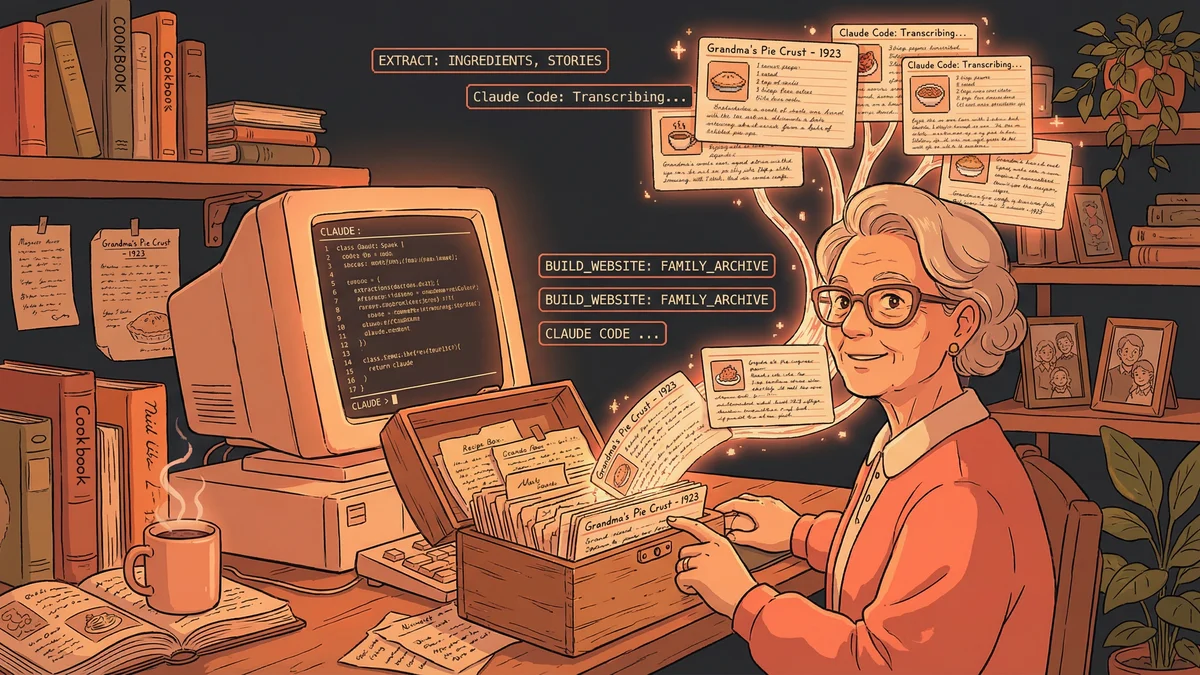
“Process each image. Extract the recipe. Preserve any personal notes, stories, or context. Note whose handwriting it appears to be if you can tell from the signature.”
Claude worked through the folder over several hours. Margaret watched in disbelief.
“Cards I couldn’t read at all — Claude figured them out. It was like having an expert paleographer and a grandmother in one.”
The Structure Emerges
The output wasn’t just text files. It was organized data.
“Claude created categories. Desserts. Main courses. Holiday specials. Family gathering dishes. It grouped things based on when they’d be used.”
Cross-references appeared. Grandma’s pie filling and Aunt Sarah’s pie crust — Claude noted they were often made together.
“The collection became navigable for the first time in its 125-year history.”
The Stories Preserved
The personal notes were the real treasure.
“Claude separated the recipe instructions from the context. So for Grandma’s cookies, you had the actual recipe, and then a separate ‘story’ field with the proposal note.”
Some stories were sad. A cake recipe marked “Made this the day Thomas didn’t come home from the war.”
Some were funny. A casserole recipe with “Don’t tell anyone the secret ingredient is spite.”
“Claude preserved all of it. The recipes were useful. The stories were priceless.”
The Website
Margaret wanted to share this with family. All 47 of them, scattered across the country.
“I asked Claude if it could build a website. A private one, just for family. With the recipes searchable and the stories readable.”
Claude built it in an afternoon.
“I’d never made a website. Never thought I could. Claude generated the whole thing — a searchable database of family recipes with photos of the original handwritten cards.”
Family members got login credentials. Suddenly, great-aunts in Florida could see recipes their mothers had written in Kansas a century ago.
The Reunion Effect
The website transformed the next family reunion.
“People gathered around laptops looking up their grandmother’s handwriting. Cousins discovered recipes they’d never known existed. Someone found their own baby announcement tucked between index cards.”
The box of recipes had been a single-point-of-failure archive. The website was shared history.
“My mom cried when she saw her mother’s handwriting, clear and preserved, on a screen she could actually read.”
The Additions
The website wasn’t static. Family members started contributing.
“There was an ‘add recipe’ feature. People submitted their own additions. The 125-year collection started growing again.”
New recipes linked to old ones. “Adapted from Great-Aunt Miriam’s version” with a reference to the 1940s original.
“The archive became living again. Not just preserved — extended.”
The Preservation Lessons
Margaret learned things about digital preservation.
“The scans are backed up in three places. The website has automatic backups. I’m never going back to having just one copy.”
She also scanned the original physical cards at higher resolution. The OCR version was useful; the images were irreplaceable.
“Claude can process images, but it can’t recreate a grandmother’s handwriting. Those originals still matter.”
The Unexpected Connections
Claude found patterns Margaret hadn’t noticed.
“Certain spices appeared in recipes from one branch of the family and nowhere else. Claude flagged it. Turns out that branch had spent time in New Orleans and brought back Cajun influences.”
Recipe migrations across decades became visible. A dish that appeared in one aunt’s collection would show up decades later in a niece’s, subtly modified.
“The recipes told a story of how families adapt and pass down traditions. Claude helped me see the patterns.”
The Technical Reality
The process wasn’t perfectly smooth.
“Some cards were too damaged. Some handwriting was truly illegible. Maybe 5% of the collection couldn’t be fully processed.”
But 95% was a miracle compared to the 0% that had been digitized before.
“I could have spent years trying to do this manually and still not matched what Claude did in hours. And I would have missed the pattern analysis entirely.”
The Advice
For others with family archives:
“Start scanning now. Even if you’re not ready to process. Get the images before the originals fade further.”
Let Claude structure things. Don’t try to impose categories before you see what emerges from the data.
“And save the stories. The recipes are useful. The context is precious. Make sure both survive.”
The Current State
Three years later, the family recipe website has become a family institution.
“It’s where we go when planning holiday meals. It’s what we show new partners who join the family. It’s our shared memory.”
The box still exists, carefully preserved. But its contents are no longer trapped inside.
“My great-grandmother wrote down her bread recipe in 1899. Now anyone in my family can bake it. That continuity matters.”
125 years of cooking wisdom, rescued from a deteriorating box, now shared across generations.
“Claude didn’t just process files. It saved memories.”