TL;DR
- C.H. Robinson processes 15,000 shipping emails daily with AI, automating 5,500 orders
- Response time dropped from 4 hours (queue wait) to under 90 seconds
- 600+ hours saved daily on email processing; 30% productivity increase across 2023-2024
- Best for: High-volume operations drowning in unstructured email requests
- Key lesson: Multi-agent systems can crack problems that defeated automation for decades
C.H. Robinson’s fleet of 30+ AI agents has processed over 3 million shipping tasks, turning a 4-hour email queue into 90-second responses—and saving 600 hours of manual work every single day.
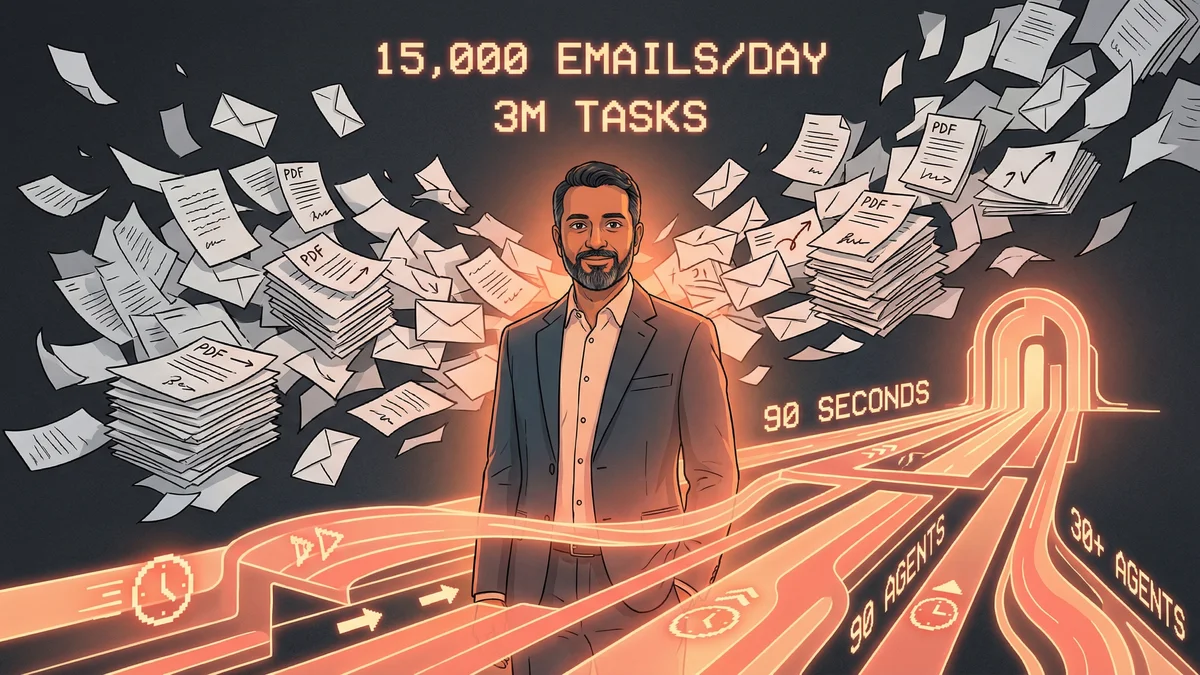
Fifteen thousand emails land in C.H. Robinson’s inbox every day.
Each one is a shipping request. Each one needs attention. Each one contains some combination of pickup locations, delivery deadlines, cargo specifications, and special instructions.
Some are neatly formatted. Most aren’t. Many include scanned PDFs with handwritten notes. Others reference previous conversations. Some are missing critical information entirely.
“For decades, this was the barrier,” said Arun Rajan, Chief Strategy and Innovation Officer. “Unstructured data in unstructured formats. Traditional automation couldn’t touch it.”
Employees spent seven minutes processing each email into an order. Customers waited up to four hours in the queue. At that rate, the math never worked.
Then C.H. Robinson deployed 30+ AI agents. Now 5,500 orders process automatically every day. Queue time collapsed to 90 seconds. The company saves 600 hours daily on email processing alone.
The Unstructured Data Problem
Logistics runs on relationships and communication. That means email.
But email is chaos. A shipping request might arrive as:
- A formal RFQ with structured fields
- A forwarded conversation with “see below”
- A PDF attachment with handwritten annotations
- A one-liner: “Same as last week but to Denver”
“Traditional automation needs structure,” Rajan explained. “It needs the right data in the right fields. Real-world logistics communication doesn’t work that way.”
For decades, humans bridged this gap. They read the messy emails, connected the dots, filled in missing information, and created clean orders in the system.
It worked. But it didn’t scale.
The Agent Architecture
C.H. Robinson didn’t build one AI. They built a workforce.
Thirty-plus specialized agents, each handling a specific task in the shipment lifecycle:
The Quote Agent reads incoming requests and generates price quotes. Started with truckload shipments, expanded to less-than-truckload (LTL). Now delivers over 1 million quotes.
The Order Agent transforms approved quotes into system orders. Handles the complexity of different shipment types, special instructions, and customer preferences.
The Appointment Agent schedules pickup and delivery windows with carriers and facilities. Has set over 1 million appointments.
The Tracking Agent monitors loads in transit, generates status updates, and proactively communicates with customers.
The Carrier Agent acquires truck capacity by processing carrier emails. Uploads 10x more trucks than the previous month as it learns.
The Voice Agent (pilot) calls carriers directly when tracking updates are missing. Real conversation, not just text.
“That’s 3 million manual tasks our people didn’t have to do,” Rajan said. “And we’re just getting started.”
The Email Reading Breakthrough
The core innovation wasn’t fancy algorithms. It was teaching AI to read like a human.
When a request arrives, the AI:
- Parses the unstructured content — even handwritten notes on scanned PDFs
- Connects fragmented information — piecing together details from email chains
- Detects what’s missing — identifying required fields that weren’t provided
- Requests clarification — automatically replying to ask for missing data
- Creates the order — once complete, inserting structured data into the system
“We didn’t try to force customers to change how they communicate,” explained Mark Albrecht, VP for Artificial Intelligence. “We taught our systems to understand how customers actually communicate.”
This required distinguishing between less-than-truckload and full truckload shipments—a classification problem that had stumped automation for years.
How LangChain Powers the Agent Fleet
Building 30+ agents that work together required robust infrastructure.
LangChain provided model interoperability. When one model worked better for certain tasks, they could swap it without rewriting everything.
LangGraph handled complex multi-step workflows. The order entry process isn’t linear—it branches, loops, and requires decisions at each stage.
LangGraph Studio accelerated development. Engineers could visualize agent interactions, identify bottlenecks, and debug without deploying to production.
LangSmith became the observability layer. Subject matter experts could review agent decisions, catch errors, and feed corrections back to developers.
“LangSmith was our first line of defense,” the team reported. “SMEs could catch issues and send them to developers, keeping the project focused and high-quality.”
The Results
The numbers tell the story:
3 million+ tasks automated by AI agents
1 million+ quotes delivered without human intervention
1 million+ orders processed by AI
1 million+ appointments scheduled automatically
5,500 orders automated daily from email
600+ hours saved per day on email processing
90 seconds response time (down from 4 hours)
30% productivity increase across 2023-2024
5,200+ customers now receiving instant responses
“Generative AI played a key role in the company’s 30% productivity increase across 2023 and 2024,” Rajan confirmed.
The Human Evolution
The agents didn’t replace employees. They changed what employees do.
Before: manually processing emails, copying data between systems, chasing missing information, scheduling appointments by phone.
After: handling exceptions, managing complex negotiations, building customer relationships, solving problems that require judgment.
“Greater automation not only makes our operations and our customers’ supply chains more efficient,” Rajan noted. The efficiency freed humans for higher-value work.
The subject matter experts who once processed emails now train and supervise the AI. They review edge cases, identify errors, and improve the system continuously.
The Expansion Path
C.H. Robinson started with truckload quotes—the highest volume, most standardized request type.
Success there funded expansion:
- Added LTL quoting (30%+ monthly increase since launch)
- Extended to order processing
- Built appointment scheduling
- Deployed tracking automation
- Piloted voice-enabled carrier contact
“Price quotes for truckload shipments was a natural starting place,” Albrecht explained. “In February and March, our AI took care of just as many LTL orders as truckload orders.”
Each new capability builds on the foundation. The agents share context, learn from each other’s interactions, and improve collectively.
The Agentic Supply Chain Vision
At their 2025 customer event, C.H. Robinson announced the next phase: the Agentic Supply Chain.
Not just automation. Intelligence.
“An intelligent ecosystem that continuously thinks, learns, adapts and acts,” the company described. “Going beyond automation, this is the most advanced form of artificial intelligence in logistics.”
The vision: AI that understands context, makes decisions in real time, and self-optimizes global supply chains at scale.
The 30+ agents aren’t the end state. They’re the foundation for a system that gets smarter with every shipment, every email, every decision.
The Pattern for Others
C.H. Robinson’s approach offers a template for any organization drowning in unstructured communications.
Start with volume. Pick the highest-volume, most repetitive task. Prove value there first.
Accept the mess. Don’t force customers into structured forms. Teach AI to handle unstructured reality.
Build specialists. One agent doing everything fails. Many specialized agents collaborating succeeds.
Invest in observability. If you can’t see what agents are doing, you can’t improve them.
Expand systematically. Each successful agent funds the next. Compound the capability over time.
“We’re at well over 1 million price quotes delivered by AI,” Rajan said. “In March, we hit 1 million orders processed by AI.”
Those millions started with one email. One agent. One proof point.
The inbox hasn’t shrunk. Fifteen thousand emails still arrive daily. But now, 90 seconds later, they’re handled.