TL;DR
- Claude Code with MCP servers transformed an unmanageable D&D world into a coherent living archive
- Post-session processing dropped from 2 hours to 20 minutes
- AI catches continuity errors before they become plot holes
- Best for: long-running campaigns, complex worldbuilding, any fiction requiring consistency
- Key lesson: you remain the storyteller, AI handles the archival burden
A DM with 8 years of campaign notes used Claude Code with MCP servers to transform chaos into a campaign management system that remembers everything and catches continuity errors automatically.
Kyle had been running D&D campaigns for eight years.
His world had grown massive. Hundreds of NPCs. Dozens of locations. Interconnected plot threads spanning multiple campaigns. Political factions with complex relationships.
“I’d built something beautiful and completely unmanageable. I couldn’t remember which NPC was connected to which quest. Players would ask about a character we’d met two years ago and I’d blank.”
His Obsidian vault contained the knowledge. Finding it was the problem.
The Mess
Kyle’s campaign notes were extensive but disorganized.
“I had a note for every session. Notes for every NPC. Notes for locations, items, factions. Thousands of markdown files. But no way to see how they connected.”
When players asked “what happened to that merchant from the capital?” Kyle would search. Scroll through sessions. Try to remember which file contained the answer.
“I was spending more time searching than playing. The knowledge management overhead was killing my creativity.”
The MCP Discovery
Kyle knew about Claude Code for work tasks. He wondered if it could help with hobbies.
“I’d seen people use it for note organization. But D&D notes are different — they’re not just facts, they’re narrative threads that need to stay consistent.”
He started with basic queries. Pointed Claude at his Obsidian vault and asked questions.
“Who is the blacksmith in Thornhold?” Claude found the answer. But Kyle wanted more than search.
The MCP Integration
Claude Code with MCP servers changed everything.
Kyle set up three integrations:
Filesystem MCP: Claude could read and write to his Obsidian vault directly. Not just query — actually update notes, add links, fix inconsistencies.
Obsidian MCP: A specialized connector that understood Obsidian’s linking syntax, frontmatter, and graph structure.
Calendar MCP: Connected to his campaign schedule, so Claude knew when sessions happened and could track timeline consistency.
“Suddenly Claude wasn’t just reading my notes. It was part of my campaign infrastructure.”
The Session Prep Revolution
Before each session, Kyle ran a prep routine.
“I’d tell Claude: ‘Next session, the party is traveling from Thornhold to the Whispering Marsh. What do they need to know? What loose threads should I reference? What NPCs might appear?’”
Claude would analyze the route. Find relevant location notes. Identify NPCs the party had previously met along that path. Flag unresolved plot threads.
“It synthesized my own world back to me. Things I’d written and forgotten. Connections I’d created without realizing.”
The prep document Claude generated included:
- Location descriptions and relevant history
- NPCs likely to be encountered (with their motivations and secrets)
- Loose threads the party might tug on
- Potential encounters and their narrative weight
The Consistency Guardian
Kyle’s biggest problem had been consistency. With years of worldbuilding, contradictions crept in.
“Claude became my continuity checker. Before introducing something new, I’d ask: ‘Does this contradict anything established?’”
When Kyle wanted to make the Duke of Thornhold secretly evil, Claude found the problem: in session 47, the Duke had sacrificed his own wealth to save refugees. That wasn’t evil behavior.
“I either needed to explain that contradiction or change my plan. Claude caught it before I introduced a plot hole.”
The AI tracked relationships that Kyle had forgotten establishing. Timeline events he’d mentioned in passing. World rules he’d set and then accidentally violated.
The NPC Manager
Managing NPCs was always chaos. Who knew what? Who wanted what? Who was connected to whom?
Kyle built a system.
“Every NPC note had standard frontmatter: allegiances, secrets, goals, relationships. Claude could query across all NPCs to find patterns.”
Before sessions, Kyle would ask: “Which NPCs have goals that would be advanced by the party’s current actions?” Claude would return a list — often including characters Kyle hadn’t thought about in months.
“The merchant from session 12 wanted something the party just found. I’d forgotten that entirely. Claude didn’t.”
When players encountered NPCs, Claude suggested dialogue hooks based on what that character knew and wanted. Not scripts — prompts that kept personalities consistent.
The World Graph
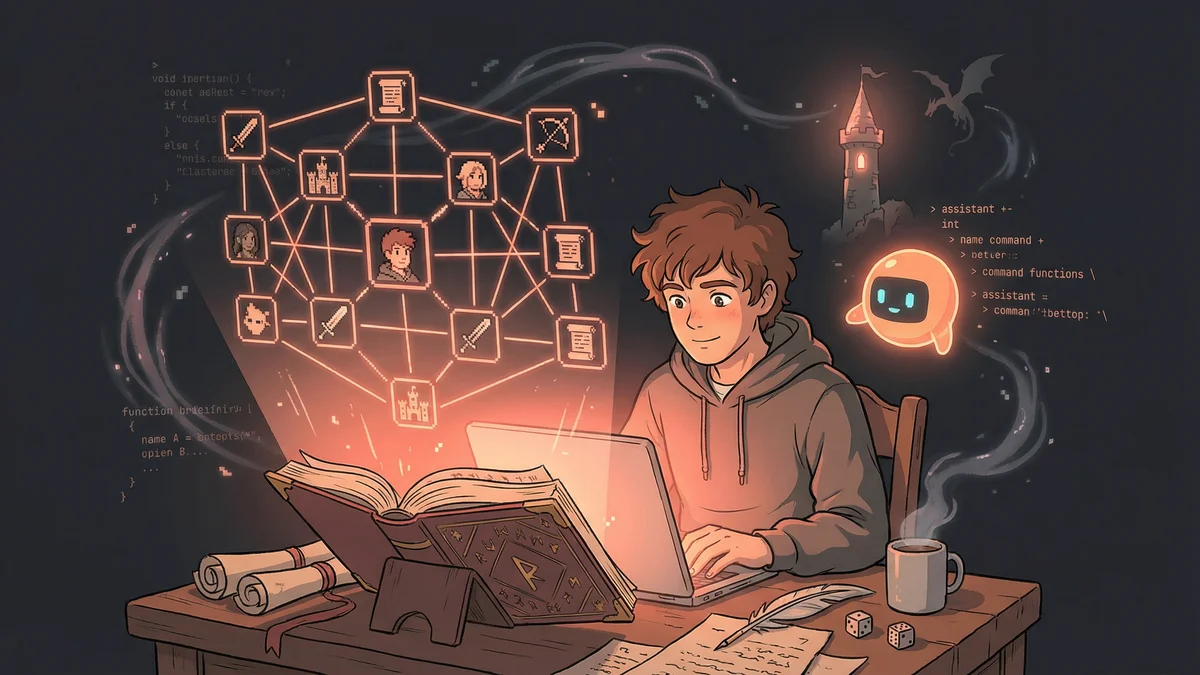
Kyle’s favorite feature: having Claude build relationship maps.
“Show me everyone connected to the Thieves Guild and their relationship type.” Claude would generate a graph from the notes, revealing connections Kyle hadn’t consciously designed.
“Sometimes the patterns were surprising. I’d written separate backstories that accidentally connected. Claude found the threads and I could choose whether to make them explicit in the narrative.”
The world felt more alive because it actually was more connected. Not through top-down planning, but through Claude finding the emergent structure in eight years of improvised storytelling.
The Session Notes Processor
After each session, Kyle did voice transcription of what happened. Messy, rambling, unstructured.
Claude processed the raw notes:
- Extracted new NPCs and created note stubs
- Updated existing NPC notes with new information
- Added timeline events
- Linked new content to existing notes
- Flagged potential inconsistencies introduced during play
“Post-session processing went from two hours to twenty minutes. And it was more thorough than my manual approach.”
The Player Handout Generator
Kyle started generating player-facing materials automatically.
“I’d ask Claude to create a ‘what your character knows about Thornhold’ document based on the sessions that character had participated in. Different characters knew different things.”
Players loved it. They had personalized knowledge bases that matched their character’s experiences. No more “wait, was my character there for that?”
The Complexity Management
The MCP setup wasn’t trivial.
“I spent a weekend configuring everything. Getting the Obsidian MCP to work with my vault structure. Setting up the right permissions. Creating the templates Claude should follow.”
But the investment paid off exponentially. Each session was smoother. Each prep took less time. The world became more coherent, not less, as it grew.
“The complexity of managing a living world became manageable. I was the creative, Claude was the archivist.”
The Unexpected Benefits
Kyle noticed improvements beyond efficiency.
“My storytelling got better. Because Claude could find connections I’d forgotten, I could weave tighter narratives. Callbacks to earlier sessions. Payoffs for setups from years ago.”
Players commented that the world felt more real. Small details persisted. Minor characters reappeared with remembered histories. The world had memory.
“They didn’t know I had AI assistance. They just knew the campaign felt more alive than most.”
The Limitations
The system wasn’t perfect.
“Claude sometimes made suggestions that were technically consistent but narratively wrong. It didn’t understand dramatic timing or player enjoyment.”
Kyle remained the storyteller. Claude handled lore management and consistency, but the creative decisions stayed human.
“I’d ask for options and pick the best one. Claude would suggest five ways to resolve a plot thread. I’d choose based on what would be fun, not just what was logical.”
The Community Interest
Kyle shared his setup with other DMs. The interest was immediate.
“Everyone running long campaigns has this problem. The world gets too big for human memory. Some solution was inevitable.”
He created a guide for basic setup. Others adapted it for different note systems, different campaign styles, different complexity levels.
“The tools are there for anyone. The setup takes some technical work, but the payoff is huge if you’re managing complex fictional worlds.”
The Current State
Three years into the MCP-enhanced campaign, Kyle’s world has never been more coherent.
New players can join and get personalized summaries. Old players can query their character’s history. Kyle can improvise confident that Claude will catch any contradictions.
“I run games now, not a database. The administration is automated. The creativity is mine.”
The hobby that was drowning in its own complexity became manageable again. Not by simplifying the world, but by having AI manage the complexity.
“I built a world too big for me to remember. Now I have help remembering it.”